







Question: This is Discrete Math please help with Question 2 ke use of the definition of the object to define it. We define a basis step
This is Discrete Math please help with Question 2
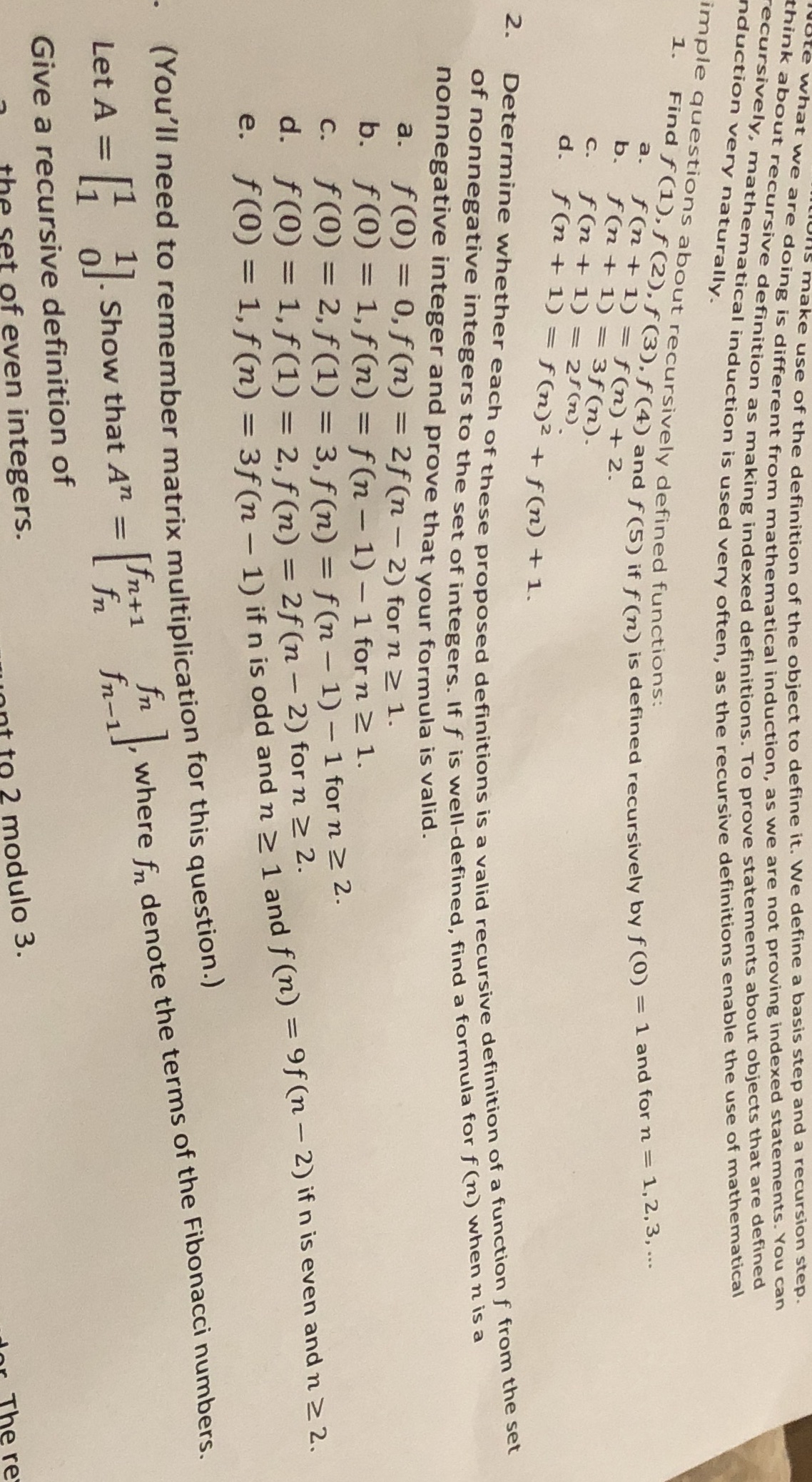
ke use of the definition of the object to define it. We define a basis step and a recursion step. what we are doing is different from mathematical induction, as we are not proving indexed statements. You can think about recursive definition as making indexed definitions. To prove statements about objects that are defined ecursively, mathematical induction is used very often, as the recursive definitions enable the use of mathematical nduction very naturally. imple questions about recursively defined functions: Find f (1), f (2), f(3), f (4) and f(5) if f(n) is defined recursively by f (0) = 1 and for n = 1, 2,3, ... f(n + 1) = f (n) +2. f (n + 1) = 3f (n). f (n + 1) = 25(2). f (n + 1) = f (n) 2 + f (n) + 1. 2. Determine whether each of these proposed definitions is a valid recursive definition of a function f from the set of nonnegative integers to the set of integers. If f is well-defined, find a formula for f (n) when n is a nonnegative integer and prove that your formula is valid. a. f(0) = 0, f(n) = 2f(n - 2) for n 2 1. f(0) = 1, f (n) = f(n - 1) - 1 for n 2 1. C. f(0) = 2, f (1) = 3, f (n) = f(n - 1) - 1 for n 2 2. d. f(0) = 1, f(1) = 2, f(n) = 2f(n - 2) forn > 2. f(0) = 1, f(n) = 3f(n - 1) ifn is odd and n 2 1 and f (n) = 9f (n - 2) if n is even and n > 2. (You'll need to remember matrix multiplication for this question.) , where fo denote the terms of the Fibonacci numbers, Let A = [ ]. show that An = [in+ 1 45 fn-1. Give a recursive definition of the set of even integers. to 2 modulo 3. The re
Step by Step Solution
There are 3 Steps involved in it

Get step-by-step solutions from verified subject matter experts
 Study Help