







Question: this is for matlab, they already give you the answer to question (A). Please answer (B), (C), and (D). 2. Consider the IVP for 0
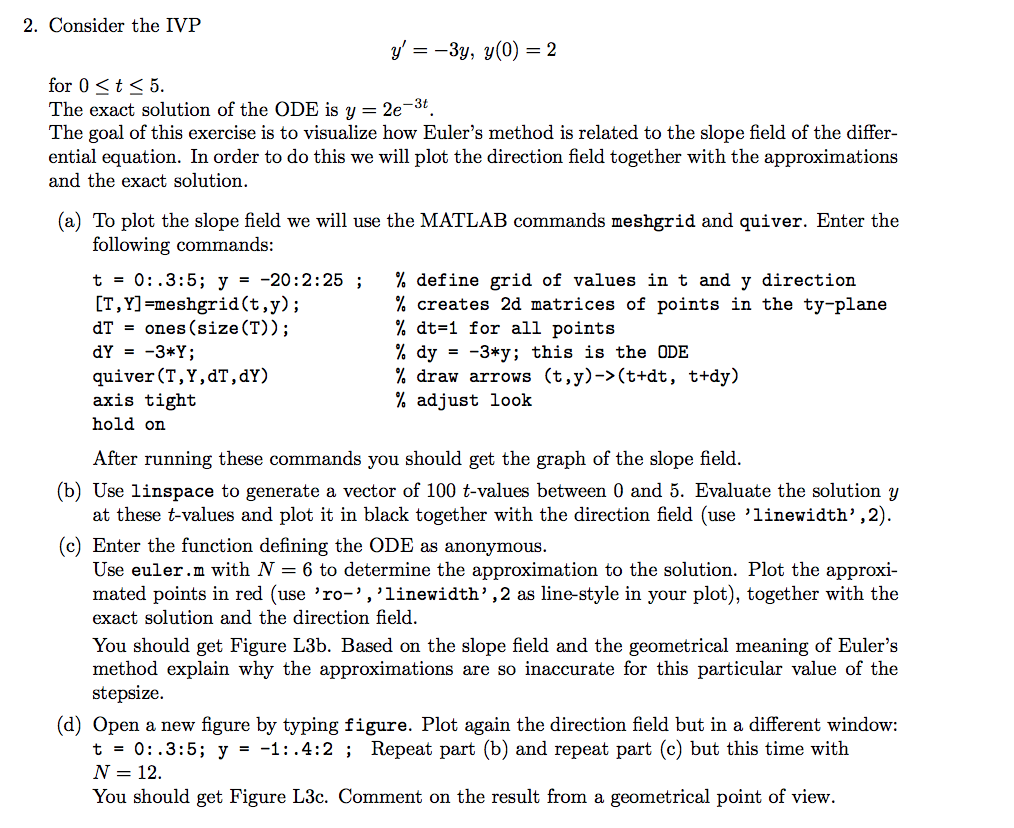 this is for matlab, they already give you the answer to question (A). Please answer (B), (C), and (D).
2. Consider the IVP for 0 (t+dt, t+dy) % adjust look t-0: . 3:5; y--20: 2:25 ; [T,Y]-meshgrid(t,y); dT - ones(size (T); quiver(T,Y,dT,dY) axis tight hold on After running these commands vou should get the graph of the slope field (b) Use linspace to generate a vector of 100 t-values between 0 and 5. Evaluate the solution y at these t-values and plot it in black together with the direction field (use 'linewidth',2) (c) Enter the function defining the ODE as anonymous Use euler.m with N -6 to determine the approximation to the solution. Plot the approxi mated points in red (use 'ro-' , 'linewidth',2 as line-style in your plot), together with the exact solution and the direction field You should get Figure L3b. Based on the slope field and the geometrical meaning of Euler's method explain why the approximations are so inaccurate for this particular value of the stepsize (d) Open a new figure by typing figure. Plot again the direction field but in a different window: t0:.3:5; y - -1:.4:2 Repeat part (b) and repeat part (c) but this time with N- 12. You should get Figure L3c. Comment on the result from a geometrical point of view
Step by Step Solution
There are 3 Steps involved in it

Get step-by-step solutions from verified subject matter experts
 Study Help