







Question: This is in python In this exercise, we combine the primes from the second half of the lesson with the list-based approach of the first
This is in python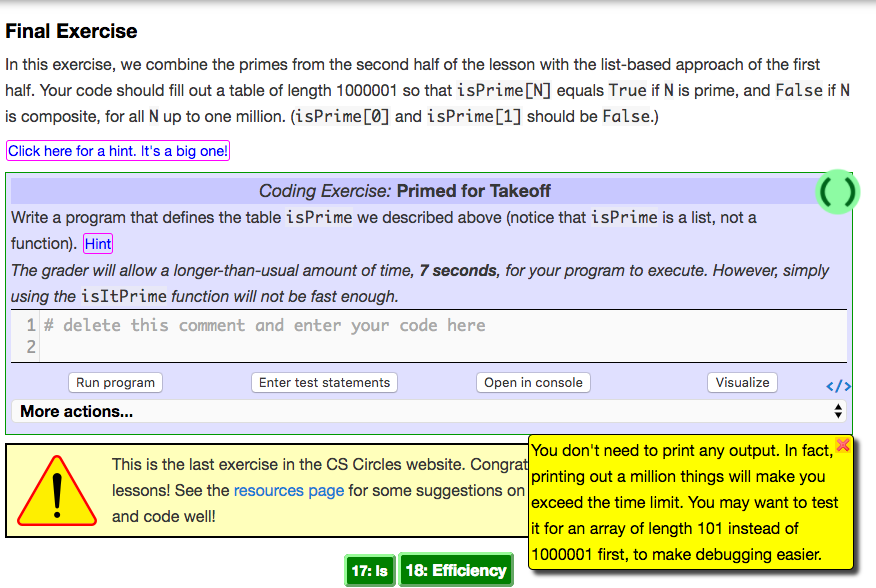
In this exercise, we combine the primes from the second half of the lesson with the list-based approach of the first half. Your code should fill out a table of length 1000001 so that isPrime[N] equals True if N is prime, and False if N is composite, for all N up to one million. (isPrime[0] and isPrime[1] should be False.) Write a program that defines the table isPrime we described above (notice that isPrime is a list, not a function). The grader will allow a longer-than-usual amount of time, 7 seconds, for your program to execute. However, simply using the is It Prime function will not be fast enough. # delete this comment and enter your code here In this exercise, we combine the primes from the second half of the lesson with the list-based approach of the first half. Your code should fill out a table of length 1000001 so that isPrime[N] equals True if N is prime, and False if N is composite, for all N up to one million. (isPrime[0] and isPrime[1] should be False.) Write a program that defines the table isPrime we described above (notice that isPrime is a list, not a function). The grader will allow a longer-than-usual amount of time, 7 seconds, for your program to execute. However, simply using the is It Prime function will not be fast enough. # delete this comment and enter your code here
Step by Step Solution
There are 3 Steps involved in it

Get step-by-step solutions from verified subject matter experts
 Study Help