







Question: This is it. there is bo Data 2. In instruments giving a digital output, the precision or uncertainty of the instrument usually corresponds to the
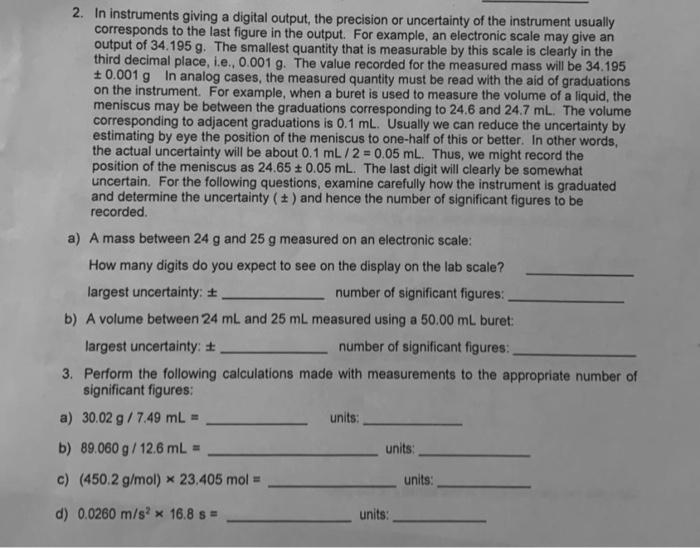
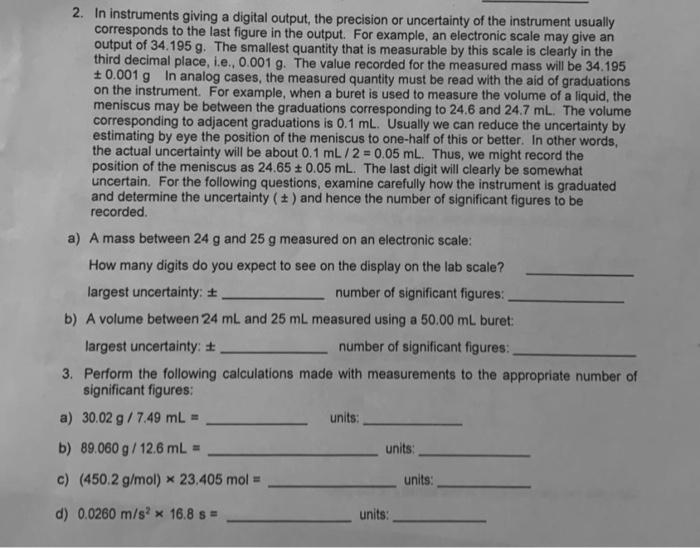
2. In instruments giving a digital output, the precision or uncertainty of the instrument usually corresponds to the last figure in the output. For example, an electronic scale may give an output of 34.195 g. The smallest quantity that is measurable by this scale is clearly in the third decimal place, i.e., 0.001 g. The value recorded for the measured mass will be 34.195 +0.001 In analog cases, the measured quantity must be read with the aid of graduations on the instrument. For example, when a buret is used to measure the volume of a liquid, the meniscus may be between the graduations corresponding to 24.6 and 24.7 ml. The volume corresponding to adjacent graduations is 0.1 mL. Usually we can reduce the uncertainty by estimating by eye the position of the meniscus to one-half of this or better. In other words, the actual uncertainty will be about 0.1 mL/2 = 0.05 ml. Thus, we might record the position of the meniscus as 24.65 + 0.05 mL. The last digit will clearly be somewhat uncertain. For the following questions, examine carefully how the instrument is graduated and determine the uncertainty (+) and hence the number of significant figures to be recorded. a) A mass between 24 g and 25 g measured on an electronic scale: How many digits do you expect to see on the display on the lab scale? largest uncertainty: number of significant figures: b) A volume between 24 mL and 25 ml measured using a 50.00 mL buret: largest uncertainty: number of significant figures: 3. Perform the following calculations made with measurements to the appropriate number of significant figures: a) 30.02 g/7.49 mL = units: b) 89.060 g/126 mL = units c) (450.2 g/mol) * 23.405 mol = units: d) 0.0260 m/s? * 16.8 s = units: 2. In instruments giving a digital output, the precision or uncertainty of the instrument usually corresponds to the last figure in the output. For example, an electronic scale may give an output of 34.195 g. The smallest quantity that is measurable by this scale is clearly in the third decimal place, i.e., 0.001 g. The value recorded for the measured mass will be 34.195 +0.001 In analog cases, the measured quantity must be read with the aid of graduations on the instrument. For example, when a buret is used to measure the volume of a liquid, the meniscus may be between the graduations corresponding to 24.6 and 24.7 ml. The volume corresponding to adjacent graduations is 0.1 mL. Usually we can reduce the uncertainty by estimating by eye the position of the meniscus to one-half of this or better. In other words, the actual uncertainty will be about 0.1 mL/2 = 0.05 ml. Thus, we might record the position of the meniscus as 24.65 + 0.05 mL. The last digit will clearly be somewhat uncertain. For the following questions, examine carefully how the instrument is graduated and determine the uncertainty (+) and hence the number of significant figures to be recorded. a) A mass between 24 g and 25 g measured on an electronic scale: How many digits do you expect to see on the display on the lab scale? largest uncertainty: number of significant figures: b) A volume between 24 mL and 25 ml measured using a 50.00 mL buret: largest uncertainty: number of significant figures: 3. Perform the following calculations made with measurements to the appropriate number of significant figures: a) 30.02 g/7.49 mL = units: b) 89.060 g/126 mL = units c) (450.2 g/mol) * 23.405 mol = units: d) 0.0260 m/s? * 16.8 s = units
Step by Step Solution
There are 3 Steps involved in it

Get step-by-step solutions from verified subject matter experts
 Study Help