







Question: this is Matlab code and I am including two pictures, the first one has the main idea but my question is about number 3 and
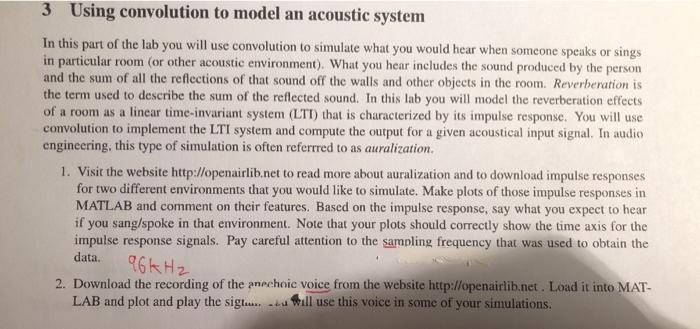

3 Using convolution to model an acoustic system In this part of the lab you will use convolution to simulate what you would hear when someone speaks or sings in particular room (or other acoustic environment). What you hear includes the sound produced by the person and the sum of all the reflections of that sound off the walls and other objects in the room. Reverberation is the term used to describe the sum of the reflected sound. In this lab you will model the reverberation effects of a room as a linear time-invariant system (LTI) that is characterized by its impulse response. You will use convolution to implement the LTI system and compute the output for a given acoustical input signal. In audio engineering, this type of simulation is often referred to as auralization. 1. Visit the website http://openairlib.net to read more about auralization and to download impulse responses for two different environments that you would like to simulate. Make plots of those impulse responses in MATLAB and comment on their features. Based on the impulse response, say what you expect to hear if you sang/spoke in that environment. Note that your plots should correctly show the time axis for the impulse response signals. Pay careful attention to the sampling frequency that was used to obtain the 96kHz 2. Download the recording of the anechoic voice from the website http://openairlih.net. Load it into MAT- LAB and plot and play the sigt..... tu will use this voice in some of your simulations. data, 3. Write a function to compute the output of your room simulation given an input signal and the impulse response signal. Include a copy of your function in the report, along with a description of how you verified that it was working. 3 Using convolution to model an acoustic system In this part of the lab you will use convolution to simulate what you would hear when someone speaks or sings in particular room (or other acoustic environment). What you hear includes the sound produced by the person and the sum of all the reflections of that sound off the walls and other objects in the room. Reverberation is the term used to describe the sum of the reflected sound. In this lab you will model the reverberation effects of a room as a linear time-invariant system (LTI) that is characterized by its impulse response. You will use convolution to implement the LTI system and compute the output for a given acoustical input signal. In audio engineering, this type of simulation is often referred to as auralization. 1. Visit the website http://openairlib.net to read more about auralization and to download impulse responses for two different environments that you would like to simulate. Make plots of those impulse responses in MATLAB and comment on their features. Based on the impulse response, say what you expect to hear if you sang/spoke in that environment. Note that your plots should correctly show the time axis for the impulse response signals. Pay careful attention to the sampling frequency that was used to obtain the 96kHz 2. Download the recording of the anechoic voice from the website http://openairlih.net. Load it into MAT- LAB and plot and play the sigt..... tu will use this voice in some of your simulations. data, 3. Write a function to compute the output of your room simulation given an input signal and the impulse response signal. Include a copy of your function in the report, along with a description of how you verified that it was working
Step by Step Solution
There are 3 Steps involved in it

Get step-by-step solutions from verified subject matter experts
 Study Help