







Question: This is my question. The (hypothetical) data given below are based on a random sample of customers shopping at a local electronics store. The goal
This is my question.
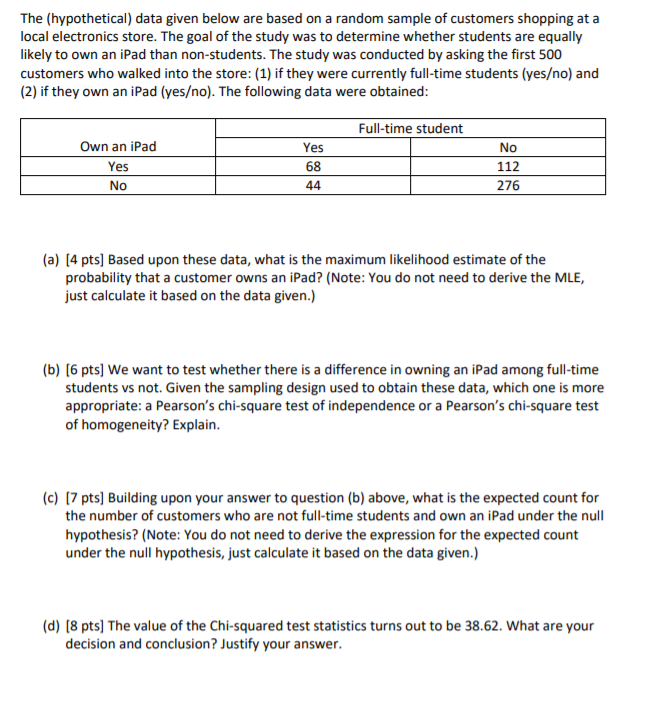
The (hypothetical) data given below are based on a random sample of customers shopping at a local electronics store. The goal of the study was to determine whether students are equally likely to own an ipad than non-students. The study was conducted by asking the first 500 customers who walked into the store: (1) if they were currently full-time students (yeso) and (2) if they own an ipad (yeso). The following data were obtained: Full-time student Own an ipad Yes No Yes 68 112 No 44 276 (a) [4 pts] Based upon these data, what is the maximum likelihood estimate of the probability that a customer owns an ipad? (Note: You do not need to derive the MLE, just calculate it based on the data given.) (b) [6 pts] We want to test whether there is a difference in owning an ipad among full-time students vs not. Given the sampling design used to obtain these data, which one is more appropriate: a Pearson's chi-square test of independence or a Pearson's chi-square test of homogeneity? Explain. (c) [7 pts] Building upon your answer to question (b) above, what is the expected count for the number of customers who are not full-time students and own an ipad under the null hypothesis? (Note: You do not need to derive the expression for the expected count under the null hypothesis, just calculate it based on the data given.) (d) [8 pts] The value of the Chi-squared test statistics turns out to be 38.62. What are your decision and conclusion? Justify your
Step by Step Solution
There are 3 Steps involved in it

Get step-by-step solutions from verified subject matter experts
 Study Help