







Question: This is on R language. I do not provide the date so just give me the answers to parts b and c with the general
This is on R language. I do not provide the date so just give me the answers to parts b and c with the general code leaving it empty and specifying where the values should be put
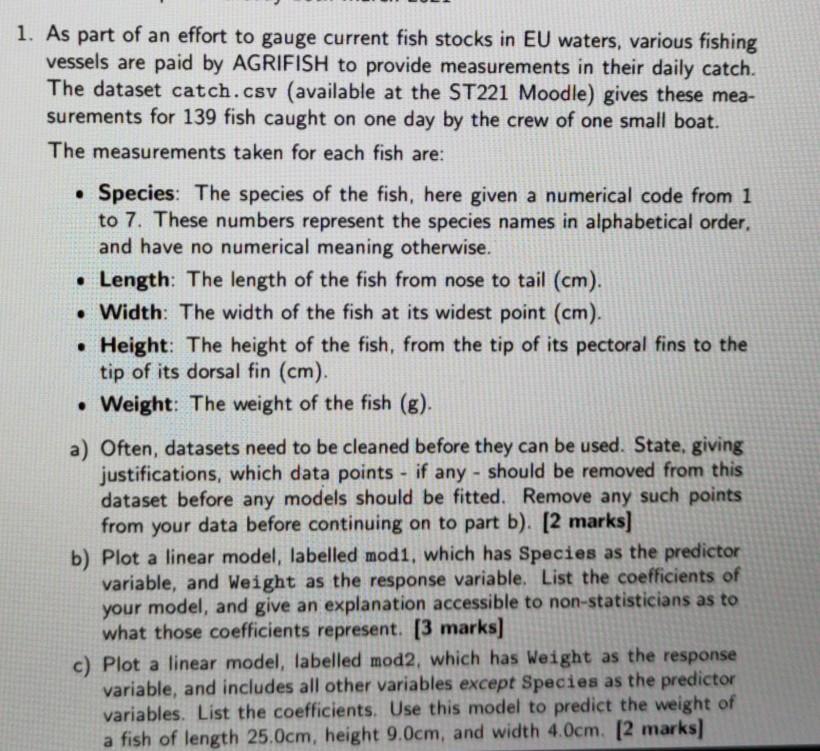
1. As part of an effort to gauge current fish stocks in EU waters, various fishing vessels are paid by AGRIFISH to provide measurements in their daily catch. The dataset catch.csv (available at the ST221 Moodle) gives these mea- surements for 139 fish caught on one day by the crew of one small boat. The measurements taken for each fish are: Species: The species of the fish, here given a numerical code from 1 to 7. These numbers represent the species names in alphabetical order. and have no numerical meaning otherwise. Length: The length of the fish from nose to tail (cm). Width: The width of the fish at its widest point (cm). Height: The height of the fish, from the tip of its pectoral fins to the tip of its dorsal fin (cm). Weight: The weight of the fish (g). a) Often, datasets need to be cleaned before they can be used. State, giving justifications, which data points - if any - should be removed from this dataset before any models should be fitted. Remove any such points from your data before continuing on to part b). [2 marks] b) Plot a linear model, labelled modi, which has Species as the predictor variable, and weight as the response variable. List the coefficients of your model, and give an explanation accessible to non-statisticians as to what those coefficients represent. [3 marks] c) Plot a linear model, labelled mod2, which has Weight as the response variable, and includes all other variables except Species as the predictor variables. List the coefficients. Use this model to predict the weight of a fish of length 25.0cm, height 9.0cm, and width 4.0cm. (2 marks]
Step by Step Solution
There are 3 Steps involved in it

Get step-by-step solutions from verified subject matter experts
 Study Help