







Question: ## This is the Case study I upload above and I have to apply Ethical theory on this case like Utilitarianism Common Good or Immanuel
##This is the Case study I upload above and I have to apply Ethical theory on this case like Utilitarianism Common Good or Immanuel Kant.##
Please help me out. I need to write 700 words minimum.
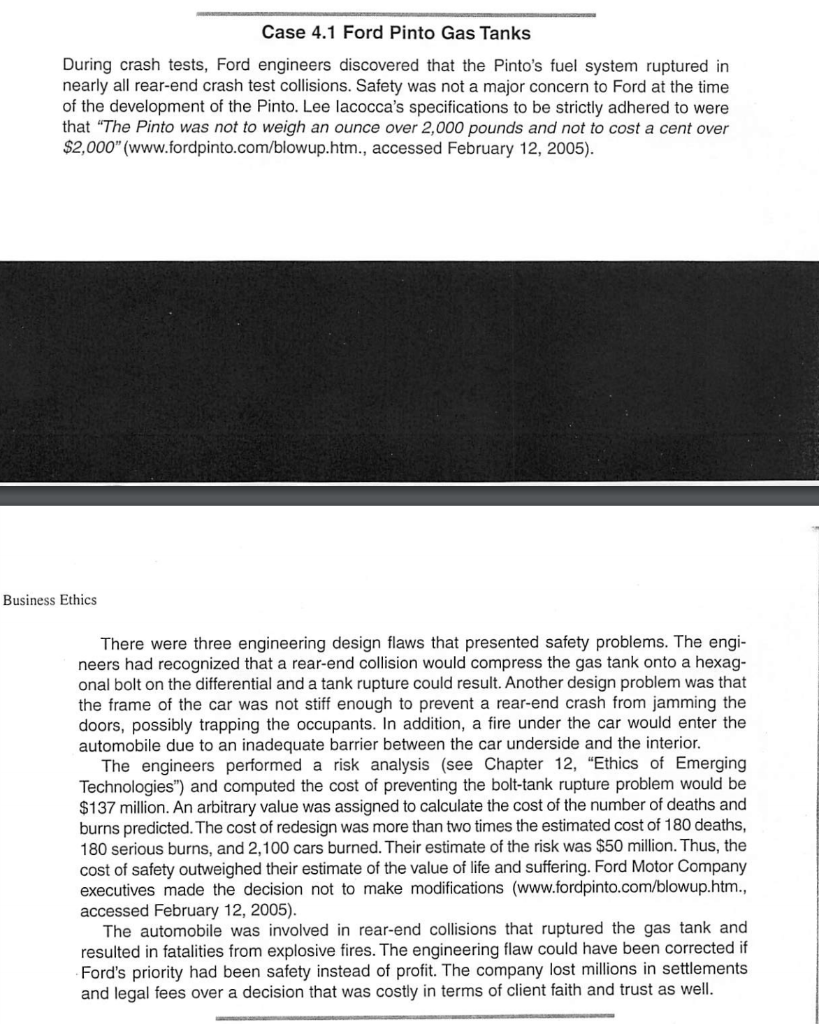
Case 4.1 Ford Pinto Gas Tanks During crash tests, Ford engineers discovered that the Pinto's fuel system ruptured in nearly all rear-end crash test collisions. Safety was not a major concern to Ford at the time of the development of the Pinto. Lee lacocca's specifications to be strictly adhered to were that "The Pinto was not to weigh an ounce over 2,000 pounds and not to cost a cent over $2,000" (www.fordpinto.com/blowup.htm., accessed February 12, 2005). Business Ethics There were three engineering design flaws that presented safety problems. The engi- neers had recognized that a rear-end collision would compress the gas tank onto a hexag- onal bolt on the differential and a tank rupture could result. Another design problem was that the frame of the car was not stiff enough to prevent a rear-end crash from jamming the doors, possibly trapping the occupants. In addition, a fire under the car would enter the automobile due to an inadequate barrier between the car underside and the interior. The engineers performed a risk analysis (see Chapter 12, "Ethics of Emerging Technologies") and computed the cost of preventing the bolt-tank rupture problem would be $137 million. An arbitrary value was assigned to calculate the cost of the number of deaths and burns predicted. The cost of redesign was more than two times the estimated cost of 180 deaths, 180 serious burns, and 2,100 cars burned. Their estimate of the risk was $50 million. Thus, the cost of safety outweighed their estimate of the value of life and suffering. Ford Motor Company executives made the decision not to make modifications (www.fordpinto.com/blowup.htm., accessed February 12, 2005). The automobile was involved in rear-end collisions that ruptured the gas tank and resulted in fatalities from explosive fires. The engineering flaw could have been corrected if Ford's priority had been safety instead of profit. The company lost millions in settlements and legal fees over a decision that was costly in terms of client faith and trust as well. Case 4.1 Ford Pinto Gas Tanks During crash tests, Ford engineers discovered that the Pinto's fuel system ruptured in nearly all rear-end crash test collisions. Safety was not a major concern to Ford at the time of the development of the Pinto. Lee lacocca's specifications to be strictly adhered to were that "The Pinto was not to weigh an ounce over 2,000 pounds and not to cost a cent over $2,000" (www.fordpinto.com/blowup.htm., accessed February 12, 2005). Business Ethics There were three engineering design flaws that presented safety problems. The engi- neers had recognized that a rear-end collision would compress the gas tank onto a hexag- onal bolt on the differential and a tank rupture could result. Another design problem was that the frame of the car was not stiff enough to prevent a rear-end crash from jamming the doors, possibly trapping the occupants. In addition, a fire under the car would enter the automobile due to an inadequate barrier between the car underside and the interior. The engineers performed a risk analysis (see Chapter 12, "Ethics of Emerging Technologies") and computed the cost of preventing the bolt-tank rupture problem would be $137 million. An arbitrary value was assigned to calculate the cost of the number of deaths and burns predicted. The cost of redesign was more than two times the estimated cost of 180 deaths, 180 serious burns, and 2,100 cars burned. Their estimate of the risk was $50 million. Thus, the cost of safety outweighed their estimate of the value of life and suffering. Ford Motor Company executives made the decision not to make modifications (www.fordpinto.com/blowup.htm., accessed February 12, 2005). The automobile was involved in rear-end collisions that ruptured the gas tank and resulted in fatalities from explosive fires. The engineering flaw could have been corrected if Ford's priority had been safety instead of profit. The company lost millions in settlements and legal fees over a decision that was costly in terms of client faith and trust as wellStep by Step Solution
There are 3 Steps involved in it
1 Expert Approved Answer
Step: 1 Unlock

Question Has Been Solved by an Expert!
Get step-by-step solutions from verified subject matter experts
Step: 2 Unlock
Step: 3 Unlock
 Study Help