Question: This is the case^ ^ Write 5 Analysis and 5 Recommendations on why Jill White has been unable to develop a service-oriented organization culture ,
This is the case^
^ Write 5 Analysis and 5 Recommendations on why Jill White has been unable to develop a service-oriented organization culture, high-quality service, a committed group of employees and managers who can work effectively independently, low employee turnover, and a profitable business at Club Lido.
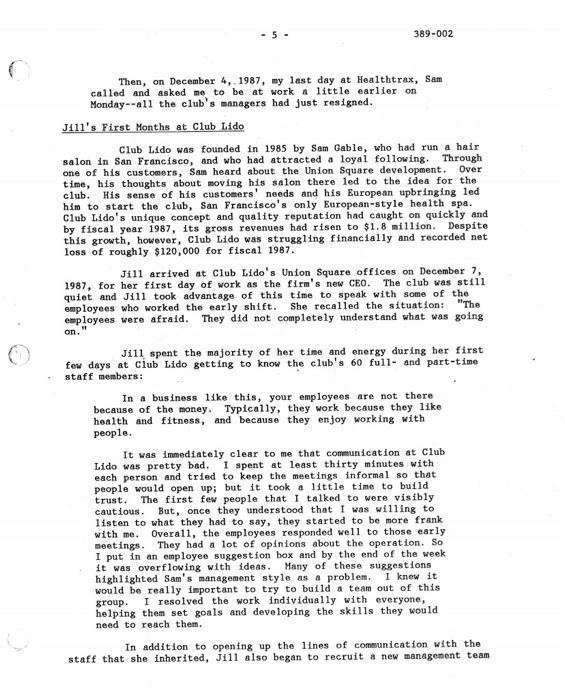
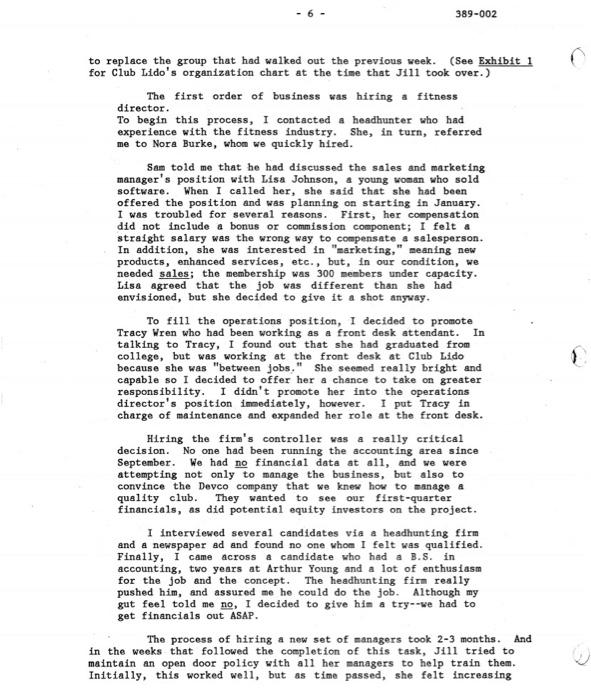
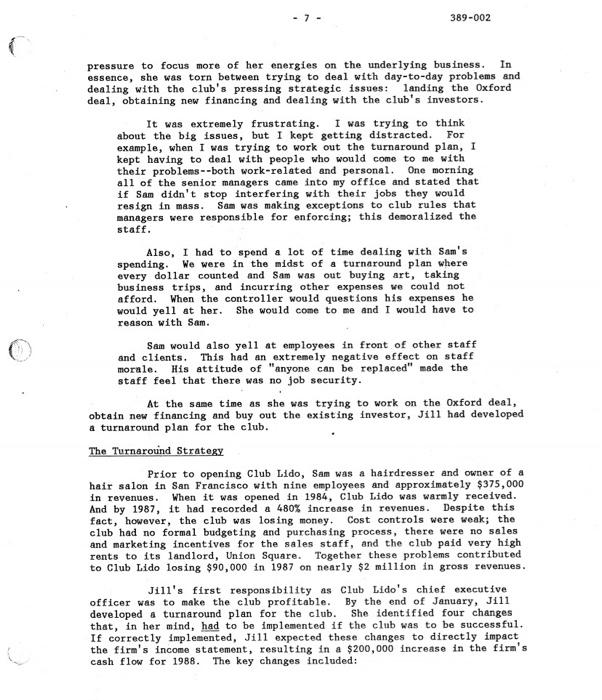
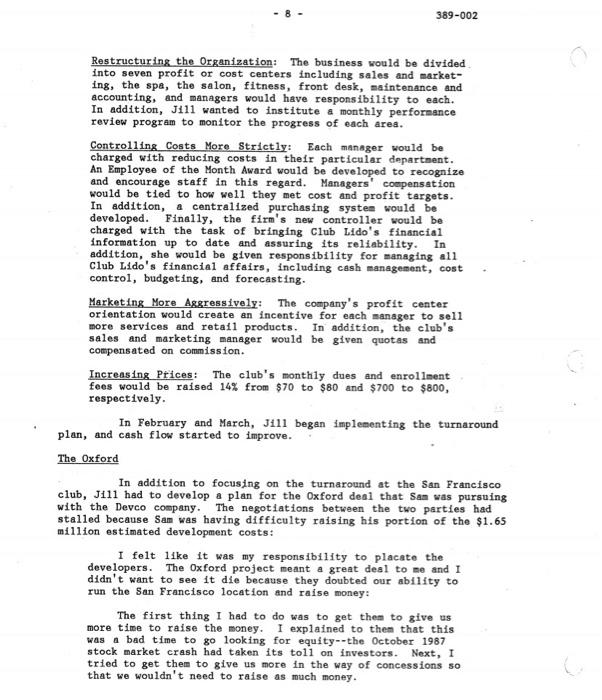
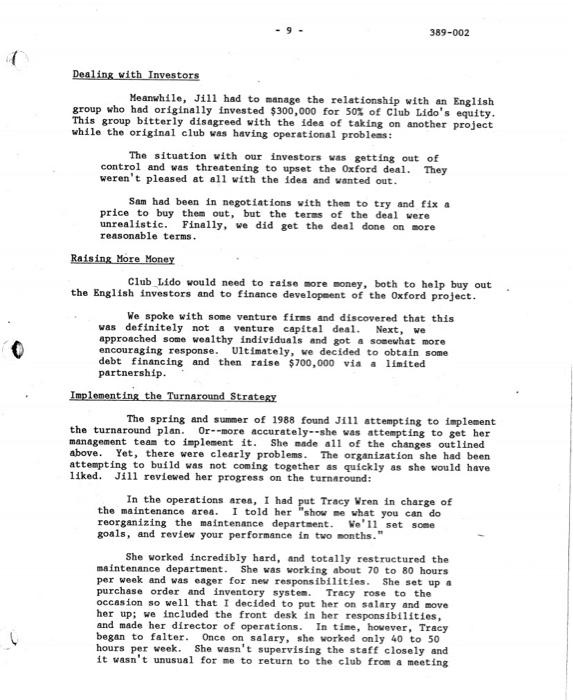
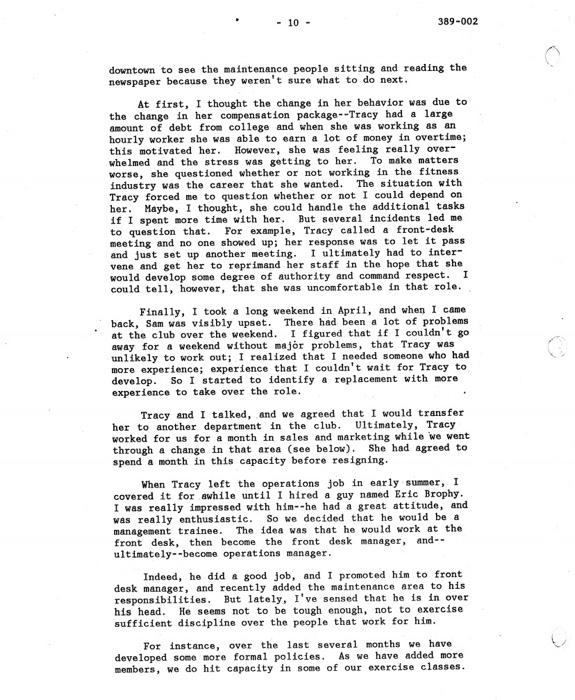
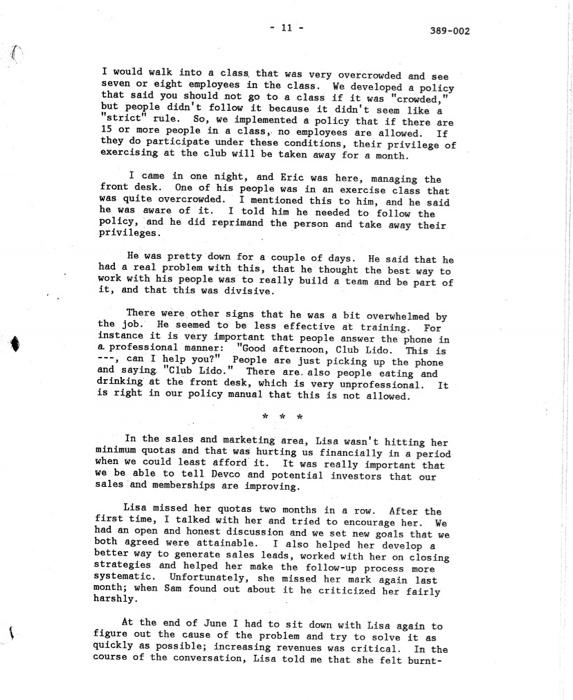
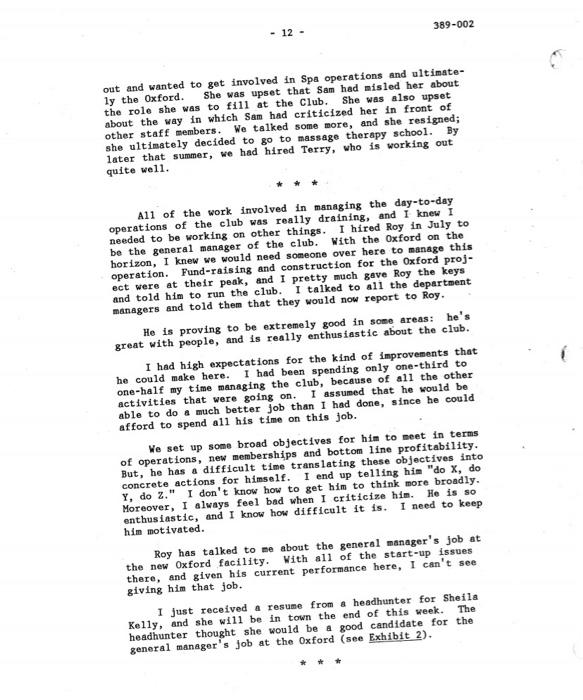
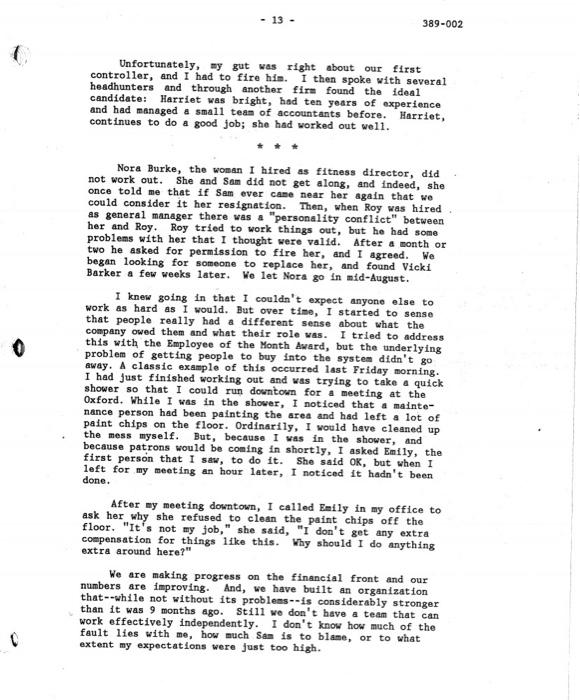
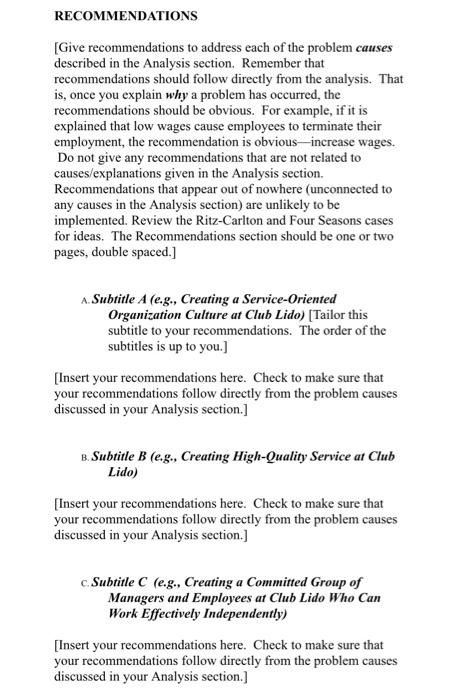
JILL WHITE It was September of 1988, and Jill White was preparing for another week of work at Club Lido, a European-style health spa in San Francisco, California. Jill had assumed the chief executive officer's role at Club Lido in December of the previous year. During the ensuing months she had made progress on a number of fronts, including the financing, start-up and marketing of a new Club Lido; the buyout of a group of existing investors who had tried to block this expansion; and, the turnaround of the club in San Francisco. Jill described the situation: It was clear before I ever started working at Club Lido that a major turnaround was needed. That's why Sam--Club Lido's founder and owner--hired me. Based on my background and experience in the industry, I formulated a turnaround plan, and began moving ahead to implement it. At the same time I had identified a number of other critical issues, relative to both our existing ownership structure and the start-up of a second Club Lido in San Francisco. I thought, frankly, that by this time the turnaround would be complete, and I could turn my energies towards expanding the club. I was wrong. We've made some progress, but I am still far too involved in the day-to-day operations of the club. It has been extraordinarily difficult to get people to step up, take responsibility, and execute well. Thus, at exactly the time I really need to step away from the day-to-day operations, I can't. Sam has also been a source of some problems. He has had real trouble removing himself from the details of operating the Club and as a result--my managers have become quite frustrated 389-002 And yet, it is difficult to see how I could work any harder. I am emotionally drained. I've worked hard before-- in consulting, venture capital--but nothing in my life pre- pared me for what I've been through in the last nine months. I don't know whether this is exactly what I should have expected or if something has gone drastically wrong and I's in the middle of a real crisis. Background Jill graduated from Harvard Business School in 1987. Prior to entering the MBA program, she had worked for a Boston-ares publishing house, and had also spent two years with Bain & Co., a Boston consulting firm. At the Business School, Jill become interested in small companies, and spent the summer between her first and second years working for a venture capital firm researching Investment proposals. She enjoyed the work, and was impressed with the wide variety of individual entrepreneurs that she met: These people were incredibly enthusiastic, and loved what they were doing. I began thinking it would be an exciting career path for me to pursue. After deciding to pursue a career as an entrepreneur, Jill began to think about how to accomplish this goal In talking to different people, she realized that there were two schools of thought about entre- preneurship. One perspective suggested that it doesn't really matter what business you go into just as long as it's your own. The second point of view said that "1f you're going to work that hard at something, you really need to love it." After considering these alternatives, Jill decided that the latter made more sense to her. In line with this thinking, she began to explore the spa/health club industry, a business that had always held a special appeal to her. During the latter part of her summer in Europe, Jill met the founder of Avalon, an English exercise equipment firm, who wanted to build a chain of health clubs throughout the United Kingdom; she arranged to write an independent research report (IRR) for Avalon to test the feasibility of its plan. After a few months of intensive work, however, it was clear that Avalon's idea had major flaws. While their concept never came to fruition, the IRR was an invaluable experience for J111. In addition to educating her on the industry, she began to meet people in the business. One such individual was Don Leopold. Don had graduated from Harvard Business School, and had become a consultant to the fitness industry. Jill arranged to do a second semester independent research report, working for Don on an industry analysis for the fitness industry's trade association. During the course of this work, I met Sam Gable, owner of Club Lido-- a health spa in Union Square. Sam and I spent the better part of an afternoon talking, and we agreed that there 389-002 ( was a good market for high-end health clubs in major metro- politan cities like San Francisco. San's club, Club Lido, was San Francisco's only European-style health spa, combining a health club, spa and salon. It was the most expensive club in the San Francisco area, with a $700 initiation fee, and a $70 per month charge. Jill was impressed with the basic concept of Club Lido, and was excited when Sam offered her the CEO's job at the club: Sam and I talked about the possibility of working together, but we both agreed that it made more sense for me to go to a larger, well-established club to learn about club management. However, we agreed to stay in touch, since we knew that--with our interests and backgrounds--our paths were bound to cross again. Jill continued her job search throughout the spring. She identified a number of firms that met her criteria and eventually chose to work for Healthtrax, a Rhode Island-based fire that owned and operated 15 health clubs across New England: It was really the only firm that seemed to have what I was looking for. Healthtrax had been in the business for five years and had developed a systematic approach to operating clubs... and everybody that joined Healthtrax had to begin at the bottom and learn every aspect of the business: fitness, food and beverage, club operations, sales, and the like. My position with the firm differed from that of most new employees since I had my MBA, but I still spent time rotating through the system learning how to run the front desk, work as a fitness technician, bartend, and sell memberships. In retrospect, this was extremely important because it really taught me how to run a club. Jill moved quickly through the ranks at Healthtrax. In a matter of months, she had become the firm's best salesperson, setting a new record for membership sales (77 in one month). And in recognition for her accomplishments, the company promoted her to sales manager. Although Jill enjoyed her work, she realized that she was more interested in serving the "high end of the fitness industry. In the course of her deliberations, Jill received a call from Sam in which he asked her reconsider the CEO's job at Club Lido: Sam was really feeling the pressure of managing Club Lido. His revenues were great, but his costs were out of control. The company was losing roughly $10,000 per month. Moreover, none of the club's previous managers had been able to deal successfully with Sam's impulsive, demanding entrepre- neurial style; turnover at the club was extremely high. No one at Club Lido had their eyes on the bottom line. There 389-002 were no budgets, no controls; people would pick up the phone and order any equipment or supplies they needed with no oversight. As Sam was attempting to deal with these issues, he was also engaged in discussions with Devco, the San Francisco- based developer behind the Oxford, a prestigious residential, office and retail development overlooking San Francisco Bay. Devco was extremely interested in placing a luxury health club in the Oxford, but was reluctant to take the risk of actually running the club. Consequently, Devco had contacted Sam about opening a second branch of Club Lido at the Oxford. The Oxford deal seemed really promising and I was really worried that something might ruin it. Devco had learned about the problems Sam was experiencing at Club Lido, and I felt certain that the deal would fall through if Sam couldn't prove that he could manage things better. Trying to push ahead with the Oxford deal, while at the same time attempting to keep the San Francisco club above water was really taking its toll on Sam. And, to make matters worse, his investors didn't even support the Oxford deal; they questioned his ability to run two clubs and were threatening to block the expansion proposal. Jill was attracted to Club Lido despite its obvious management problems. After weighing her options carefully, she decided to accept Sam's offer of the CEO position: Leaving the security of Healthtrax was a difficult decision. I had learned the ropes at Healthtrax and they had given me the opportunity to advance quickly there. Still, I decided to leave because I liked the core concept behind Club Lido. I felt that it was either now or never; if I waited any longer, Club Lido might go under. Before leaving Healthtrax, Jill set with Sam's lawyer to hammer out the details of her employment. The final package included a base salary of $30,000 with a potential $15,000 performance bonus, a seat on the company's board of directors, and an equity position tied to Sam's ownership interest in the business. At the time, Sam owned 50% of the business and a group of investors from England owned the remaining 50%. Under the terms of the contract, Jill was given rights to 15% of Sam's ownership, or 7.5% of the business. The contract also stipulated that Jill's percentage of the business would increase (or decrease) directly with Sam's ownership. J411 looked forward to beginning work at Club Lido in early December: 5 389-002 Then, on December 4, 1987, my last day at Healthtrax, Sam called and asked me to be at work a little earlier on Monday--all the club's managers had just resigned. Jill's First Months at Club Lido Club Lido was founded in 1985 by Sam Gable, who had run a hair salon in San Francisco, and who had attracted a loyal following. Through one of his customers, Sam heard about the Union Square development. Over time, his thoughts about moving his salon there led to the idea for the club. His sense of his customers' needs and his European upbringing led him to start the club, San Francisco's only European-style health spa. Club Lido's unique concept and quality reputation had caught on quickly and by fiscal year 1987, Its gross revenues had risen to $1.8 million. Despite this growth, however, Club Lido was struggling financially and recorded net loss of roughly $120,000 for fiscal 1987. Jill arrived at Club Lido's Union Square offices on December 7, 1987, for her first day of work as the firm's new CEO. The club was still quiet and Jill took advantage of this time to speak with some of the employees who worked the early shift. She recalled the situation: "The employees were afraid. They did not completely understand what was going on. Jill spent the majority of her time and energy during her first few days at club Lido getting to know the club's 60 full- and part-time staff members: In a business like this, your employees are not there because of the money. Typically, they work because they like health and fitness, and because they enjoy working with people. It was immediately clear to me that communication at Club Lido was pretty bad. I spent at least thirty minutes with each person and tried to keep the meetings informal so that people would open up; but it took a little time to build trust. The first few people that I talked to were visibly cautious. But, once they understood that I was willing to listen to what they had to say, they started to be more frank with me. Overall, the employees responded well to those early meetings. They had a lot of opinions about the operation. So I put in an employee suggestion box and by the end of the week it was overflowing with ideas. Many of these suggestions highlighted Sam's management style as a problem. I knew it would be really important to try to build a team out of this group I resolved the work individually with everyone, helping them set goals and developing the skills they would need to reach them. In addition to opening up the lines of communication with the staff that she inherited, Jill also began to recruit a new management team 389-002 to replace the group that had walked out the previous week. (See Exhibit 1 for Club Lido's organization chart at the time that J111 took over.) The first order of business was hiring a fitness director. To begin this process, I contacted a headhunter who had experience with the fitness industry. She, in turn, referred me to Nora Burke, whom we quickly hired. Sam told me that he had discussed the sales and marketing manager's position with Lisa Johnson, a young woman who sold software. When I called her, she said that she had been offered the position and was planning on starting in January. I was troubled for several reasons. First, her compensation did not include a bonus or commission component; I felt a straight salary was the wrong way to compensate a salesperson. In addition, she was interested in "marketing," meaning new products, enhanced services, etc., but, in our condition, we needed sales; the membership was 300 members under capacity. Lisa agreed that the job was different than she had envisioned, but she decided to give it a shot anyway. To fill the operations position, I decided to promote Tracy Wren who had been working as a front desk attendant. In talking to Tracy, I found out that she had graduated from college, but was working at the front desk at Club Lido because she was "between jobs." She seemed really bright and capable so I decided to offer her a chance to take on greater responsibility I didn't promote her into the operations director's position immediately, however. I put Tracy in charge of maintenance and expanded her role at the front desk. Hiring the firm's controller was a really critical decision. No one had been running the accounting area since September. We had no financial data at all, and we were attempting not only to manage the business, but also to convince the Devco company that we knew how to manage a quality club. They wanted to see our first-quarter financials, as did potential equity Investors on the project. I Interviewed several candidates via a headhunting firm and a newspaper ad and found no one whom I felt was qualified. Finally, I came across a candidate who had a B.s in accounting, two years at Arthur Young and a lot of enthusiasm for the job and the concept. The headhunting fim really pushed him, and assured me he could do the job. Although my gut feel told me no, I decided to give him a try--we had to get financials out ASAP. The process of hiring a new set of managers took 2-3 months. And in the weeks that followed the completion of this task, Jill tried to maintain an open door policy with all her managers to help train them. Initially, this worked well, but as time passed, she felt increasing 389-002 pressure to focus more of her energies on the underlying business. In essence, she was torn between trying to deal with day-to-day problems and dealing with the club's pressing strategic issues: landing the Oxford deal, obtaining new financing and dealing with the club's investors. It was extremely frustrating. I was trying to think about the big issues, but I kept getting distracted. For example, when I was trying to work out the turnaround plan, I kept having to deal with people who would come to me with their problems --both work-related and personal. One morning all of the senior managers came into my office and stated that if Sam didn't stop interfering with their jobs they would resign in mass. Sam was making exceptions to club rules that managers were responsible for enforcing; this demoralized the staff. Also, I had to spend a lot of time dealing with Sam's spending We were in the midst of a turnaround plan where every dollar counted and Sam was out buying art, taking business trips, and incurring other expenses we could not afford. When the controller would questions his expenses he would yell at her. She would come to me and I would have to reason with Sam. San would also yell at employees in front of other staff and clients. This had an extremely negative effect on staff morale. His attitude of "anyone can be replaced" made the staff feel that there was no job security. At the same time as she was trying to work on the Oxford deal, obtain new financing and buy out the existing investor, Jill had developed a turnaround plan for the club. The Turnaround Strategy Prior to opening Club Lido, Sam was a hairdresser and owner of a hair salon in San Francisco with nine employees and approximately $375,000 in revenues. When it was opened in 1984, Club Lido was warmly received. And by 1987, it had recorded a 480% increase in revenues. Despite this fact, however, the club was losing money. Cost controls were weak; the club had no formal budgeting and purchasing process, there were no sales and marketing incentives for the sales staff, and the club paid very high rents to its landlord, Union Square. Together these problems contributed to Club Lido losing $90,000 in 1987 on nearly $2 million in gross revenues. Jill's first responsibility as Club Lido's chief executive officer was to make the club profitable. By the end of January, Jill developed a turnaround plan for the club. She identified four changes that, in her mind, had to be implemented if the club was to be successful. If correctly implemented, Jill expected these changes to directly impact the firm's Income statement, resulting in a $200,000 Increase in the firm's cash flow for 1988. The key changes included: 389-002 Restructuring the Organization: The business would be divided into seven profit or cost centers including sales and market- ing, the spa, the salon, fitness, front desk, maintenance and accounting, and managers would have responsibility to each. In addition, Jill wanted to institute a monthly performance review program to monitor the progress of each area. Controlling Costs More Strictly Each manager would be charged with reducing costs in their particular department. An Employee of the Month Award would be developed to recognize and encourage staff in this regard. Managers' compensation would be tied to how well they met cost and profit targets. In addition, a centralized purchasing system would be developed. Finally, the firm's new controller would be charged with the task of bringing Club Lido's financial information up to date and assuring its reliability. In addition, she would be given responsibility for managing all Club Lido's financial affairs, including cash management, cost control, budgeting, and forecasting. Marketing More Aggressively: The company's profit center orientation would create an incentive for each manager to sell more services and retail products. In addition, the club's sales and marketing manager would be given quotes and compensated on commission. Increasing Prices: The club's monthly dues and enrollment fees would be raised 14% from $70 to $80 and $700 to $800, respectively. In February and March, Jill began implementing the turnaround plan, and cash flow started to improve. The Oxford In addition to focusing on the turnaround at the San Francisco club, J111 had to develop a plan for the Oxford deal that San was pursuing with the Devco company. The negotiations between the two parties had stalled because Sam was having difficulty raising his portion of the $1.65 million estimated development costs: I felt like it was my responsibility to placate the developers. The Oxford project meant a great deal to me and I didn't want to see it die because they doubted our ability to run the San Francisco location and raise money: The first thing I had to do was to get them to give us more time to raise the money. I explained to them that this was a bad time to go looking for equity--the October 1987 stock market crash had taken its toll on investors. Next, I tried to get them to give us more in the way of concessions so that we wouldn't need to raise as much money. 389-002 Dealing with Investors Meanwhile, Jill had to manage the relationship with an English group who had originally invested $300,000 for 50% of Club Lido's equity. This group bitterly disagreed with the idea of taking on another project while the original club was having operational problems: The situation with our investors was getting out of control and was threatening to upset the Oxford deal. They weren't pleased at all with the ides and wanted out. Sam had been in negotiations with them to try and fix a price to buy them out, but the terms of the deal were unrealistic. Finally, we did get the deal done on more reasonable terms. Raising More Money Club Lido would need to raise more money, both to help buy out the English investors and to finance development of the Oxford project. We spoke with some venture fires and discovered that this was definitely not a venture capital deal. Next, we approached some wealthy individuals and got a somewhat more encouraging response. Ultimately, we decided to obtain some debt financing and then raise $700,000 via a limited partnership. Implementing the Turnaround Strategy The spring and summer of 1988 found Jill attempting to implement the turnaround plan. Or--more accurately--she was attempting to get her management team to implement it. She made all of the changes outlined above. Yet, there were clearly problems. The organization she had been attempting to build was not coming together as quickly as she would have 11ked. Jill reviewed her progress on the turnaround: In the operations area, I had put Tracy Wren in charge of the maintenance area. I told her "show me what you can do reorganizing the maintenance department. We'11 set some goals, and review your performance in two months." She worked incredibly hard, and totally restructured the maintenance department. She was working about 70 to 80 hours per week and was eager for new responsibilities. She set up a purchase order and inventory system. Tracy rose to the occasion so well that I decided to put her on salary and move her up: we included the front desk in her responsibilities, and made her director of operations. In time, however, Tracy began to falter. Once on salary, she worked only 40 to 50 hours per week. She wasn't supervising the staff closely and it wasn't unusual for me to return to the club from a meeting - 10 - 389-002 downtown to see the maintenance people sitting and reading the newspaper because they weren't sure what to do next. At first, I thought the change in her behavior was due to the change in her compensation package--Tracy had a large amount of debt from college and when she was working as an hourly worker she was able to earn a lot of money in overtime; this motivated her. However, she was feeling really over- whelmed and the stress was getting to her. To make matters worse, she questioned whether or not working in the fitness industry was the career that she wanted. The situation with Tracy forced me to question whether or not I could depend on her. Maybe, I thought, she could handle the additional tasks if I spent more time with her. But several incidents led me to question that For example, Tracy called a front desk meeting and no one showed up; her response was to let it pass and just set up another meeting. I ultimately had to inter- vene and get her to reprimand her staff in the hope that she would develop some degree of authority and command respect. I could tell, however, that she was uncomfortable in that role. Finally, I took a long weekend in April, and when I came back, Sam was visibly upset. There had been a lot of problems at the club over the weekend. I figured that if I couldn't go away for a weekend without major problems, that Tracy was un likely to work out; I realized that I needed someone who had more experience; experience that I couldn't wait for Tracy to develop So I started to identify a replacement with more experience to take over the role. Tracy and I talked, and we agreed that I would transfer her to another department in the club. Ultimately, Tracy worked for us for a month in sales and marketing while we went through a change in that area (see below). She had agreed to spend a month in this capacity before resigning. When Tracy left the operations Job in early summer, 1 covered it for awhile until I hired a guy named Eric Brophy. I was really impressed with him--he had a great attitude, and was really enthusiastic. So we decided that he would be a management trainee. The idea was that he would work at the front desk, then become the front desk manager, and ultimately--become operations manager. Indeed, he did a good job, and I promoted him to front desk manager, and recently added the maintenance area to his responsibilities. But lately, I've sensed that he is in over his head. He seems not to be tough enough, not to exercise sufficient discipline over the people that work for him. For instance, over the last several months we have developed some more formal policies. As we have added more members, we do hit capacity in some of our exercise classes. - 11 - 389-002 I would walk into a class that was very overcrowded and see seven or eight employees in the class. We developed a policy that said you should not go to a class if it was "crowded, but people didn't follow It because it didn't seem like a "strict rule. So, we implemented a policy that if there are 15 or more people in a class, no employees are allowed. If they do participate under these conditions, their privilege of exercising at the club will be taken away for a month. I came in one night, and Eric was here, managing the front desk. One of his people was in an exercise class that was quite overcrowded. I mentioned this to him, and he said he was aware of it. I told his he needed to follow the policy, and he did reprimand the person and take away their privileges. He was pretty down for a couple of days. He said that he had a real problem with this, that he thought the best way to work with his people was to really build a team and be part of it, and that this was divisive. There were other signs that he was a bit overwhelmed by the job. He seemed to be less effective at training. For Instance it is very important that people answer the phone in a professional manner: "Good afternoon, Club Lido. This is --, can I help you?" People are just picking up the phone and saying "Club Lido." There are also people eating and drinking at the front desk, which is very unprofessional. It is right in our policy manual that this is not allowed. In the sales and marketing area, Lisa wasn't hitting her minimum quotas and that was hurting us financially in a period when we could least afford it. It was really important that we be able to tell Devco and potential investors that our sales and memberships are improving. Lisa missed her quotas two months in a row. After the first time, I talked with her and tried to encourage her. We had an open and honest discussion and we set new goals that we both agreed were attainable. I also helped her develop a better way to generate sales leads, worked with her on closing strategies and helped her make the follow-up process more systematic. Unfortunately, she missed her mark again last month; when Sam found out about it he criticized her fairly harshly At the end of June I had to sit down with Lisa again to figure out the cause of the problem and try to solve it as quickly as possible; Increasing revenues was critical. In the course of the conversation, Lisa told me that she felt burnt- 389-002 - 12 - out and wanted to get involved in Spa operations and ultimate- ly the Oxford She was upset that Sam had misled her about the role she was to fill at the Club. She was also upset about the way in which Sam had criticized her in front of other staff members. We talked some more, and she resigned; she ultimately decided to go to massage therapy school. By later that summer, we had hired Terry, who is working out quite well. All of the work involved in managing the day-to-day operations of the club was really draining, and I knew I needed to be working on other things. I hired Roy in July to be the general manager of the club. With the Oxford on the horizon, I knew we would need someone over here to manage this operation. Fund-raising and construction for the Oxford proj- ect were at their peak, and I pretty much gave Roy the keys and told him to run the club. I talked to all the department managers and told them that they would now report to Roy. He is proving to be extremely good in some areas: he's great with people, and is really enthusiastic about the club. I had high expectations for the kind of improvements that he could make here. I had been spending only one-third to one-half my time managing the club, because of all the other activities that were going on. I assumed that he would be able to do & much better job than I had done, since he could afford to spend all his time on this job. We set up some broad objectives for him to meet in terms of operations, new memberships and bottom line profitability. But, he has a difficult time translating these objectives into concrete actions for himself. I end up telling him "do X, do Y, do z." I don't know how to get him to think more broadly. Moreover, I always feel bad when I criticize him. He is so enthusiastic, and I know how difficult it is. I need to keep him motivated. Roy has talked to me about the general manager's job at the new Oxford facility. With all of the start-up issues there, and given his current performance here, I can't see giving him that job. I just received a resume from a headhunter for Sheila Kelly, and she will be in town the end of this week. The headhunter thought she would be a good candidate for the general manager's job at the Oxford (see Exhibit 2). - 13 389-002 Unfortunately, my gut was right about our first controller, and I had to fire his. I then spoke with several headhunters and through another firm found the ideal candidate: Harriet was bright, had ten years of experience and had managed a small team of accountants before. Harriet, continues to do a good job; she had worked out well. 0 Nora Burke, the woman I hired as fitness director, did not work out. She and Sam did not get along, and indeed, she once told me that if Sam ever came near her again that we could consider it her resignation. Then, when Roy was hired as general manager there was a personality conflict between her and Roy. Roy tried to work things out, but he had some problems with her that I thought were valid. After a month or two he asked for permission to fire her, and I agreed. We began looking for someone to replace her, and found Vicki Barker a few weeks later. We let Nora go in mid-August. I knew going in that I couldn't expect anyone else to work as hard as I would. But over time, I started to sense that people really had a different sense about what the company owed them and what their role was. I tried to address this with the Employee of the Month Award, but the underlying problem of getting people to buy into the system didn't go away. A classic example of this occurred last Friday morning. I had just finished working out and was trying to take a quick shower so that I could run downtown for a meeting at the Oxford. While I was in the shower, I noticed that a mainte- nance person had been painting the area and had left a lot of paint chips on the floor. Ordinarily, I would have cleaned up the mess myself. But, because I was in the shower, and because patrons would be coming in shortly, I asked Emily, the first person that I saw, to do it. She said ok, but when I left for my meeting an hour later, I noticed it hadn't been done. After my meeting downtown, I called Emily in my office to ask her why she refused to clean the paint chips off the floor. "It's not my job," she said, "I don't get any extra compensation for things like this. Why should I do anything extra around here?" We are making progress on the financial front and our numbers are improving. And, we have built an organization that--while not without its problems is considerably stronger than it was 9 months ago. Still we don't have a team that can work effectively independently. I don't know how much of the fault lies with me, how much Sam is to blame, or to what extent my expectations were just too high. RECOMMENDATIONS [Give recommendations to address each of the problem causes described in the Analysis section. Remember that recommendations should follow directly from the analysis. That is, once you explain why a problem has occurred, the recommendations should be obvious. For example, if it is explained that low wages cause employees to terminate their employment, the recommendation is obvious-increase wages. Do not give any recommendations that are not related to causes/explanations given in the Analysis section. Recommendations that appear out of nowhere (unconnected to any causes in the Analysis section) are unlikely to be implemented. Review the Ritz-Carlton and Four Seasons cases for ideas. The Recommendations section should be one or two pages, double spaced.] A. Subtitle A (e.g., Creating a Service-Oriented Organization Culture at Club Lido) (Tailor this subtitle to your recommendations. The order of the subtitles is up to you.] [Insert your recommendations here. Check to make sure that your recommendations follow directly from the problem causes discussed in your Analysis section.] B. Subtitle B (e.g., Creating High-Quality Service at Club Lido) [Insert your recommendations here. Check to make sure that your recommendations follow directly from the problem causes discussed in your Analysis section.] Subtitle C (e.g., Creating a Committed Group of Managers and Employees at Club Lido Who Can Work Effectively Independently) [Insert your recommendations here. Check to make sure that your recommendations follow directly from the problem causes discussed in your Analysis section.]










 Study Help