Question: this is the codebook Background Data comes from a research project whose purpose is to study young people's relationship to their parents during the high
this is the codebook
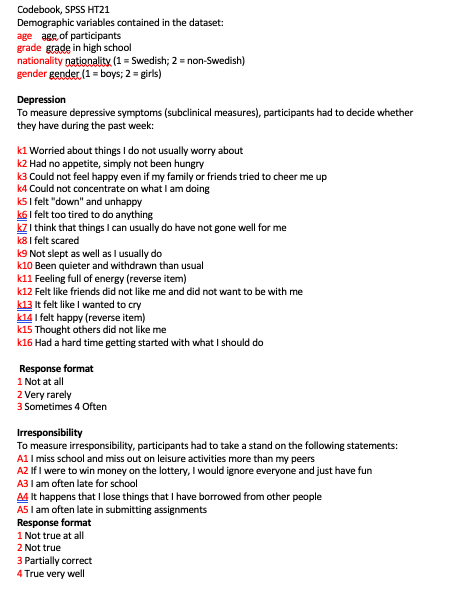
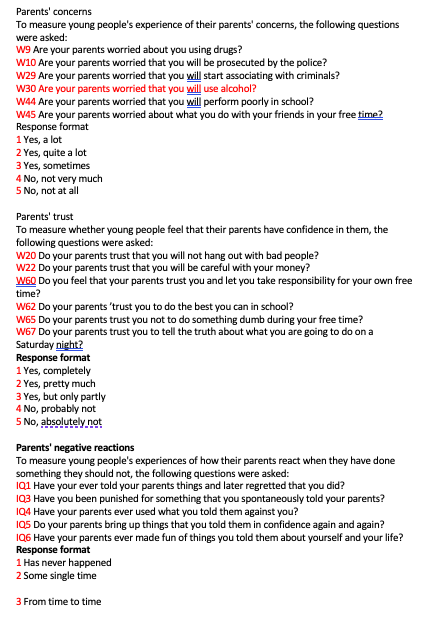
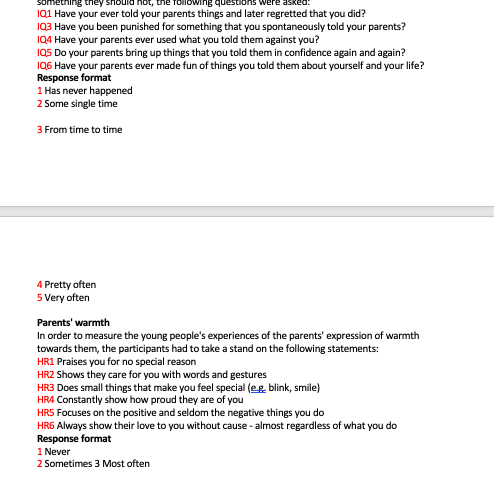
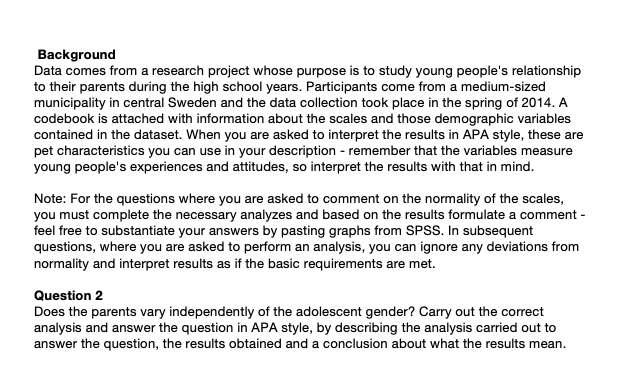
Background Data comes from a research project whose purpose is to study young people's relationship to their parents during the high school years. Participants come from a medium-sized municipality in central Sweden and the data collection took place in the spring of 2014. A codebook is attached with information about the scales and those demographic variables contained in the dataset. When you are asked to interpret the results in APA style, these are pet characteristics you can use in your description - remember that the variables measure young people's experiences and attitudes, so interpret the results with that in mind. Note: For the questions where you are asked to comment on the normality of the scales, you must complete the necessary analyzes and based on the results formulate a comment- feel free to substantiate your answers by pasting graphs from SPSS. In subsequent questions, where you are asked to perform an analysis, you can ignore any deviations from normality and interpret results as if the basic requirements are met. Question 2 Does the parents vary independently of the adolescent gender? Carry out the correct analysis and answer the question in APA style, by describing the analysis carried out to answer the question, the results obtained and a conclusion about what the results mean. Codebook, SPSS HT21 Demographic variables contained in the dataset: age age of participants grade grade in high school nationality nationality. (1 = Swedish; 2 = non-Swedish) gender gender (1 = boys; 2 = girls) Depression To measure depressive symptoms (subclinical measures), participants had to decide whether they have during the past week: ki Worried about things I do not usually worry about k2 Had no appetite, simply not been hungry k3 Could not feel happy even if my family or friends tried to cheer me up k4 Could not concentrate on what I am doing k5 i felt "down" and unhappy kg I felt too tired to do anything kZ I think that things I can usually do have not gone well for me k8 I felt scared k9 Not slept as well as I usually do k10 Been quieter and withdrawn than usual k11 Feeling full of energy (reverse item) k12 Felt like friends did not like me and did not want to be with me k13 It felt like I wanted to cry k14 I felt happy (reverse item) k15 Thought others did not like me k16 Had a hard time getting started with what I should do Response format 1 Not at all 2 Very rarely 3 Sometimes 4 Often Irresponsibility To measure irresponsibility, participants had to take a stand on the following statements: A1 I miss school and miss out on leisure activities more than my peers A2 If I were to win money on the lottery, I would ignore everyone and just have fun A3 I am often late for school A4 it happens that I lose things that I have borrowed from other people As I am often late in submitting assignments Response format 1 Not true at all 2 Not true 3 Partially correct 4 True very well Parents' concerns To measure young people's experience of their parents' concerns, the following questions were asked: W9 Are your parents worried about you using drugs? W10 Are your parents worried that you will be prosecuted by the police? W29 Are your parents worried that you will start associating with criminals? W30 Are your parents worried that you will use alcohol? W44 Are your parents worried that you will perform poorly in school? W45 Are your parents worried about what you do with your friends in your free time? Response format 1 Yes, a lot 2 Yes, quite a lot 3 Yes, sometimes 4 No, not very much 5 No, not at all Parents' trust To measure whether young people feel that their parents have confidence in them, the following questions were asked: W20 Do your parents trust that you will not hang out with bad people? W22 Do your parents trust that you will be careful with your money? W60 Do you feel that your parents trust you and let you take responsibility for your own free time? W62 Do your parents 'trust you to do the best you can in school? W65 Do your parents trust you not to do something dumb during your free time? W67 Do your parents trust you to tell the truth about what you are going to do on a Saturday night? Response format 1 Yes, completely 2 Yes, pretty much 3 Yes, but only partly 4 No, probably not 5 No, absolutely not Parents' negative reactions To measure young people's experiences of how their parents react when they have done something they should not, the following questions were asked: 101 Have your ever told your parents things and later regretted that you did? 103 Have you been punished for something that you spontaneously told your parents? 104 Have your parents ever used what you told them against you? 105 Do your parents bring up things that you told them in confidence again and again? 106 Have your parents ever made fun of things you told them about yourself and your life? Response format 1 Has never happened 2 Some single time 3 From time to time not, the questions were 101 Have your ever told your parents things and later regretted that you did? 103 Have you been punished for something that you spontaneously told your parents? 104 Have your parents ever used what you told them against you? 195 Do your parents bring up things that you told them in confidence again and again? IQ6 Have your parents ever made fun of things you told them about yourself and your life? Response format 1 Has never happened 2 Some single time 3 From time to time 4 Pretty often 5 Very often Parents' warmth In order to measure the young people's experiences of the parents' expression of warmth towards them, the participants had to take a stand on the following statements: HR1 Praises you for no special reason HR2 Shows they care for you with words and gestures HR3 Does small things that make you feel special (eg blink, smile) HR4 Constantly show how proud they are of you HRS Focuses on the positive and seldom the negative things you do HR6 Always show their love to you without cause - almost regardless of what you do Response format 1 Never 2 Sometimes 3 Most often









 Study Help