







Question: this is the driver code #include int wbitadd(const unsigned char w, const unsigned long m, const unsigned long n, unsigned long *result); int main() {


int wbitadd(const unsigned char w, const unsigned long m,
const unsigned long n, unsigned long *result);
int main() {
unsigned char w = 11;
unsigned long m = 0xffff400;
unsigned long n = 0x400;
unsigned long sum;
int overflow;
overflow = !wbitadd(w,m,n,&sum);
printf("%d-bit 0x%lx + 0x%lx = 0x%lx ",w,m,n,sum);
if (overflow)
printf("(overflows)");
putchar(' ');
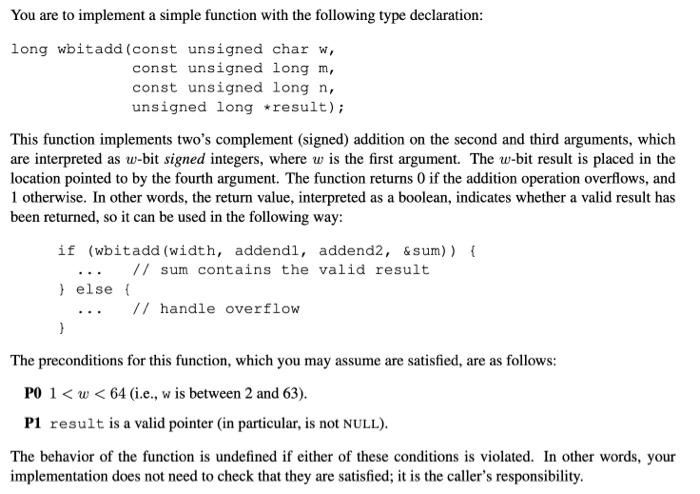
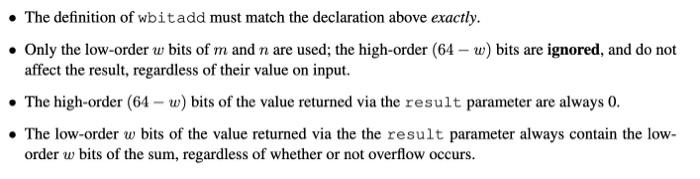
You are to implement a simple function with the following type declaration: long wbitadd (const unsigned char w, const unsigned long m, const unsigned long n, unsigned long *result); This function implements two's complement (signed) addition on the second and third arguments, which are interpreted as w-bit signed integers, where w is the first argument. The w-bit result is placed in the location pointed to by the fourth argument. The function returns 0 if the addition operation overflows, and 1 otherwise. In other words, the return value, interpreted as a boolean, indicates whether a valid result has been returned, so it can be used in the following way: if (wbitadd (width, addendi, addenda, &sum)) { // sum contains the valid result } else { // handle overflow ) The preconditions for this function, which you may assume are satisfied, are as follows: PO 1
Step by Step Solution
There are 3 Steps involved in it

Get step-by-step solutions from verified subject matter experts
 Study Help