







Question: This is the equation you will use ( ) = / ENUMERATION OF MICROORGANISMS Worksheet to include in notebook As part of daily routine, the
-
()=/
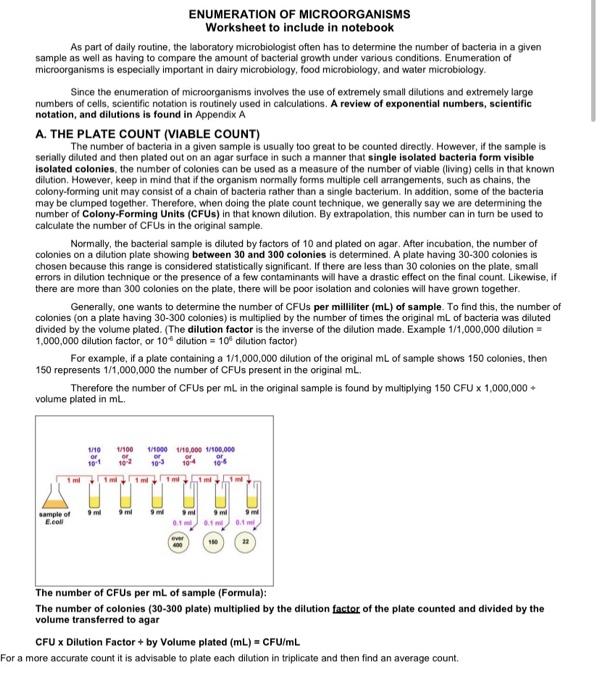
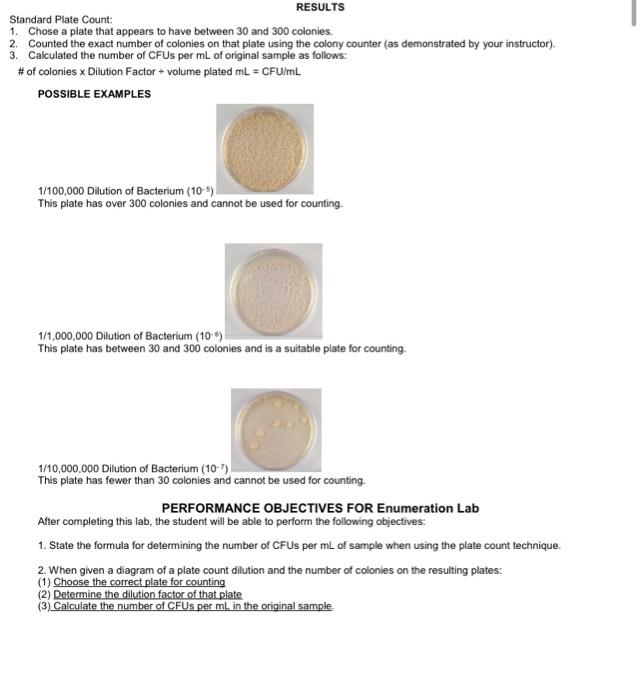
ENUMERATION OF MICROORGANISMS Worksheet to include in notebook As part of daily routine, the laboratory microbiologist often has to determine the number of bacteria in a given sample as well as having to compare the amount of bacterial growth under various conditions. Enumeration of microorganisms is especially important in dairy microbiology, food microbiology, and water microbiology Since the enumeration of microorganisms involves the use of extremely small dilutions and extremely large numbers of cells, scientific notation is routinely used in calculations. A review of exponential numbers, scientific notation, and dilutions is found in Appendix A A. THE PLATE COUNT (VIABLE COUNT) The number of bacteria in a given sample is usually too great to be counted directly. However, if the sample is serially diluted and then plated out on an agar surface in such a manner that single isolated bacteria form visible Isolated colonies, the number of colonies can be used as a measure of the number of viable (living) cells in that known dilution. However, keep in mind that if the organism normally forms multiple cell arrangements, such as chains, the colony-forming unit may consist of a chain of bacteria rather than a single bacterium. In addition, some of the bacteria may be clumped together. Therefore, when doing the plate count technique, we generally say we are determining the number of Colony-Forming Units (CFU) in that known dilution. By extrapolation, this number can in turn be used to calculate the number of CFUs in the original sample. Normally, the bacterial sample is diluted by factors of 10 and plated on agar. After incubation, the number of colonies on a dilution plate showing between 30 and 300 colonies is determined. A plate having 30-300 colonies is chosen because this range is considered statistically significant. If there are less than 30 colonies on the plate, small errors in dilution technique or the presence of a few contaminants will have a drastic effect on the final count. Likewise, if there are more than 300 colonies on the plate, there will be poor isolation and colonies will have grown together. Generally, one wants to determine the number of CFUs per milliliter (mL) of sample. To find this, the number of colonies (on a plate having 30-300 colonies) is multiplied by the number of times the original mL of bacteria was diluted divided by the volume plated. (The dilution factor is the inverse of the dilution made. Example 1/1,000,000 dilution = 1,000,000 dilution factor, or 10 dilution = 10% dilution factor) For example, if a plate containing a 1/1,000,000 dilution of the original mL of sample shows 150 colonies, then 150 represents 1/1,000,000 the number of CFUs present in the original mL. Therefore the number of CFUs per mL in the original sample is found by multiplying 150 CFU x 1,000,000 volume plated in mL. 1110 or 10-1 1100 103 1/1000 110.000 1/100.000 10-3 10-4 10-6 1 ml 11 1 mi 9 sample of E.coli 01 0.1 0. 150 22 The number of CFUs per mL of sample (Formula): The number of colonies (30-300 plate) multiplied by the dilution factor of the plate counted and divided by the volume transferred to agar CFU x Dilution Factor + by Volume plated (mL) - CFU/ mL For a more accurate count it is advisable to plate each dilution in triplicate and then find an average count. RESULTS Standard Plate Count: 1. Chose a plate that appears to have between 30 and 300 colonies. 2. Counted the exact number of colonies on that plate using the colony counter (as demonstrated by your instructor). 3. Calculated the number of CFUs per mL of original sample as follows: # of colonies Dilution Factor + volume plated mL = CFU/mL POSSIBLE EXAMPLES 1/100,000 Dilution of Bacterium (105) This plate has over 300 colonies and cannot be used for counting. 1/1,000,000 Dilution of Bacterium (10) This plate has between 30 and 300 colonies and is a suitable plate for counting. 1/10,000,000 Dilution of Bacterium (10) This plate has fewer than 30 colonies and cannot be used for counting PERFORMANCE OBJECTIVES FOR Enumeration Lab After completing this lab, the student will be able to perform the following objectives: 1. State the formula for determining the number of CFUS per mL of sample when using the plate count technique. 2. When given a diagram of a plate count dilution and the number of colonies on the resulting plates: (1) Choose the correct plate for counting (2) Determine the dilution factor of that plate (3) Calculate the number of CFUs per ml in the original sample
Step by Step Solution
There are 3 Steps involved in it

Get step-by-step solutions from verified subject matter experts
 Study Help