







Question: This is the full question given! In this question you will be examining how changes in the underlying model will affect the optimal monetary policy
 This is the full question given!
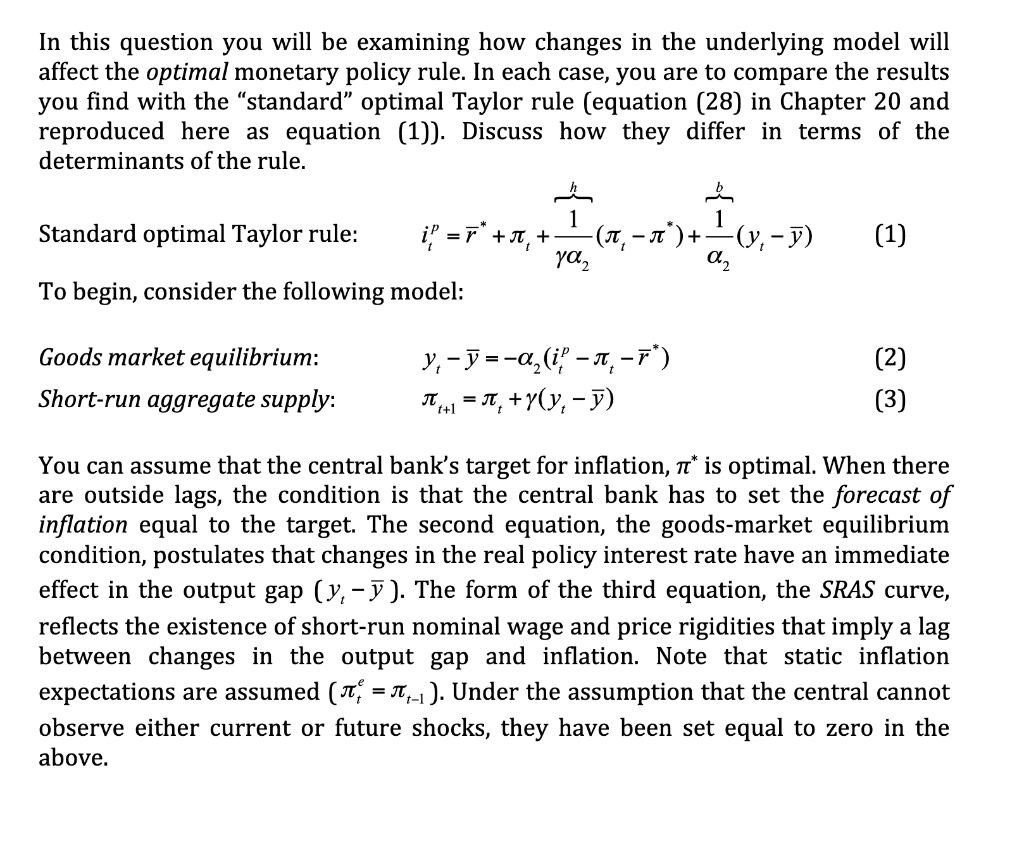
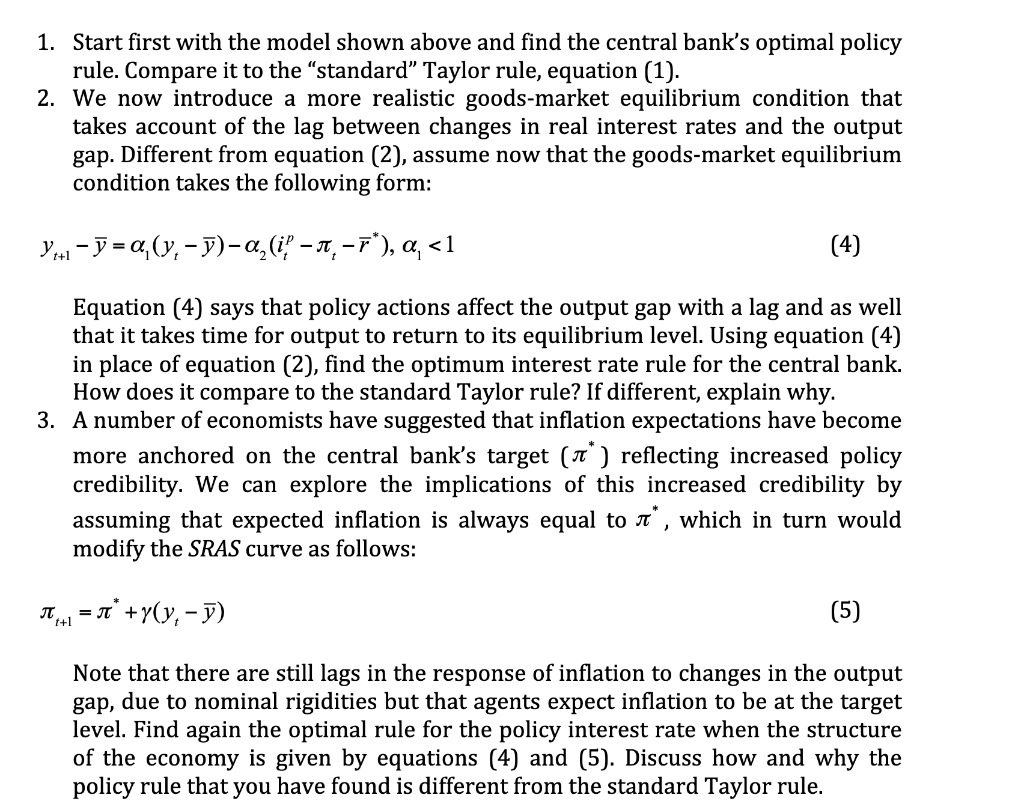
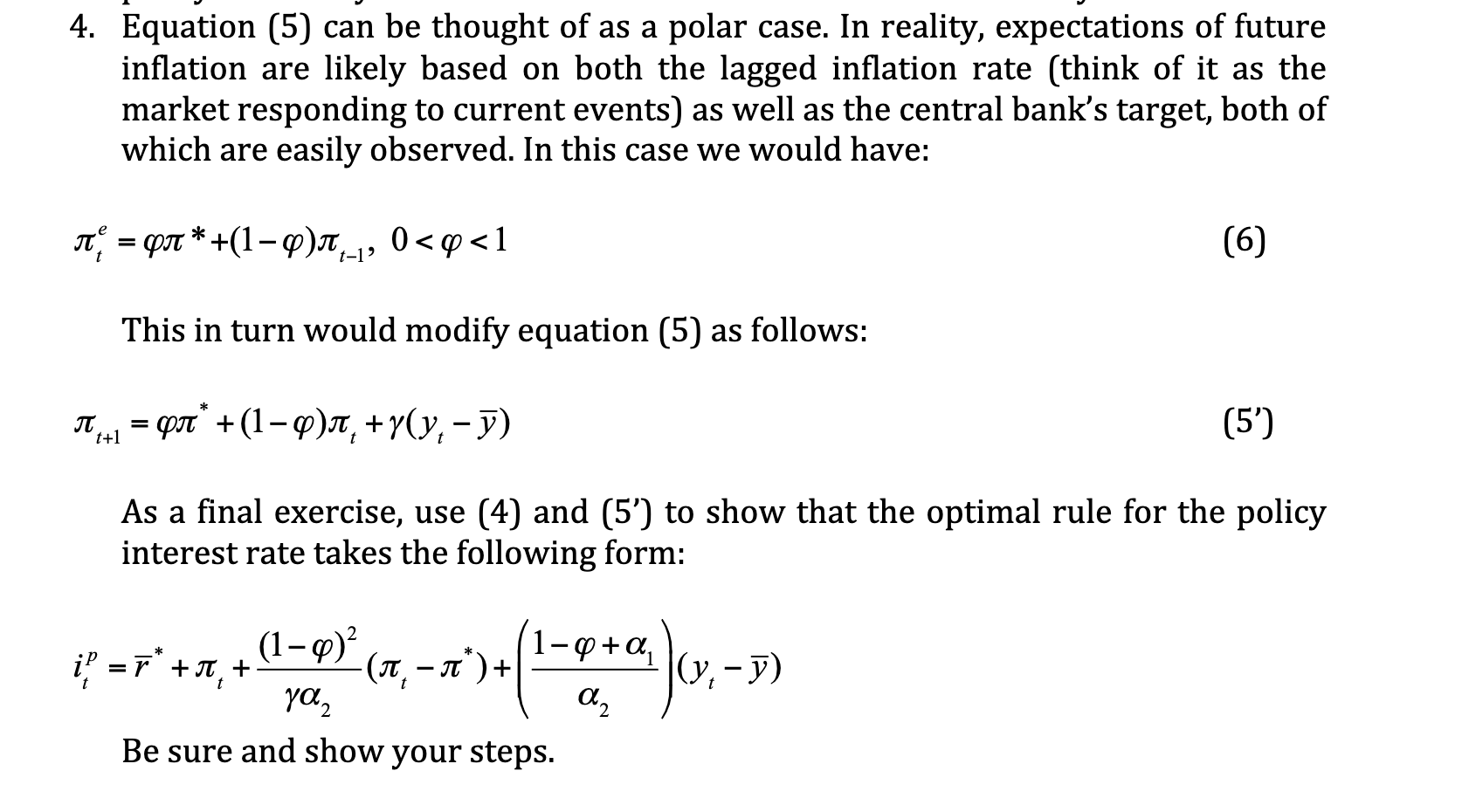
In this question you will be examining how changes in the underlying model will affect the optimal monetary policy rule. In each case, you are to compare the results you find with the standard optimal Taylor rule (equation (28) in Chapter 20 and reproduced here as equation (1)). Discuss how they differ in terms of the determinants of the rule. 1 (1) Standard optimal Taylor rule: i-1* +,+ -(TT, - *)+(,-5) , am To begin, consider the following model: Goods market equilibrium: Short-run aggregate supply: y, - ]=-a,(i! , -7*) J+1 = 1, +Y(y, -5) (2) (3) You can assume that the central bank's target for inflation, r* is optimal. When there are outside lags, the condition is that the central bank has to set the forecast of inflation equal to the target. The second equation, the goods-market equilibrium condition, postulates that changes in the real policy interest rate have an immediate effect in the output gap (y, -y). The form of the third equation, the SRAS curve, reflects the existence of short-run nominal wage and price rigidities that imply a lag between changes in the output gap and inflation. Note that static inflation expectations are assumed (vt = 1,-1). Under the assumption that the central cannot observe either current or future shocks, they have been set equal to zero in the above. 1. Start first with the model shown above and find the central bank's optimal policy rule. Compare it to the "standard Taylor rule, equation (1). 2. We now introduce a more realistic goods-market equilibrium condition that takes account of the lag between changes in real interest rates and the output gap. Different from equation (2), assume now that the goods-market equilibrium condition takes the following form: Yit1 - ] = a,(y, -7)-a, (i! , - "), a,
Step by Step Solution
There are 3 Steps involved in it

Get step-by-step solutions from verified subject matter experts
 Study Help