







Question: This is the problem for a bead on a rotating hoop. Please solve and explain the Question 2 b) and Question 3. There is no
This is the problem for a bead on a rotating hoop. Please solve and explain the Question 2 b) and Question 3. There is no missing information. Question 1 is about when sin_theta is 0 and pi, the system has an equilibrium point. Question 2 is about when cos_theta term is 0, pi, and a^2/?^2, the system has an equilibrium point.
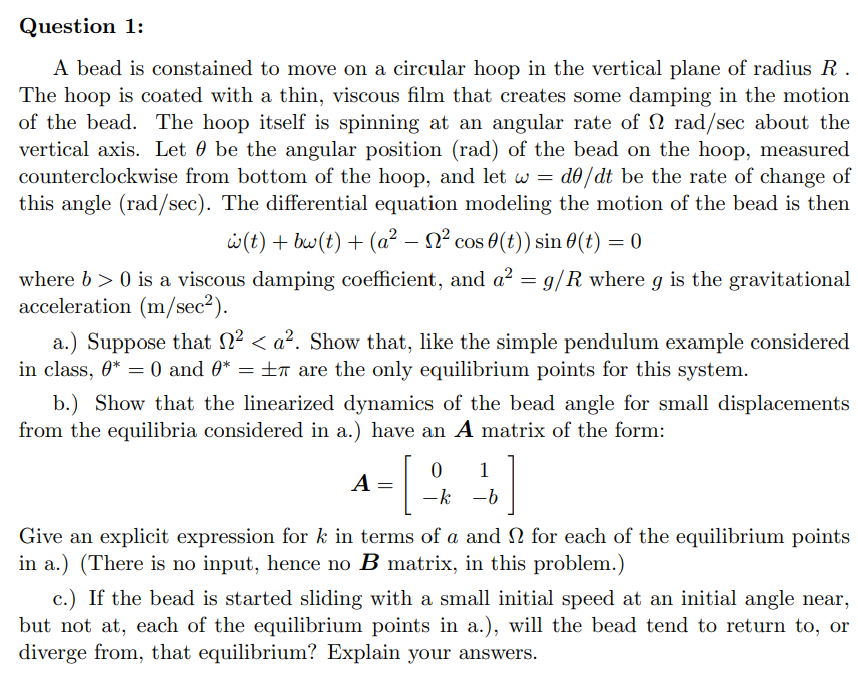
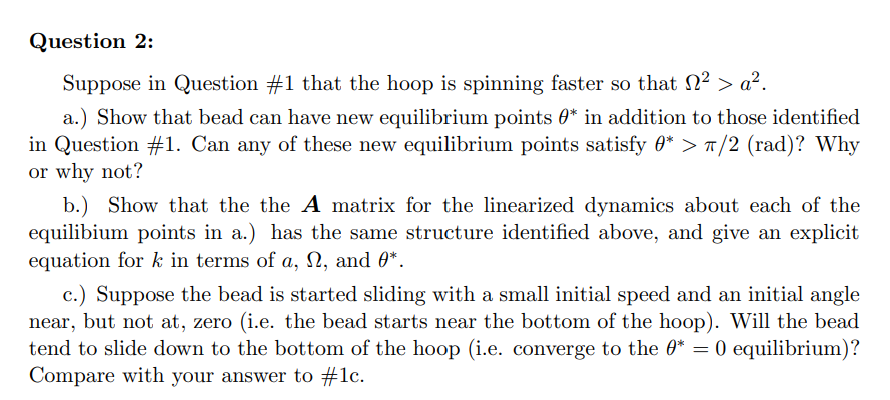
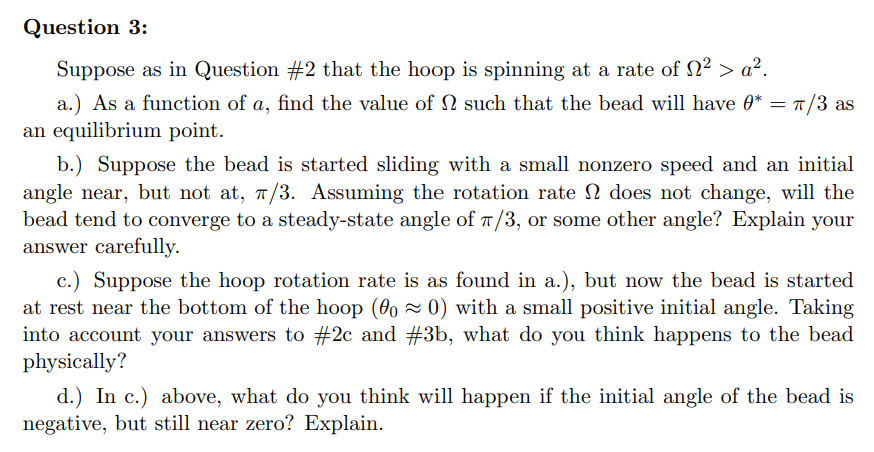
Question 1: A bead is constained to move on a circular hoop in the vertical plane of radius R . The hoop is coated with a thin7 viscous lm that creates some damping in the motion of the bead. The hoop itself is spinning at an angular rate of S! rad/sec about the vertical axis. Let 6 be the angular position (rad) of the bead on the hoop, measured counterclockwise from bottom of the hoop, and let to : dG/dt be the rate of change of this angle (rad/ sec). The differential equation modeling the motion of the bead is then DU) + mm) + (a2 92 cos t)(.t)) sin) : 0 where b > 0 is a viscous damping coefficient1 and a2 : g/R where g is the gravitational acceleration (m/secz). a.) Suppose that [22 12. a.) Show that bead can have new equilibrium points 9'\" in addition to those identied in Question #1. Can any of these new equilibrium points satisfy 9* > 17/2 (rad)? Why or why not'.J b.) Show that the the A matrix for the linearized dynamics about each of the equilibium points in a.) has the same structure identified above, and give an explicit equation for k in terms of a, Q, and 6"\". (3.) Suppose the head is started sliding with a small initial speed and an initial angle near, but not at, zero (i.e. the bead starts near the bottom of the hoop). Will the bead tend to slide down to the bottom of the hoop (i.e. converge to the 6" : O equilibrium)? Compare with your answer to #1c. Question 3: Suppose as in Question #2 that the hoop is spinning at a rate of 02 > (12. a.) As a function of (1, nd the value of S] such that the bead will have 9* = 7r/3 as an equilibrium point. b.) Suppose the head is started sliding with a small nonzero speed and an initial angle near, but not at, 7r/3. Assuming the rotation rate 52 does not change, will the bead tend to converge to a steady-state angle of \"tr/3, or some other angle? Explain your answer carefully. (3.) Suppose the hoop rotation rate is as found in a.)I but now the bead is started at rest near the bottom of the hoop (6'0 \"5 U) with a small positive initial angle. Taking into account your answers to #2c and #3b, what do you think happens to the bead physically? d.) In (3.) above, what do you think will happen if the initial angle of the bead is negative, but still near zero? Explain
Step by Step Solution
There are 3 Steps involved in it

Get step-by-step solutions from verified subject matter experts
 Study Help