







Question: This is the process of converting a wrapper class object to a primitive type. A) simplifying B) unboxing C) parsing d) devaluating What does the
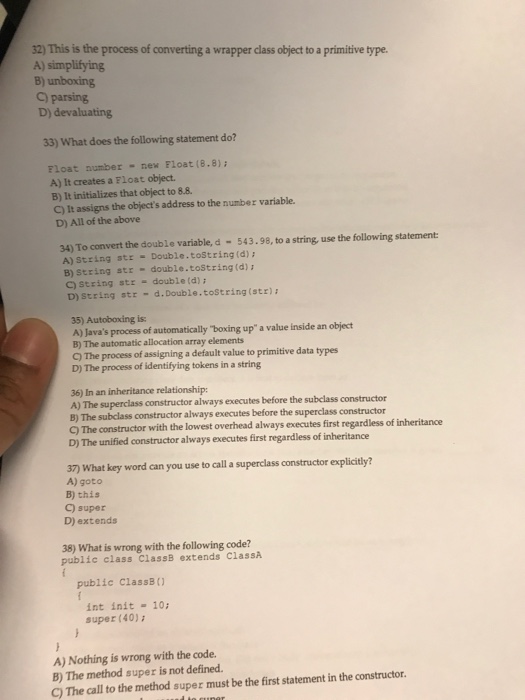
This is the process of converting a wrapper class object to a primitive type. A) simplifying B) unboxing C) parsing d) devaluating What does the following statement do? Float number = new Float(8, 8); A) It creates a Float object. B) It initializes that object to 8.8. C) It assigns the object's address to the number variable. D) All of the above To convert the double variable, d = 543.98, to a string, use the following statement: A) String str = Double.toString(d); B)String str = double.toString(d); C) String str = double(d); D)String str = d.Double.toString(str); Autoboxing is: A) Java's process of automatically "boxing up" a value inside an object B) The automatic allocation array elements C) The process of assigning a default value to primitive data types D) The process of identifying tokens in a string In an inheritance relationship: A) The superclass constructor always executes before the subclass constructor B) The subclass constructor always executes before the superclass constructor C) The constructor with the lowest overhead always executes first regardless of inheritance D) The unified constructor always executes first regardless of inheritance What key word can you use to call a superclass constructor explicitly? A) goto B) this C) super D) extends What is wrong with the following code? public class ClassB extends ClassA {public ClassB() {int init = 10; super(40);}} A) Nothing is wrong with the code. B) The method super is not defined. C) The all to the method super must be the first statement in the constructor
Step by Step Solution
There are 3 Steps involved in it

Get step-by-step solutions from verified subject matter experts
 Study Help