







Question: This is the second time I ask this question, but I still dont understand the second part of this problem. This first half I've figured
This is the second time I ask this question, but I still dont understand the second part of this problem. This first half I've figured out as well as part a of the second problem, but every solution I've seen or received doesnt explain how they got a value. Im trying to figure this out but almost every solution has a different way of solving which is even more confusing. If someone could please help me understand the second part of this problem and include your working notes so I understand how you were able to get to a certain value I would deeply appreciate it Cantel Company produces cleaning compounds for both commercial and household customers. Some of these products are produced
as part of a joint manufacturing process. For example, GR a coarse cleaning powder meant for commercial sale, costs $ a
pound to make and sells for $ per pound. A portion of the annual production of GR is retained for further processing in a
separate department where it is combined with several other ingredients to form SilPol, which is sold as a silver polish, at $ per
unit. The additional processing requires pound of GR per unit; additional processing costs amount to $ per unit of SilPol
produced. Variable selling costs for SilPol average $ per unit. If production of SilPol were discontinued, $ of costs in the
processing department would be avoided. Cantel has, at this point, unlimited demand for, but limited capacity to produce, product
GR
Required:
Calculate the minimum number of units of SilPol that would have to be sold in order to justify further processing of GR
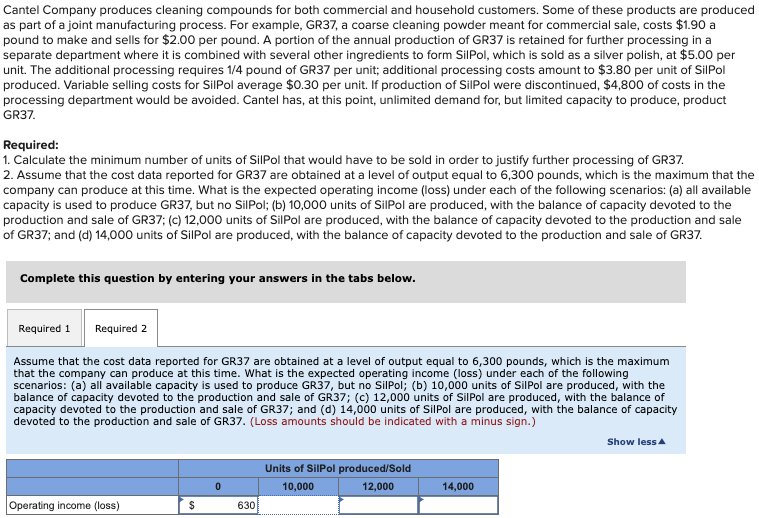
Assume that the cost data reported for GR are obtained at a level of output equal to pounds, which is the maximum that the
company can produce at this time. What is the expected operating income loss under each of the following scenarios: a all available
capacity is used to produce GR but no SilPol; b units of SilPol are produced, with the balance of capacity devoted to the
production and sale of GR; c units of SilPol are produced, with the balance of capacity devoted to the production and sale
of GR; and d units of SilPol are produced, with the balance of capacity devoted to the production and sale of GR
Complete this question by entering your answers in the tabs below.
Assume that the cost data reported for GR are obtained at a level of output equal to pounds, which is the maximum
that the company can produce at this time. What is the expected operating income loss under each of the following
scenarios: a all available capacity is used to produce GR but no SilPol; b units of SilPol are produced, with the
balance of capacity devoted to the production and sale of GR; c units of SilPol are produced, with the balance of
capacity devoted to the production and sale of GR; and d units of SilPol are produced, with the balance of capacity
devoted to the production and sale of GRLoss amounts should be indicated with a minus sign.
Step by Step Solution
There are 3 Steps involved in it
1 Expert Approved Answer
Step: 1 Unlock

Question Has Been Solved by an Expert!
Get step-by-step solutions from verified subject matter experts
Step: 2 Unlock
Step: 3 Unlock
 Study Help