







Question: This is the starter script: # household trash # libraries library(tidyverse) library(MASS) # trash sample trash APPLIED STATISTICS ANALYSIS: HOUSEHOLD TRASH ABSTRACT. Use Box-Cox transformations
This is the starter script:
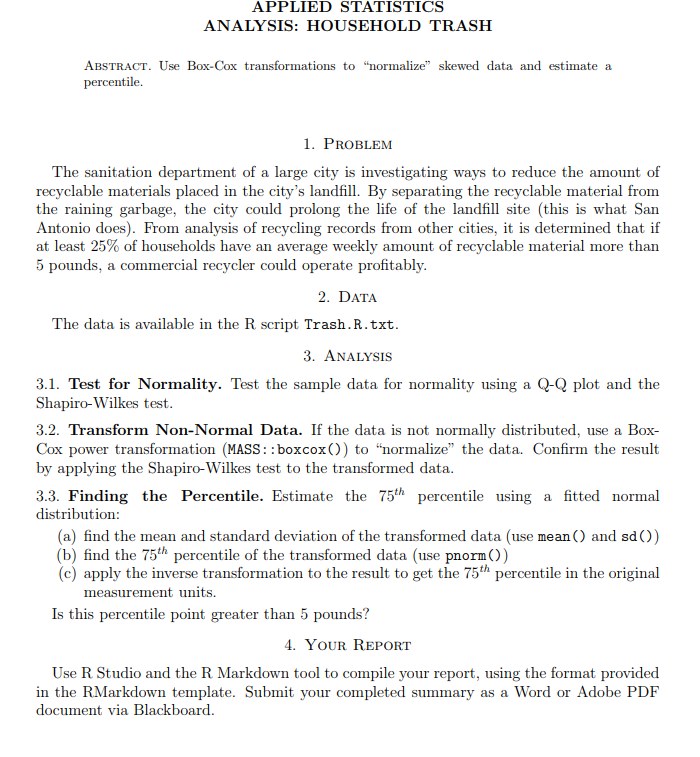
# household trash # libraries library(tidyverse) library(MASS) # trash sample trash APPLIED STATISTICS ANALYSIS: HOUSEHOLD TRASH ABSTRACT. Use Box-Cox transformations to "normalize" skewed data and estimate a percentile 1. PROBLEM The sanitation department of a large city is investigating ways to reduce the amount of recyclable materials placed in the city's landfill. By separating the recyclable material from the raining garbage, the city could prolong the life of the landfill site (this is what San Antonio does). From analysis of recycling records from other cities, it is determined that if at least 25% of households have an average weekly amount of recyclable material more than 5 pounds, a commercial recy cler could operate profitably 2. DATA The data is available in the R script Trash.R.txt 3. ANALYSIS 3.1. Test for Normality. Test the sample data for normality using a Q-Q plot and the Shapiro-Wilkes test 3.2. Transform Non-Normal Data. If the data is not normally distributed, use a Box Cox power transformation (MASS: :boxcox)) to "normalize" the data. Confirm the result by applying the Shapiro-Wilkes test to the transformed data 3.3. Finding the Percentile. Estimate the 75th percentile using a fitted normal distribution: (a) find the mean and standard deviation of the transformed data (use mean () and sdO) (b) find the 75th percentile of the transformed data (use pnorm)) (c) apply the inverse transformation to the result to get the 75th percentile in the original measurement units. Is this percentile point greater than 5 pounds? 4. YOUR REPORT Use R Studio and the R Markdown tool to compile your report, using the format provided in the RMarkdown template. Submit your completed summary as a Word or Adobe PDF document via Blackboard. APPLIED STATISTICS ANALYSIS: HOUSEHOLD TRASH ABSTRACT. Use Box-Cox transformations to "normalize" skewed data and estimate a percentile 1. PROBLEM The sanitation department of a large city is investigating ways to reduce the amount of recyclable materials placed in the city's landfill. By separating the recyclable material from the raining garbage, the city could prolong the life of the landfill site (this is what San Antonio does). From analysis of recycling records from other cities, it is determined that if at least 25% of households have an average weekly amount of recyclable material more than 5 pounds, a commercial recy cler could operate profitably 2. DATA The data is available in the R script Trash.R.txt 3. ANALYSIS 3.1. Test for Normality. Test the sample data for normality using a Q-Q plot and the Shapiro-Wilkes test 3.2. Transform Non-Normal Data. If the data is not normally distributed, use a Box Cox power transformation (MASS: :boxcox)) to "normalize" the data. Confirm the result by applying the Shapiro-Wilkes test to the transformed data 3.3. Finding the Percentile. Estimate the 75th percentile using a fitted normal distribution: (a) find the mean and standard deviation of the transformed data (use mean () and sdO) (b) find the 75th percentile of the transformed data (use pnorm)) (c) apply the inverse transformation to the result to get the 75th percentile in the original measurement units. Is this percentile point greater than 5 pounds? 4. YOUR REPORT Use R Studio and the R Markdown tool to compile your report, using the format provided in the RMarkdown template. Submit your completed summary as a Word or Adobe PDF document via Blackboard
Step by Step Solution
There are 3 Steps involved in it
1 Expert Approved Answer
Step: 1 Unlock

Question Has Been Solved by an Expert!
Get step-by-step solutions from verified subject matter experts
Step: 2 Unlock
Step: 3 Unlock
 Study Help