







Question: This problem asks you to numerically calculate Delta and Gamma for the Asian put option in Problem 1. All parametric settings are the same as
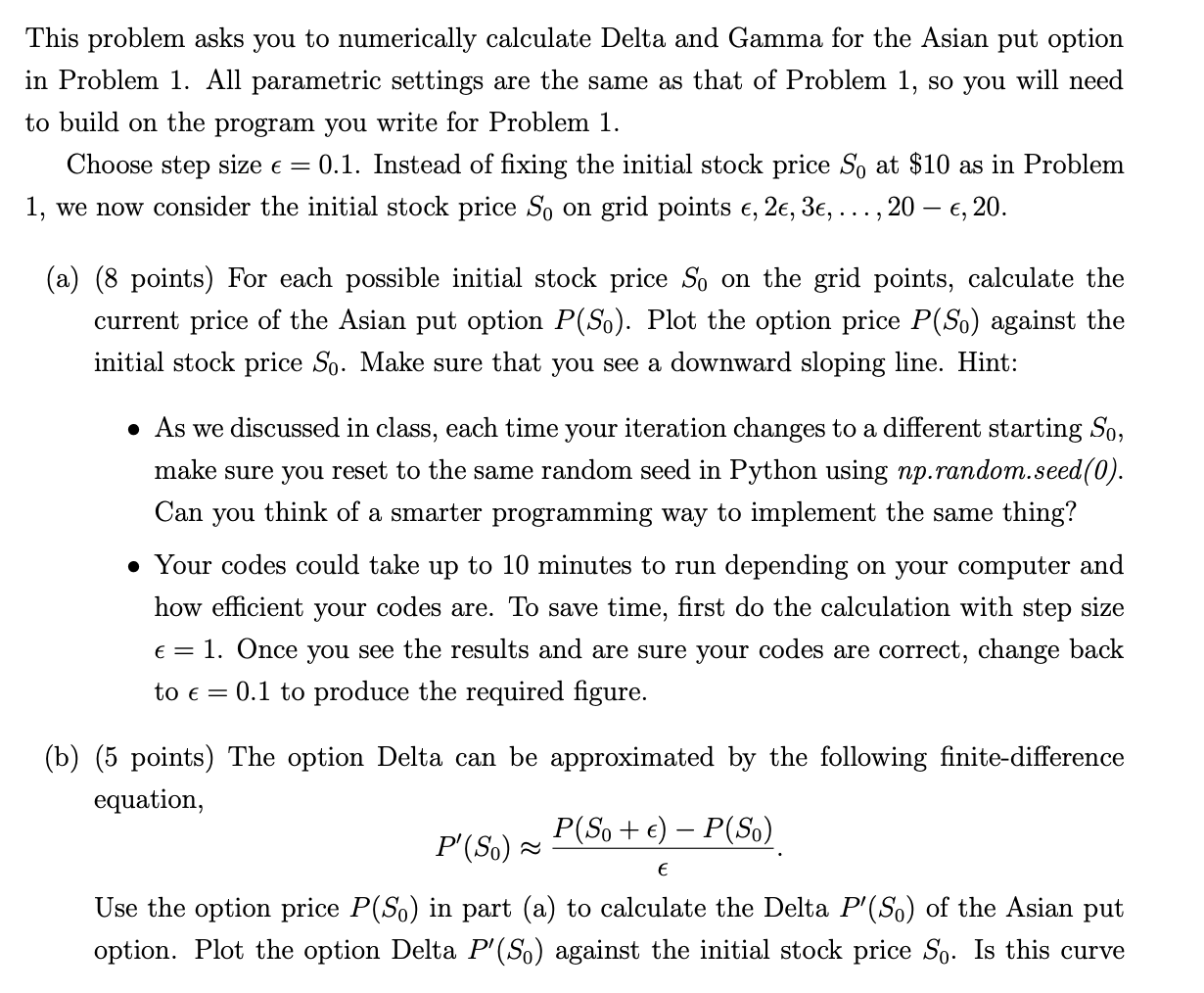
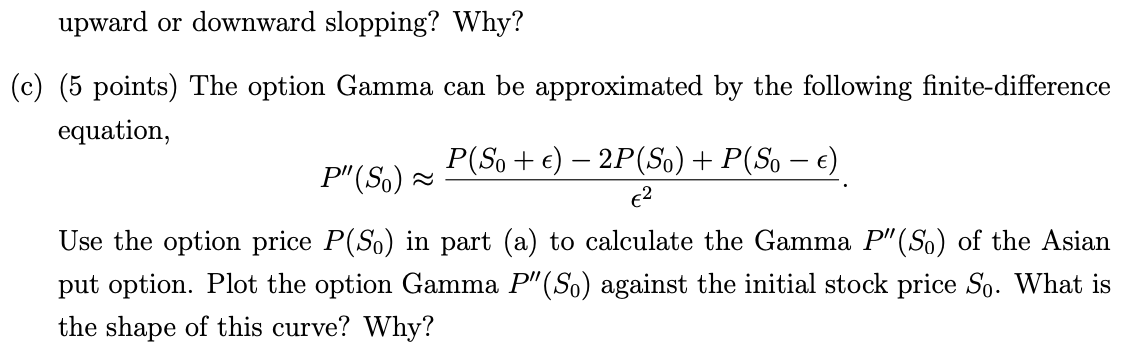
This problem asks you to numerically calculate Delta and Gamma for the Asian put option in Problem 1. All parametric settings are the same as that of Problem 1, so you will need to build on the program you write for Problem 1. Choose step size =0.1. Instead of fixing the initial stock price S0 at $10 as in Problem 1 , we now consider the initial stock price S0 on grid points ,2,3,,20,20. (a) (8 points) For each possible initial stock price S0 on the grid points, calculate the current price of the Asian put option P(S0). Plot the option price P(S0) against the initial stock price S0. Make sure that you see a downward sloping line. Hint: - As we discussed in class, each time your iteration changes to a different starting S0, make sure you reset to the same random seed in Python using np.random.seed(0). Can you think of a smarter programming way to implement the same thing? - Your codes could take up to 10 minutes to run depending on your computer and how efficient your codes are. To save time, first do the calculation with step size =1. Once you see the results and are sure your codes are correct, change back to =0.1 to produce the required figure. (b) (5 points) The option Delta can be approximated by the following finite-difference equation, P(S0)P(S0+)P(S0) Use the option price P(S0) in part (a) to calculate the Delta P(S0) of the Asian put option. Plot the option Delta P(S0) against the initial stock price S0. Is this curve upward or downward slopping? Why? (c) (5 points) The option Gamma can be approximated by the following finite-difference equation, P(S0)2P(S0+)2P(S0)+P(S0). Use the option price P(S0) in part (a) to calculate the Gamma P(S0) of the Asian put option. Plot the option Gamma P(S0) against the initial stock price S0. What is the shape of this curve? Why
Step by Step Solution
There are 3 Steps involved in it

Get step-by-step solutions from verified subject matter experts
 Study Help