







Question: This problem builds on your tutorial problem for week 6. Let G graph with n 2 2 nodes and m weighted edges. Let wt(e) denote
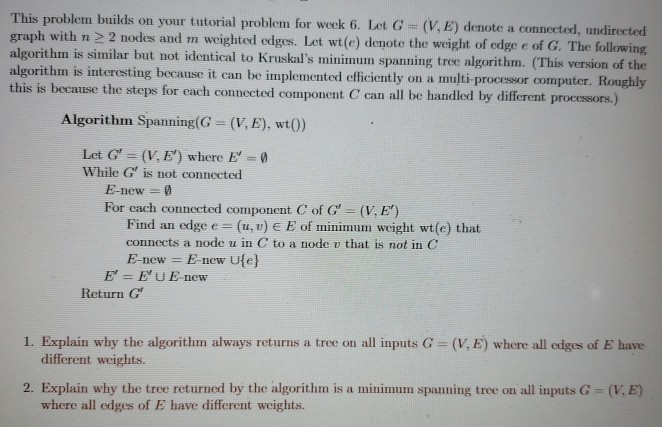
This problem builds on your tutorial problem for week 6. Let G graph with n 2 2 nodes and m weighted edges. Let wt(e) denote the weight of edge e of G. The following algorithm is interesting because it can be implemented efficiently on a multi-processor this is because the steps for each connected component C can all be handled by different processors.) (V,E) denote a connected, undirected ilar but not identical to Kruskal's minimum spanning tree algorithm. (This version of the computer. Roughly Algorithm Spanning(G (V, E), wt0) Let G, (V, E") where E While G is not connected E-new For each connected component C of G, (KE) Find an edge e (u, v) E E of minimum weight wt(e) that connects a node u in C to a node v that is not in C E-new E-new Ufe) E-EU E new Return G I. Explain why the algorithm always returns a tree on all inputs G = (V, E) where all edges of E have different weights. 2. Explain why the tree returned by the algorithm is a minimum spanning tree on all inputs G-(V. E) where all edges of E have different weights
Step by Step Solution
There are 3 Steps involved in it

Get step-by-step solutions from verified subject matter experts
 Study Help