







Question: 1. Let G = (V. E) be directed graph. Each node v E V is given a color from {0, 1, 2, ..., k}; let
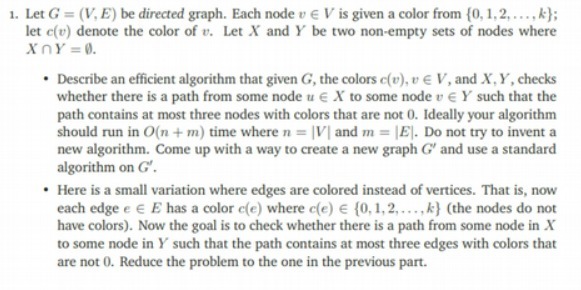
1. Let G = (V. E) be directed graph. Each node v E V is given a color from {0, 1, 2, ..., k}; let c(v) denote the color of v. Let X and Y be two non-empty sets of nodes where Xny =0. . Describe an efficient algorithm that given G, the colors c(v), v e V, and X, Y, checks whether there is a path from some node u E X to some node v E Y such that the path contains at most three nodes with colors that are not 0. Ideally your algorithm should run in O(n + m) time where n = [V| and m = |E). Do not try to invent a new algorithm. Come up with a way to create a new graph G' and use a standard algorithm on G'. . Here is a small variation where edges are colored instead of vertices. That is, now each edge e E E has a color c(e) where c(e) E {0, 1, 2,...,k} (the nodes do not have colors). Now the goal is to check whether there is a path from some node in X to some node in Y such that the path contains at most three edges with colors that are not 0. Reduce the problem to the one in the previous part
Step by Step Solution
There are 3 Steps involved in it

Get step-by-step solutions from verified subject matter experts
 Study Help