







Question: This problem concerns the Arithmetic Hierarchy. which is at the top of the World-of-Computability-and Culliplexity diagi alll. We say that a set of natu al
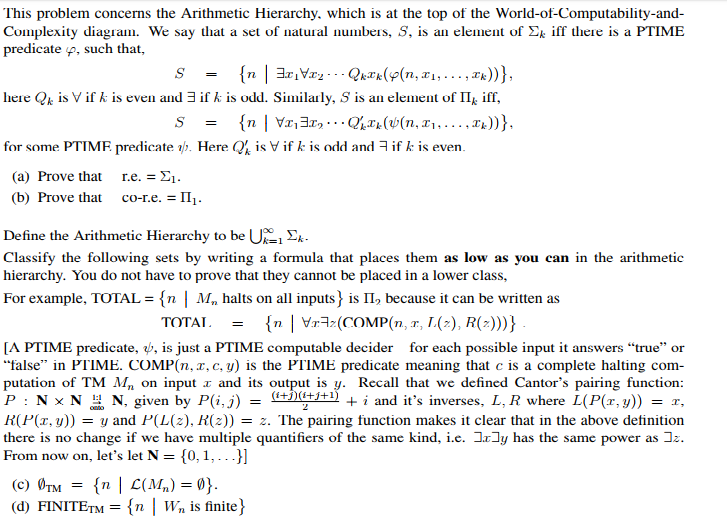
This problem concerns the Arithmetic Hierarchy. which is at the top of the World-of-Computability-and Culliplexity diagi alll. We say that a set of natu al lluillbes, S, is all eleillent of k iff theie is a PTIME predicate p, such that, heie Qk is V if k is even alld if k is odd. Sini laly, S is an element of 11k iff, for some PTIMF predicate . Here Q is Y if k is odd and if k: is even (a) Prove that (b) Prove that re co-re. =111 Define the Arithmetic Hierarchy to be U1 Classify the following sets by writing a formula that places them as low as you can in the arithmetic hierarchy. You do not have to prove that they cannot be placed in a lower class, For example, TOTAL nM, halts on all inputs is IT because it can be written as TOTAL {nlyAr(COMP(n. r..(-), R(-)))} = [A PTIME predicate, >, is just a PTIME computable decider for each possible input it answers "true" or "false" in PIME. COMP(n.x, c,y) is the PIIME predicate meaning that c is a complete halting com- putation of TM Mn on input x and its output is y. Recall that we defined Cantor's pairing function: P : N N N. given by P(i. j) = (+)('titl) i and it's inverses. L. R where L(Plr.u))-r. H(H(z, y)) y and P(L(z). H(z)) =The pairing function makes it clear that in the above definition there is no change if we have multiple quantifiers of the same kind, i.c. Jrly has the same power as Jz From now on, let's let N-{0, 1, . . . (d) FINITETM= {n | W, is finite} This problem concerns the Arithmetic Hierarchy. which is at the top of the World-of-Computability-and Culliplexity diagi alll. We say that a set of natu al lluillbes, S, is all eleillent of k iff theie is a PTIME predicate p, such that, heie Qk is V if k is even alld if k is odd. Sini laly, S is an element of 11k iff, for some PTIMF predicate . Here Q is Y if k is odd and if k: is even (a) Prove that (b) Prove that re co-re. =111 Define the Arithmetic Hierarchy to be U1 Classify the following sets by writing a formula that places them as low as you can in the arithmetic hierarchy. You do not have to prove that they cannot be placed in a lower class, For example, TOTAL nM, halts on all inputs is IT because it can be written as TOTAL {nlyAr(COMP(n. r..(-), R(-)))} = [A PTIME predicate, >, is just a PTIME computable decider for each possible input it answers "true" or "false" in PIME. COMP(n.x, c,y) is the PIIME predicate meaning that c is a complete halting com- putation of TM Mn on input x and its output is y. Recall that we defined Cantor's pairing function: P : N N N. given by P(i. j) = (+)('titl) i and it's inverses. L. R where L(Plr.u))-r. H(H(z, y)) y and P(L(z). H(z)) =The pairing function makes it clear that in the above definition there is no change if we have multiple quantifiers of the same kind, i.c. Jrly has the same power as Jz From now on, let's let N-{0, 1, . . . (d) FINITETM= {n | W, is finite}
Step by Step Solution
There are 3 Steps involved in it

Get step-by-step solutions from verified subject matter experts
 Study Help