



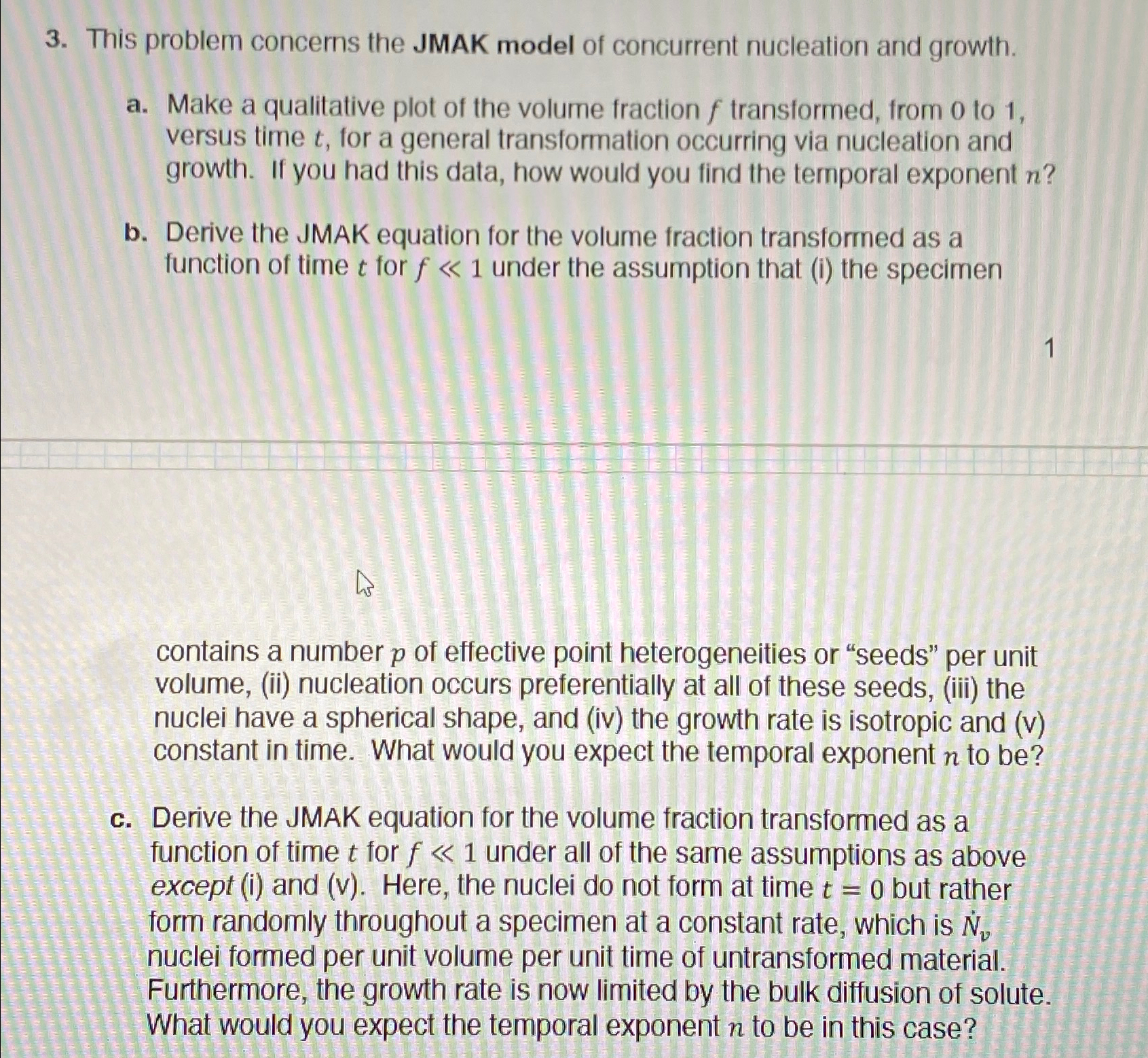
Question: This problem concerns the JMAK model of concurrent nucleation and growth. a . Make a qualitative plot of the volume fraction f transformed, from 0
This problem concerns the JMAK model of concurrent nucleation and growth.
a Make a qualitative plot of the volume fraction transformed, from to versus time for a general transformation occurring via nucleation and growth. If you had this data, how would you find the temporal exponent
b Derive the JMAK equation for the volume fraction transformed as a function of time for under the assumption that i the specimen
contains a number of effective point heterogeneities or "seeds" per unit volume, ii nucleation occurs preferentially at all of these seeds, iii the nuclei have a spherical shape, and iv the growth rate is isotropic and v constant in time. What would you expect the temporal exponent to be
c Derive the JMAK equation for the volume fraction transformed as a function of time for under all of the same assumptions as above except i and v Here, the nuclei do not form at time but rather form randomly throughout a specimen at a constant rate, which is nuclei formed per unit volume per unit time of untransformed material. Furthermore, the growth rate is now limited by the bulk diffusion of solute. What would you expect the temporal exponent to be in this case?
Step by Step Solution
There are 3 Steps involved in it
1 Expert Approved Answer
Step: 1 Unlock

Question Has Been Solved by an Expert!
Get step-by-step solutions from verified subject matter experts
Step: 2 Unlock
Step: 3 Unlock