







Question: This problem considers the estimation of parameters in linear models. Consider the linear model X X12 X22 06-30-0 which we may write more briefly
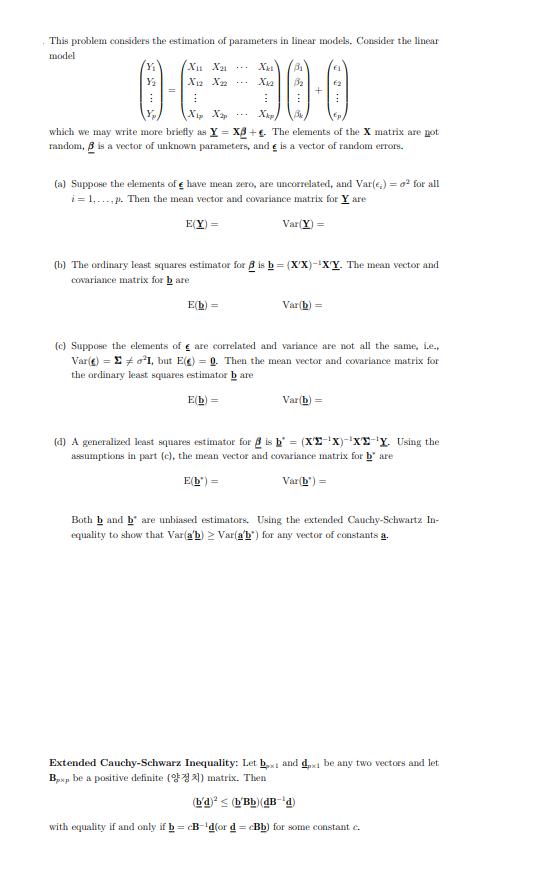
This problem considers the estimation of parameters in linear models. Consider the linear model X X12 X22 06-30-0 which we may write more briefly as Y = XB+. The elements of the X matrix are pot random, 3 is a vector of unknown parameters, and is a vector of random errors. (a) Suppose the elements of e have mean zero, are uncorrelated, and Var(e) = for all i = 1,..., p. Then the mean vector and covariance matrix for Y are E(Y) = Var(Y) = (b) The ordinary least squares estimator for B is b= (XX)-XY. The mean vector and covariance matrix for bare E(b) Var(b) = (c) Suppose the elements of e are correlated and variance are not all the same, i.e., Var(t) = I, but E() = 0. Then the mean vector and covariance matrix for the ordinary least squares estimator bare E(b) Var(b) = (d) A generalized least squares estimator for @ is b = (XE-X)-XE-Y. Using the assumptions in part (e), the mean vector and covariance matrix for bare E(b) = Var(b') = Both b and b' are unbiased estimators. Using the extended Cauchy-Schwartz In- equality to show that Var(a'b) Var(a'b') for any vector of constants a. Extended Cauchy-Schwarz Inequality: Let box and d be any two vectors and let Bax, be a positive definite (21) matrix. Then (b'd) b'Bb) (dB-d) with equality if and only if b=cB-d(or d=cBb) for some constant e. This problem considers the estimation of parameters in linear models. Consider the linear model X X12 X22 06-30-0 which we may write more briefly as Y = XB+. The elements of the X matrix are pot random, 3 is a vector of unknown parameters, and is a vector of random errors. (a) Suppose the elements of e have mean zero, are uncorrelated, and Var(e) = for all i = 1,..., p. Then the mean vector and covariance matrix for Y are E(Y) = Var(Y) = (b) The ordinary least squares estimator for B is b= (XX)-XY. The mean vector and covariance matrix for bare E(b) Var(b) = (c) Suppose the elements of e are correlated and variance are not all the same, i.e., Var(t) = I, but E() = 0. Then the mean vector and covariance matrix for the ordinary least squares estimator bare E(b) Var(b) = (d) A generalized least squares estimator for @ is b = (XE-X)-XE-Y. Using the assumptions in part (e), the mean vector and covariance matrix for bare E(b) = Var(b') = Both b and b' are unbiased estimators. Using the extended Cauchy-Schwartz In- equality to show that Var(a'b) Var(a'b') for any vector of constants a. Extended Cauchy-Schwarz Inequality: Let box and d be any two vectors and let Bax, be a positive definite (21) matrix. Then (b'd) b'Bb) (dB-d) with equality if and only if b=cB-d(or d=cBb) for some constant e. This problem considers the estimation of parameters in linear models. Consider the linear model X X12 X22 06-30-0 which we may write more briefly as Y = XB+. The elements of the X matrix are pot random, 3 is a vector of unknown parameters, and is a vector of random errors. (a) Suppose the elements of e have mean zero, are uncorrelated, and Var(e) = for all i = 1,..., p. Then the mean vector and covariance matrix for Y are E(Y) = Var(Y) = (b) The ordinary least squares estimator for B is b= (XX)-XY. The mean vector and covariance matrix for bare E(b) Var(b) = (c) Suppose the elements of e are correlated and variance are not all the same, i.e., Var(t) = I, but E() = 0. Then the mean vector and covariance matrix for the ordinary least squares estimator bare E(b) Var(b) = (d) A generalized least squares estimator for @ is b = (XE-X)-XE-Y. Using the assumptions in part (e), the mean vector and covariance matrix for bare E(b) = Var(b') = Both b and b' are unbiased estimators. Using the extended Cauchy-Schwartz In- equality to show that Var(a'b) Var(a'b') for any vector of constants a. Extended Cauchy-Schwarz Inequality: Let box and d be any two vectors and let Bax, be a positive definite (21) matrix. Then (b'd) b'Bb) (dB-d) with equality if and only if b=cB-d(or d=cBb) for some constant e.
Step by Step Solution
There are 3 Steps involved in it
a The mean vector and covariance matrix for Y are given by EY XB VarY Vare b The ordinary leas... View full answer

Get step-by-step solutions from verified subject matter experts
 Study Help