







Question: This problem contains several steps: 1. Design an interface named Colorable with a public void method named howToColor(). Every class of a colorable object must
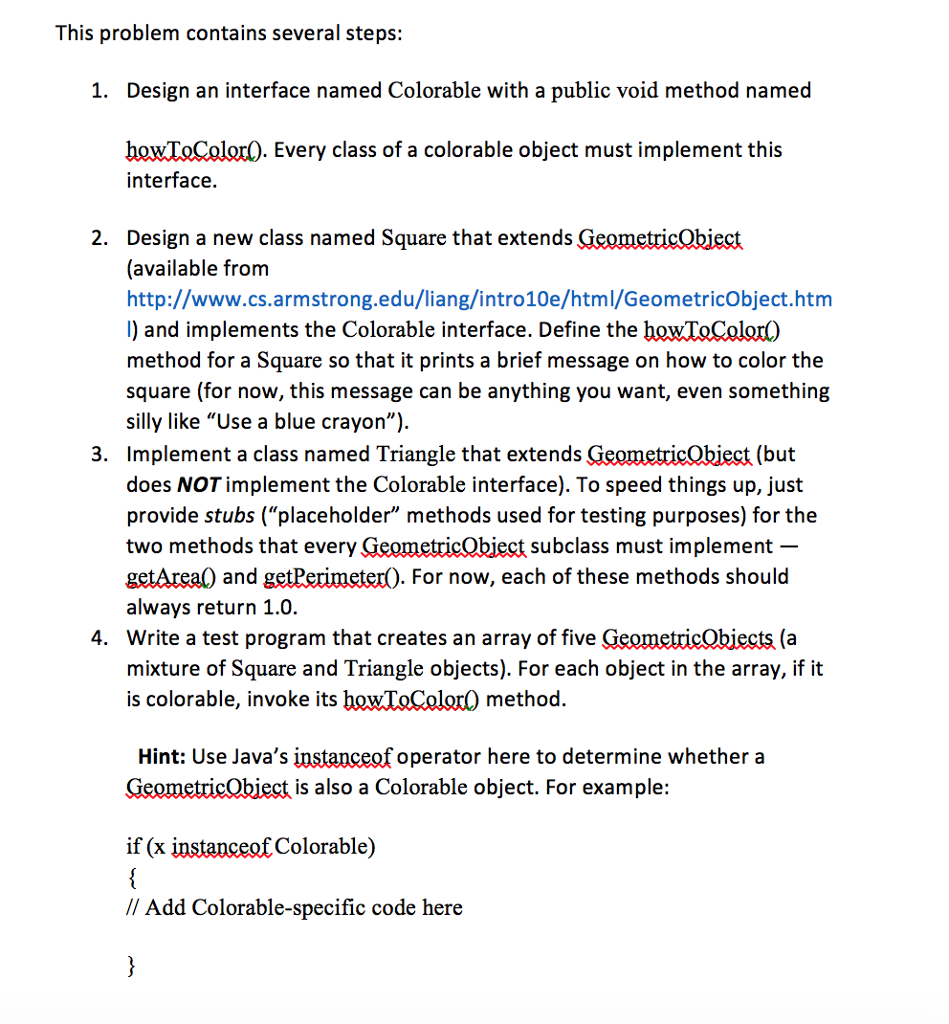
This problem contains several steps: 1. Design an interface named Colorable with a public void method named howToColor(). Every class of a colorable object must implement this interface. 2. Design a new class named Square that extends GeometricQbject (available from http://www.cs.armstrong.edu/liang/intro10e/html/GeometricObject.htm 1) and implements the Colorable interface. Define the bowToColorC) method for a Square so that it prints a brief message on how to color the square (for now, this message can be anything you want, even something silly like "Use a blue crayon"). Implement a class named Triangle that extends does NOT implement the Colorable interface). To speed things up, just provide stubs ("placeholder" methods used for testing purposes) for the two methods that every GeometricQbiect subclass must implement getArea() and getPerimeter). For now, each of these methods should always return 1.0. Write a test program that creates an array of five GeometricQbiects (a mixture of Square and Triangle objects). For each object in the array, if it is colorable, invoke its bowToColor0) method. 3. (but 4. Hint: Use Java's instanceof operator here to determine whether a GeometricQbiect is also a Colorable object. For example: if (x instanceofColorable) // Add Colorable-specific code here
Step by Step Solution
There are 3 Steps involved in it

Get step-by-step solutions from verified subject matter experts
 Study Help