







Question: This problem focuses on using Polymath, an ordinary differential equation (ODE) solver, and also a nonlinear equation (NLE) solver. These equation solvers will be used
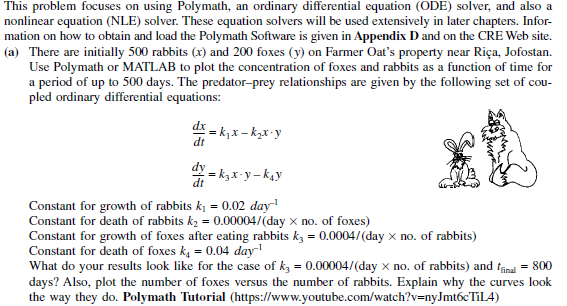
This problem focuses on using Polymath, an ordinary differential equation (ODE) solver, and also a nonlinear equation (NLE) solver. These equation solvers will be used extensively in later chapters. Information on how to obtain and load the Polymath Software is given in Appendix D and on the CRE Web site. (a) There are initially 500 rabbits (x) and 200 foxes (y) on Farmer Oat's property near Ria, Jofostan. Use Polymath or MATLAB to plot the concentration of foxes and rabbits as a function of time for a period of up to 500 days. The predator-prey relationships are given by the following set of coupled ordinary differential equations: dtdx=k1xk2xydtdy=k3xyk4y Constant for growth of rabbits k1=0.02 day 1 Constant for death of rabbits k2=0.00004 ((day no. of foxes) Constant for growth of foxes after eating rabbits k3=0.0004/ (day no. of rabbits) Constant for death of foxes k4=0.04 day 1 What do your results look like for the case of k3=0.00004/( day no. of rabbits) and tfinal=800 days? Also, plot the number of foxes versus the number of rabbits. Explain why the curves look the way they do. Polymath Tutorial (https://www.youtube.com/watch?v=nyJmt6cTiLA) This problem focuses on using Polymath, an ordinary differential equation (ODE) solver, and also a nonlinear equation (NLE) solver. These equation solvers will be used extensively in later chapters. Information on how to obtain and load the Polymath Software is given in Appendix D and on the CRE Web site. (a) There are initially 500 rabbits (x) and 200 foxes (y) on Farmer Oat's property near Ria, Jofostan. Use Polymath or MATLAB to plot the concentration of foxes and rabbits as a function of time for a period of up to 500 days. The predator-prey relationships are given by the following set of coupled ordinary differential equations: dtdx=k1xk2xydtdy=k3xyk4y Constant for growth of rabbits k1=0.02 day 1 Constant for death of rabbits k2=0.00004 ((day no. of foxes) Constant for growth of foxes after eating rabbits k3=0.0004/ (day no. of rabbits) Constant for death of foxes k4=0.04 day 1 What do your results look like for the case of k3=0.00004/( day no. of rabbits) and tfinal=800 days? Also, plot the number of foxes versus the number of rabbits. Explain why the curves look the way they do. Polymath Tutorial (https://www.youtube.com/watch?v=nyJmt6cTiLA)
Step by Step Solution
There are 3 Steps involved in it

Get step-by-step solutions from verified subject matter experts
 Study Help