Question: this problem has over 400 excel numbers. i have already calculated the sample size and average. thus, i will not include all 400 photos 1
this problem has over 400 excel numbers. i have already calculated the sample size and average. thus, i will not include all 400 photos
this problem has over 400 excel numbers. i have
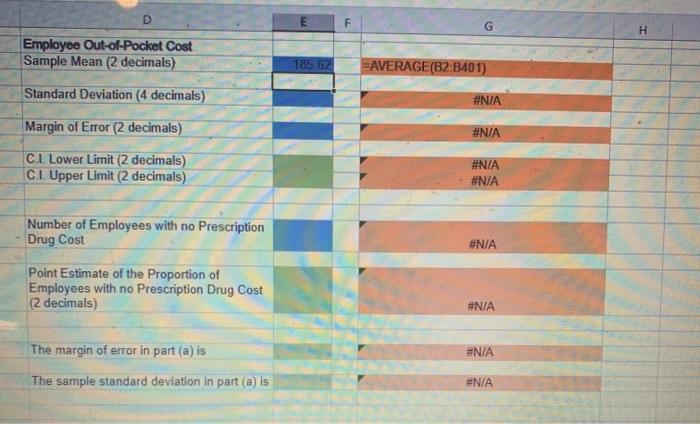
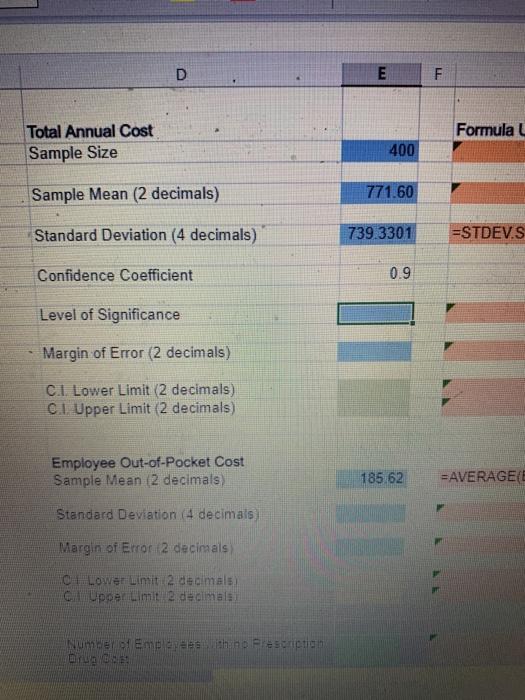
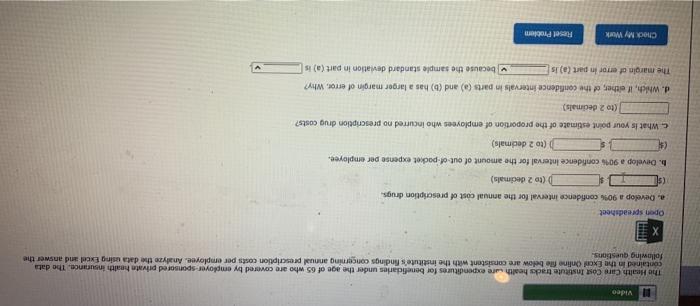
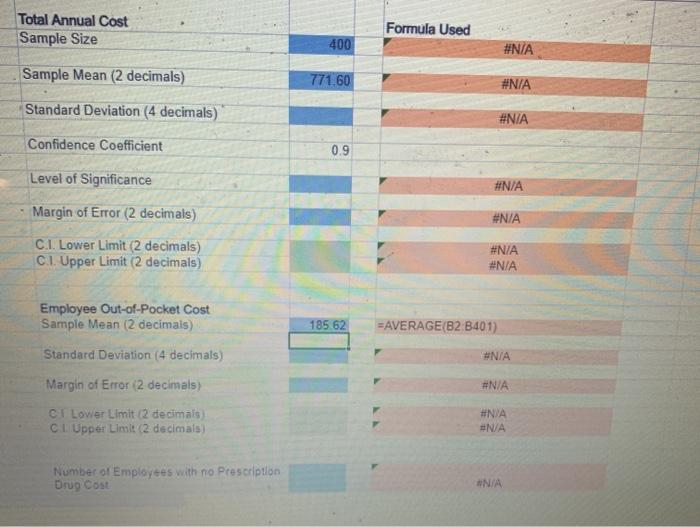
1 Video The Health Care Cost Institute tracks health are expenditures for beneficiaries under the age of 65 who are covered by employer sponsored private health insurance. The data Contained in the Exch Online file below are consistent with the institute's findings concerning annual prescription costs per employee. Analyze the data using Excel and answer the following questions. X Open spreadsheet a. Develop a 90% confidence interval for the annual cost of prescription drugs. (si D(to 2 decimals) b. Develop a 90% confidence interval for the amount of out of pocket expense per employee. (9 (to 2 decimals) c. What is your point estimate of the proportion of employees who incurred no prescription drug costs? (to 2 decimals) d. Which, either of the confidence intervals in parts (a) and (b) has a larger margin of error. Why? The margin of error in part() is because the sample standard deviation in part (a) is Check My Work Reset Problem Total Annual Cost Sample Size Formula Used 400 #N/A Sample Mean (2 decimals) 771.60 #N/A Standard Deviation (4 decimals) #N/A Confidence Coefficient 0.9 #N/A Level of Significance Margin of Error (2 decimals) #N/A C.1. Lower Limit (2 decimals) C.1 Upper Limit (2 decimals) #N/A #N/A 185 62 =AVERAGE(B2 B401) #N/A Employee Out-of-Pocket Cost Sample Mean (2 decimals) Standard Deviation (4 decimals) Margin of Error 2 decimals) CI Lower Limit 2 decimals) C1 Upper Limit (2 decimals) #N/A #N/A #N/A Number of Employees with no prescription Drug Cost #N/A D F H Employee Out-of-Pocket Cost Sample Mean (2 decimals) 185 62 AVERAGE(B2B401) Standard Deviation (4 decimals) #N/A Margin of Error (2 decimals) #N/A C. Lower Limit (2 decimals) C.1. Upper Limit (2 decimals) #N/A #N/A Number of Employees with no Prescription Drug Cost #N/A Point Estimate of the Proportion of Employees with no Prescription Drug Cost (2 decimals) #N/A The margin of error in part (a) is #N/A The sample standard deviation in part (a) is #N/A D E F Formula Total Annual Cost Sample Size 400 Sample Mean (2 decimals) 771.60 Standard Deviation (4 decimals) 739.3301 =STDEV.S Confidence Coefficient 0.9 Level of Significance Margin of Error (2 decimals) C.I Lower Limit (2 decimals) 0.1. Upper Limit (2 decimals) Employee Out-of-Pocket Cost Sample Mean (2 decimals) 185.62 =AVERAGE Standard Deviation (4 decimals, Margin of Error (2 decimals O Lower Limit 2 decimal Upoer mit 2 de mals Numer Empleanschen Frescription Dru: 1 Video The Health Care Cost Institute tracks health are expenditures for beneficiaries under the age of 65 who are covered by employer sponsored private health insurance. The data Contained in the Exch Online file below are consistent with the institute's findings concerning annual prescription costs per employee. Analyze the data using Excel and answer the following questions. X Open spreadsheet a. Develop a 90% confidence interval for the annual cost of prescription drugs. (si D(to 2 decimals) b. Develop a 90% confidence interval for the amount of out of pocket expense per employee. (9 (to 2 decimals) c. What is your point estimate of the proportion of employees who incurred no prescription drug costs? (to 2 decimals) d. Which, either of the confidence intervals in parts (a) and (b) has a larger margin of error. Why? The margin of error in part() is because the sample standard deviation in part (a) is Check My Work Reset Problem Total Annual Cost Sample Size Formula Used 400 #N/A Sample Mean (2 decimals) 771.60 #N/A Standard Deviation (4 decimals) #N/A Confidence Coefficient 0.9 #N/A Level of Significance Margin of Error (2 decimals) #N/A C.1. Lower Limit (2 decimals) C.1 Upper Limit (2 decimals) #N/A #N/A 185 62 =AVERAGE(B2 B401) #N/A Employee Out-of-Pocket Cost Sample Mean (2 decimals) Standard Deviation (4 decimals) Margin of Error 2 decimals) CI Lower Limit 2 decimals) C1 Upper Limit (2 decimals) #N/A #N/A #N/A Number of Employees with no prescription Drug Cost #N/A D F H Employee Out-of-Pocket Cost Sample Mean (2 decimals) 185 62 AVERAGE(B2B401) Standard Deviation (4 decimals) #N/A Margin of Error (2 decimals) #N/A C. Lower Limit (2 decimals) C.1. Upper Limit (2 decimals) #N/A #N/A Number of Employees with no Prescription Drug Cost #N/A Point Estimate of the Proportion of Employees with no Prescription Drug Cost (2 decimals) #N/A The margin of error in part (a) is #N/A The sample standard deviation in part (a) is #N/A D E F Formula Total Annual Cost Sample Size 400 Sample Mean (2 decimals) 771.60 Standard Deviation (4 decimals) 739.3301 =STDEV.S Confidence Coefficient 0.9 Level of Significance Margin of Error (2 decimals) C.I Lower Limit (2 decimals) 0.1. Upper Limit (2 decimals) Employee Out-of-Pocket Cost Sample Mean (2 decimals) 185.62 =AVERAGE Standard Deviation (4 decimals, Margin of Error (2 decimals O Lower Limit 2 decimal Upoer mit 2 de mals Numer Empleanschen Frescription Dru

Step by Step Solution

There are 3 Steps involved in it

1 Expert Approved Answer
Step: 1 Unlock blur-text-image

Question Has Been Solved by an Expert!

Get step-by-step solutions from verified subject matter experts

Step: 2 Unlock
Step: 3 Unlock

Students Have Also Explored These Related General Management Questions!