







Question: This problem involves designing a register capable of rearranging (or permuting) its contents. Some rearrangements such as hold (no change), and left/right rotate/shift have been
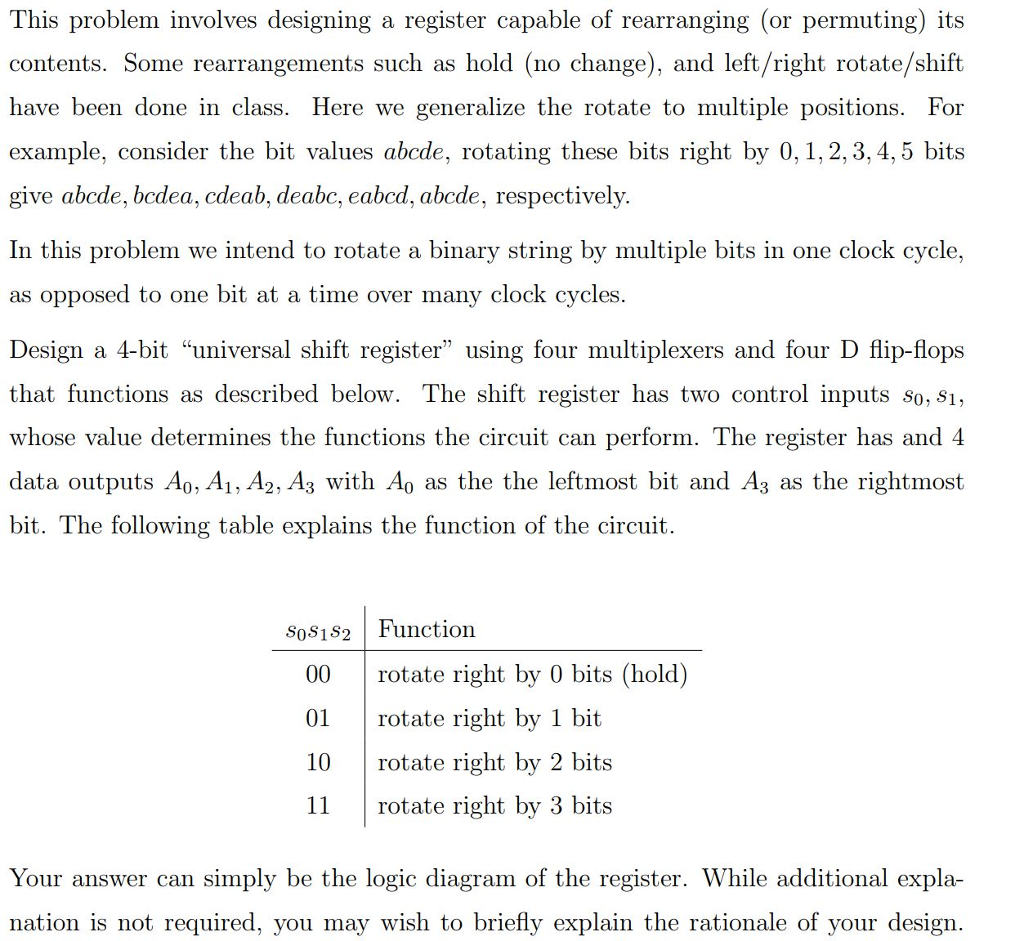
This problem involves designing a register capable of rearranging (or permuting) its contents. Some rearrangements such as hold (no change), and left/right rotate/shift have been done in class. Here we generalize the rotate to multiple positions. For example, consider the bit values abcde, rotating these bits right by 0,1, 2, 3, 4,5 bits give abcde, bcdea, cdeab, deabc, eabcd, abcde, respectively In this problem we intend to rotate a binary string by multiple bits in one clock cycle, as opposed to one bit at a time over many clock cycles Design a 4-bit "universal shift register" using four multiplexers and four D flip-flops that functions as described below. The shift register has two control inputs so, S1, whose value determines the functions the circuit can perform. The register has and 4 data outputs Ao, A1, A2, A3 with Ao as the the leftmost bit and A3 as the rightmost bit. The following table explains the function of the circuit. S0S182 Function 00 rotate right by 0 bits (hold) 01 rotate right by 1 bit 10rotate right by 2 bits 11rotate right by 3 bits Your answer can simply be the logic diagram of the register. While additional expla- nation is not required, you may wish to briefly explain the rationale of your design
Step by Step Solution
There are 3 Steps involved in it

Get step-by-step solutions from verified subject matter experts
 Study Help