







Question: This problem is about applied mathematics. It is from Introduction to Linear Optimization by Dimitris Bertsimas. I need answers for all sections a, b, c,
This problem is about applied mathematics. It is from "Introduction to Linear Optimization by Dimitris Bertsimas". I need answers for all sections a, b, c, d.
Please solve on paper and then take high-quality images.
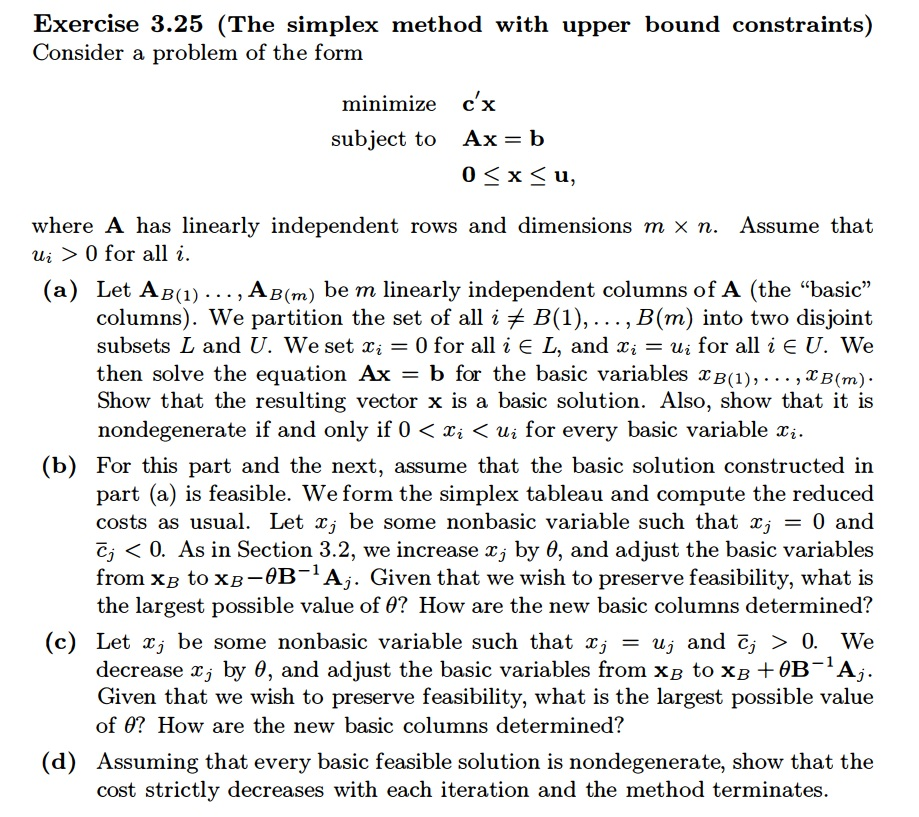
Exercise 3.25 (The simplex method with upper bound constraints) Consider a problem of the form minimize c'x subject to Ax = b %3D 0 0 for all i. (a) Let AB(1) .. , AB(m) be m linearly independent columns of A (the "basic" columns). We partition the set of all i + B(1), ..., B(m) into two disjoint subsets L and U. We set xi = 0 for all i E L, and xi = ui for all i E U. We then solve the equation Ax = b for the basic variables xB(1), .., XB(m) Show that the resulting vector x is a basic solution. Also, show that it is nondegenerate if and only if 0 0. We decrease x; by 0, and adjust the basic variables from xgB to xB + OB-'Aj. Given that we wish to preserve feasibility, what is the largest possible value of 0? How are the new basic columns determined? (d) Assuming that every basic feasible solution is nondegenerate, show that the cost strictly decreases with each iteration and the method terminates. Exercise 3.25 (The simplex method with upper bound constraints) Consider a problem of the form minimize c'x subject to Ax = b %3D 0 0 for all i. (a) Let AB(1) .. , AB(m) be m linearly independent columns of A (the "basic" columns). We partition the set of all i + B(1), ..., B(m) into two disjoint subsets L and U. We set xi = 0 for all i E L, and xi = ui for all i E U. We then solve the equation Ax = b for the basic variables xB(1), .., XB(m) Show that the resulting vector x is a basic solution. Also, show that it is nondegenerate if and only if 0 0. We decrease x; by 0, and adjust the basic variables from xgB to xB + OB-'Aj. Given that we wish to preserve feasibility, what is the largest possible value of 0? How are the new basic columns determined? (d) Assuming that every basic feasible solution is nondegenerate, show that the cost strictly decreases with each iteration and the method terminatesStep by Step Solution
There are 3 Steps involved in it
1 Expert Approved Answer
Step: 1 Unlock

Question Has Been Solved by an Expert!
Get step-by-step solutions from verified subject matter experts
Step: 2 Unlock
Step: 3 Unlock
 Study Help