







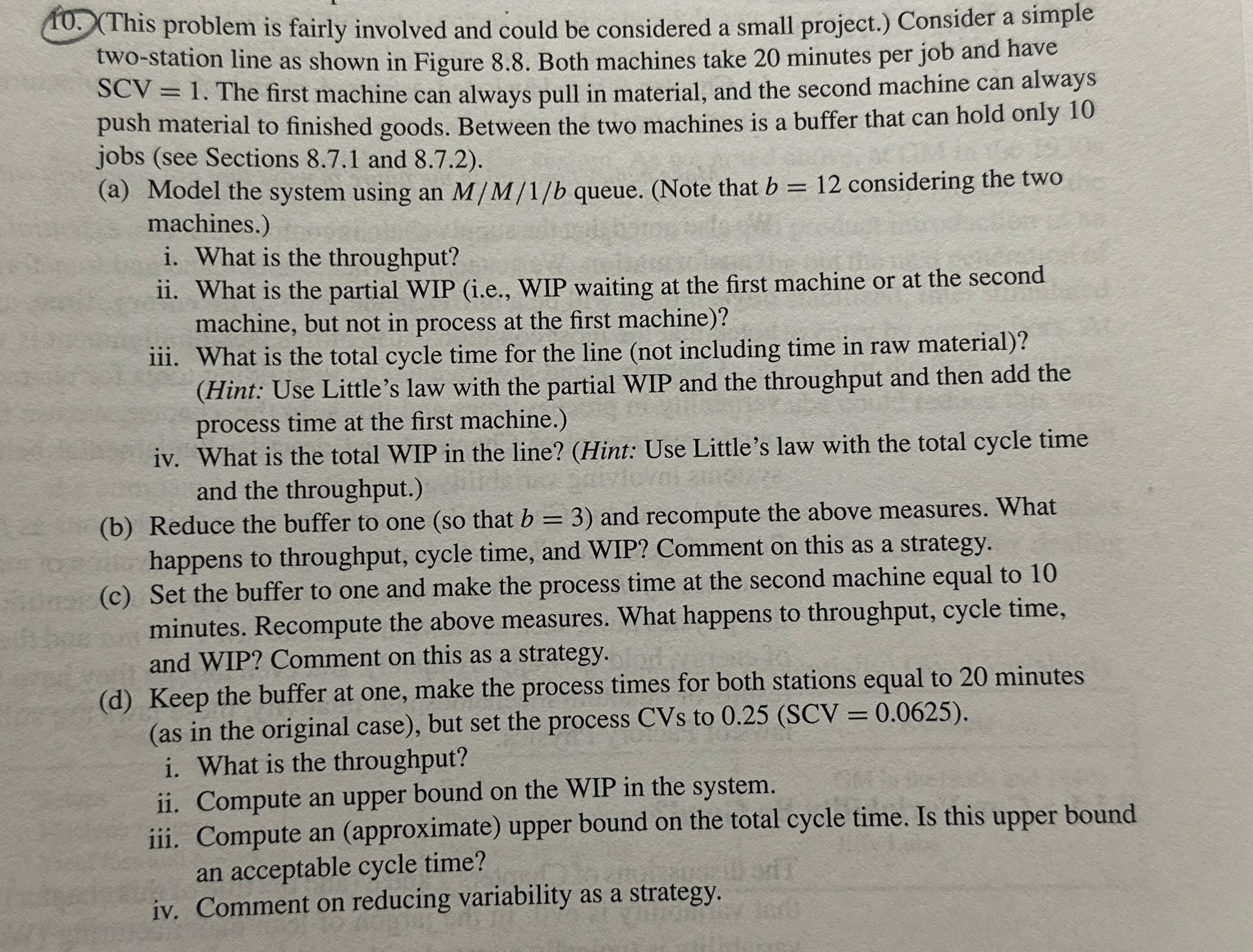
Question: ( This problem is fairly involved and could be considered a small project. ) Consider a simple two - station line as shown in Figure
This problem is fairly involved and could be considered a small project. Consider a simple twostation line as shown in Figure Both machines take minutes per job and have The first machine can always pull in material, and the second machine can always push material to finished goods. Between the two machines is a buffer that can hold only jobs see Sections and
a Model the system using an queue. Note that considering the two machines.
i What is the throughput?
ii What is the partial WIP ie WIP waiting at the first machine or at the second machine, but not in process at the first machine
iii. What is the total cycle time for the line not including time in raw material
Hint: Use Little's law with the partial WIP and the throughput and then add the process time at the first machine.
iv What is the total WIP in the line? Hint: Use Little's law with the total cycle time and the throughput.
b Reduce the buffer to one so that and recompute the above measures. What happens to throughput, cycle time, and WIP? Comment on this as a strategy.
c Set the buffer to one and make the process time at the second machine equal to minutes. Recompute the above measures. What happens to throughput, cycle time, and WIP? Comment on this as a strategy.
d Keep the buffer at one, make the process times for both stations equal to minutes as in the original case but set the process CVs to
i What is the throughput?
ii Compute an upper bound on the WIP in the system.
iii. Compute an approximate upper bound on the total cycle time. Is this upper bound an acceptable cycle time?
iv Comment on reducing variability as a strategy.
Step by Step Solution
There are 3 Steps involved in it
1 Expert Approved Answer
Step: 1 Unlock

Question Has Been Solved by an Expert!
Get step-by-step solutions from verified subject matter experts
Step: 2 Unlock
Step: 3 Unlock
 Study Help