







Question: This problem models pollution effects in the Great Lakes. We assume pollutants are owing into a lake at a constant rate ofI kglyear, and that
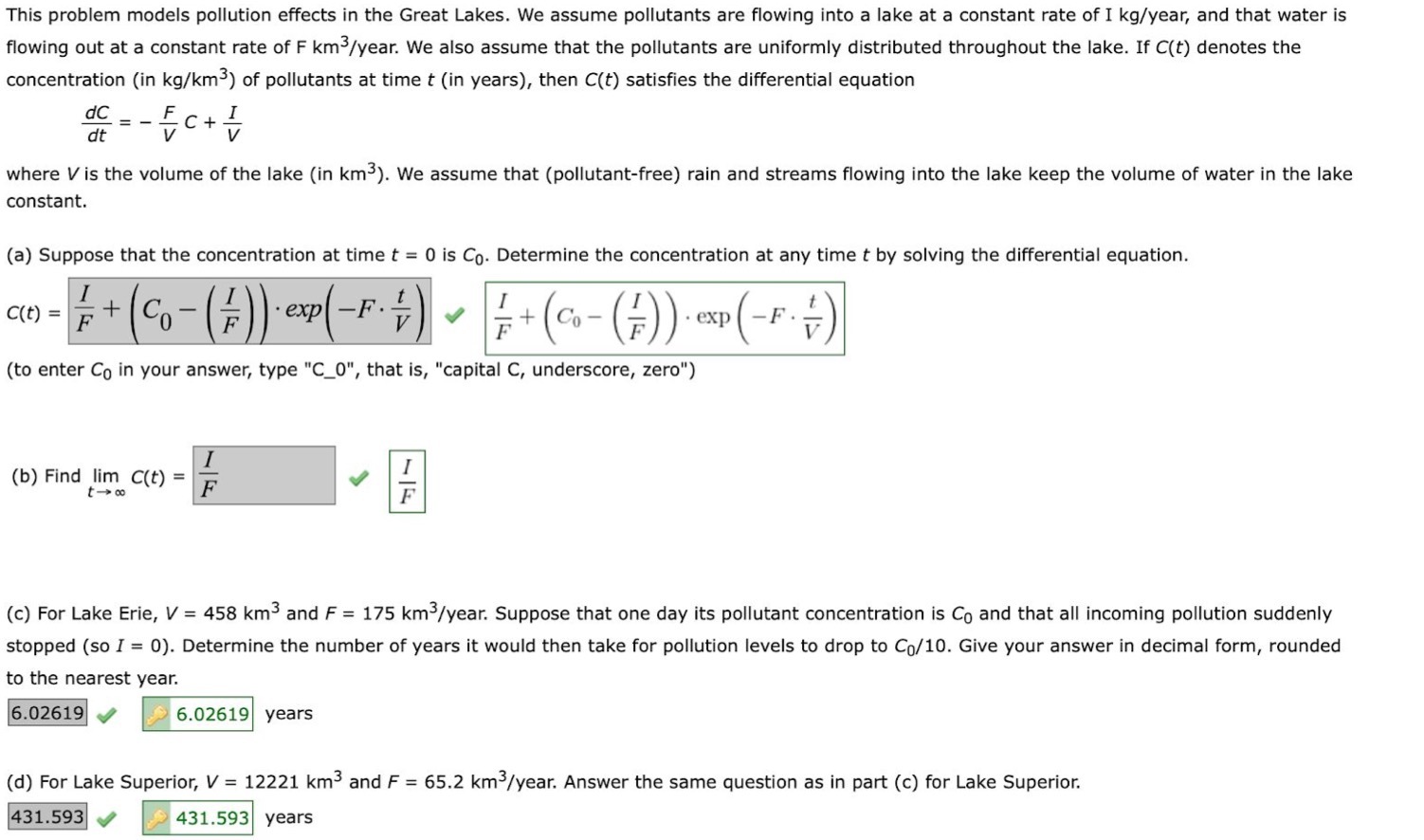
This problem models pollution effects in the Great Lakes. We assume pollutants are owing into a lake at a constant rate ofI kglyear, and that water is owing out at a constant rate of F km3/year. We also assume that the pollutanls are uniformly distributed throughout the lake. If C(t) denotes the concentration (in kglkm3) of pollutants at time t (in years), then C(t) satises the differential equation where V Is the volume of the lake (In km3}. We assume that (pollutantfree) rain and streams owing Into the lake keep the volume of water In the lake constant. (a) Suppose that the concentration at time t = 0 is Co. Deten'nlne the concentration at any time t by solving the differential equation. sea-(omens (to enter Co in your answer, type "C_0", that Is, "capital C, underscore, zero") t-tw F (c) For Lake Erie, V = 458 km3 and F = 175 km3/year. Suppose that one day its pollutant concentration is Co and that all incoming pollution suddenly stopped (50 I = 0). Determine the number of years it would then take for pollution levels to drop to C9110. Give your answer in decimal form, rounded to the nearat year. (d) For Lake Superior, V = 12221 km3 and F = 65.2 km3/year. Answer the same question as in part (c) for Lake Superio: _
Step by Step Solution
There are 3 Steps involved in it

Get step-by-step solutions from verified subject matter experts
 Study Help