



Question: This problem uses the Peng-Robinson property calculator to evaluate the inlet/outlets of a heat exchanger and find the molar flow ratio of stream B to
This problem uses the Peng-Robinson property calculator to evaluate the inlet/outlets of a heat exchanger and find the molar flow ratio of stream B to stream A. The stream A consists of water and is at a pressure of 1.2 MPa and it enters at 825 K and leaves at 592 K. Stream B is nitrogen gas at a pressure of 1.2 MPa and enters at a temperature of 342 K and exits at 455 K. The reference state is HR = 0 and SR = 0 for the real fluid equilibrium state of aggregation at 298.15K, 0.1 MPa.
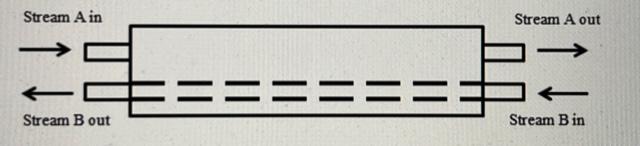
Note: One of your specified streams may be water. The Peng-Robinson EOS is not particularly accurate for water, but if you are assigned water, you are asked here to use the Peng-Robinson EOS as a learning tool for an approximate calculation.
A) What is the enthalpy of water entering the heat exchanger in stream A (J/mol)?
B) What is the enthalpy of water exiting the heat exchanger in stream A (J/mol)?
C) What is the enthalpy of nitrogen gas entering the heat exchanger in stream B (J/mol)?
D) What is the enthalpy of nitrogen gas exiting the heat exchanger in stream B (J/mol)?
E) Using an energy balance, what is the molar ratio of stream B to stream A?
Stream A in Stream A out
Step by Step Solution
There are 3 Steps involved in it

Get step-by-step solutions from verified subject matter experts