







Question: r 6. Backward induction and subgame perfect equilibria Aa Aa Backward induction is a useful tool while solving for the subgame perfect equilibrium (SPE) of
r
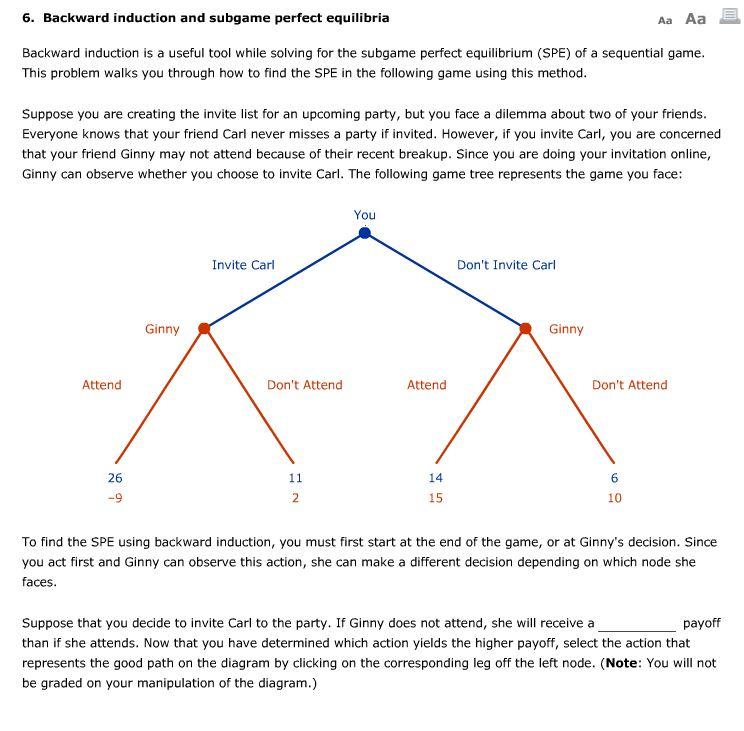
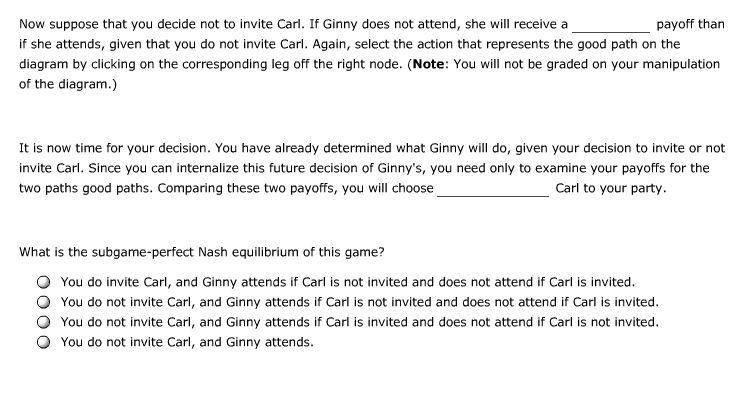
6. Backward induction and subgame perfect equilibria Aa Aa Backward induction is a useful tool while solving for the subgame perfect equilibrium (SPE) of a sequential game. This problem walks you through how to find the SPE in the following game using this method. Suppose you are creating the invite list for an upcoming party, but you face a dilemma about two of your friends. Everyone knows that your friend Carl never misses a party if invited. However, if you invite Carl, you are concerned that your friend Ginny may not attend because of their recent breakup. Since you are doing your invitation online, Ginny can observe whether you choose to invite Carl. The following game tree represents the game you face: You Invite Carl Don't Invite Carl Ginny Ginny Attend Don't Attend Attend Don't Attend 26 11 14 6 -9 2 15 10 To find the SPE using backward induction, you must first start at the end of the game, or at Ginny's decision. Since you act first and Ginny can observe this action, she can make a different decision depending on which node she faces. Suppose that you decide to invite Carl to the party. If Ginny does not attend, she will receive a payoff than if she attends. Now that you have determined which action yields the higher payoff, select the action that represents the good path on the diagram by clicking on the corresponding leg off the left node. (Note: You will not be graded on your manipulation of the diagram.) Now suppose that you decide not to invite Carl. If Ginny does not attend, she will receive a payoff than if she attends, given that you do not invite Carl. Again, select the action that represents the good path on the diagram by clicking on the corresponding leg off the right node. (Note: You will not be graded on your manipulation of the diagram.) It is now time for your decision. You have already determined what Ginny will do, given your decision to invite or not invite Carl. Since you can internalize this future decision of Ginny's, you need only to examine your payoffs for the two paths good paths. Comparing these two payoffs, you will choose Carl to your party. What is the subgame-perfect Nash equilibrium of this game? You do invite Carl, and Ginny attends if Carl is not invited and does not attend if Carl is invited. You do not invite Carl, and Ginny attends if Carl is not invited and does not attend if Carl is invited. You do not invite Carl, and Ginny attends if Carl is invited and does not attend if Carl is not invited. You do not invite Carl, and Ginny attends. 6. Backward induction and subgame perfect equilibria Aa Aa Backward induction is a useful tool while solving for the subgame perfect equilibrium (SPE) of a sequential game. This problem walks you through how to find the SPE in the following game using this method. Suppose you are creating the invite list for an upcoming party, but you face a dilemma about two of your friends. Everyone knows that your friend Carl never misses a party if invited. However, if you invite Carl, you are concerned that your friend Ginny may not attend because of their recent breakup. Since you are doing your invitation online, Ginny can observe whether you choose to invite Carl. The following game tree represents the game you face: You Invite Carl Don't Invite Carl Ginny Ginny Attend Don't Attend Attend Don't Attend 26 11 14 6 -9 2 15 10 To find the SPE using backward induction, you must first start at the end of the game, or at Ginny's decision. Since you act first and Ginny can observe this action, she can make a different decision depending on which node she faces. Suppose that you decide to invite Carl to the party. If Ginny does not attend, she will receive a payoff than if she attends. Now that you have determined which action yields the higher payoff, select the action that represents the good path on the diagram by clicking on the corresponding leg off the left node. (Note: You will not be graded on your manipulation of the diagram.) Now suppose that you decide not to invite Carl. If Ginny does not attend, she will receive a payoff than if she attends, given that you do not invite Carl. Again, select the action that represents the good path on the diagram by clicking on the corresponding leg off the right node. (Note: You will not be graded on your manipulation of the diagram.) It is now time for your decision. You have already determined what Ginny will do, given your decision to invite or not invite Carl. Since you can internalize this future decision of Ginny's, you need only to examine your payoffs for the two paths good paths. Comparing these two payoffs, you will choose Carl to your party. What is the subgame-perfect Nash equilibrium of this game? You do invite Carl, and Ginny attends if Carl is not invited and does not attend if Carl is invited. You do not invite Carl, and Ginny attends if Carl is not invited and does not attend if Carl is invited. You do not invite Carl, and Ginny attends if Carl is invited and does not attend if Carl is not invited. You do not invite Carl, and Ginny attends. 6. Backward induction and subgame perfect equilibria Aa Aa Backward induction is a useful tool while solving for the subgame perfect equilibrium (SPE) of a sequential game. This problem walks you through how to find the SPE in the following game using this method. Suppose you are creating the invite list for an upcoming party, but you face a dilemma about two of your friends. Everyone knows that your friend Carl never misses a party if invited. However, if you invite Carl, you are concerned that your friend Ginny may not attend because of their recent breakup. Since you are doing your invitation online, Ginny can observe whether you choose to invite Carl. The following game tree represents the game you face: You Invite Carl Don't Invite Carl Ginny Ginny Attend Don't Attend Attend Don't Attend 26 11 14 6 -9 2 15 10 To find the SPE using backward induction, you must first start at the end of the game, or at Ginny's decision. Since you act first and Ginny can observe this action, she can make a different decision depending on which node she faces. Suppose that you decide to invite Carl to the party. If Ginny does not attend, she will receive a payoff than if she attends. Now that you have determined which action yields the higher payoff, select the action that represents the good path on the diagram by clicking on the corresponding leg off the left node. (Note: You will not be graded on your manipulation of the diagram.) Now suppose that you decide not to invite Carl. If Ginny does not attend, she will receive a payoff than if she attends, given that you do not invite Carl. Again, select the action that represents the good path on the diagram by clicking on the corresponding leg off the right node. (Note: You will not be graded on your manipulation of the diagram.) It is now time for your decision. You have already determined what Ginny will do, given your decision to invite or not invite Carl. Since you can internalize this future decision of Ginny's, you need only to examine your payoffs for the two paths good paths. Comparing these two payoffs, you will choose Carl to your party. What is the subgame-perfect Nash equilibrium of this game? You do invite Carl, and Ginny attends if Carl is not invited and does not attend if Carl is invited. You do not invite Carl, and Ginny attends if Carl is not invited and does not attend if Carl is invited. You do not invite Carl, and Ginny attends if Carl is invited and does not attend if Carl is not invited. You do not invite Carl, and Ginny attends. 6. Backward induction and subgame perfect equilibria Aa Aa Backward induction is a useful tool while solving for the subgame perfect equilibrium (SPE) of a sequential game. This problem walks you through how to find the SPE in the following game using this method. Suppose you are creating the invite list for an upcoming party, but you face a dilemma about two of your friends. Everyone knows that your friend Carl never misses a party if invited. However, if you invite Carl, you are concerned that your friend Ginny may not attend because of their recent breakup. Since you are doing your invitation online, Ginny can observe whether you choose to invite Carl. The following game tree represents the game you face: You Invite Carl Don't Invite Carl Ginny Ginny Attend Don't Attend Attend Don't Attend 26 11 14 6 -9 2 15 10 To find the SPE using backward induction, you must first start at the end of the game, or at Ginny's decision. Since you act first and Ginny can observe this action, she can make a different decision depending on which node she faces. Suppose that you decide to invite Carl to the party. If Ginny does not attend, she will receive a payoff than if she attends. Now that you have determined which action yields the higher payoff, select the action that represents the good path on the diagram by clicking on the corresponding leg off the left node. (Note: You will not be graded on your manipulation of the diagram.) Now suppose that you decide not to invite Carl. If Ginny does not attend, she will receive a payoff than if she attends, given that you do not invite Carl. Again, select the action that represents the good path on the diagram by clicking on the corresponding leg off the right node. (Note: You will not be graded on your manipulation of the diagram.) It is now time for your decision. You have already determined what Ginny will do, given your decision to invite or not invite Carl. Since you can internalize this future decision of Ginny's, you need only to examine your payoffs for the two paths good paths. Comparing these two payoffs, you will choose Carl to your party. What is the subgame-perfect Nash equilibrium of this game? You do invite Carl, and Ginny attends if Carl is not invited and does not attend if Carl is invited. You do not invite Carl, and Ginny attends if Carl is not invited and does not attend if Carl is invited. You do not invite Carl, and Ginny attends if Carl is invited and does not attend if Carl is not invited. You do not invite Carl, and Ginny attends. 6. Backward induction and subgame perfect equilibria Aa Aa Backward induction is a useful tool while solving for the subgame perfect equilibrium (SPE) of a sequential game. This problem walks you through how to find the SPE in the following game using this method. Suppose you are creating the invite list for an upcoming party, but you face a dilemma about two of your friends. Everyone knows that your friend Carl never misses a party if invited. However, if you invite Carl, you are concerned that your friend Ginny may not attend because of their recent breakup. Since you are doing your invitation online, Ginny can observe whether you choose to invite Carl. The following game tree represents the game you face: You Invite Carl Don't Invite Carl Ginny Ginny Attend Don't Attend Attend Don't Attend 26 11 14 6 -9 2 15 10 To find the SPE using backward induction, you must first start at the end of the game, or at Ginny's decision. Since you act first and Ginny can observe this action, she can make a different decision depending on which node she faces. Suppose that you decide to invite Carl to the party. If Ginny does not attend, she will receive a payoff than if she attends. Now that you have determined which action yields the higher payoff, select the action that represents the good path on the diagram by clicking on the corresponding leg off the left node. (Note: You will not be graded on your manipulation of the diagram.) Now suppose that you decide not to invite Carl. If Ginny does not attend, she will receive a payoff than if she attends, given that you do not invite Carl. Again, select the action that represents the good path on the diagram by clicking on the corresponding leg off the right node. (Note: You will not be graded on your manipulation of the diagram.) It is now time for your decision. You have already determined what Ginny will do, given your decision to invite or not invite Carl. Since you can internalize this future decision of Ginny's, you need only to examine your payoffs for the two paths good paths. Comparing these two payoffs, you will choose Carl to your party. What is the subgame-perfect Nash equilibrium of this game? You do invite Carl, and Ginny attends if Carl is not invited and does not attend if Carl is invited. You do not invite Carl, and Ginny attends if Carl is not invited and does not attend if Carl is invited. You do not invite Carl, and Ginny attends if Carl is invited and does not attend if Carl is not invited. You do not invite Carl, and Ginny attends.
Step by Step Solution
3.46 Rating (156 Votes )
There are 3 Steps involved in it
Answer Carl is invited to the party Ginny will receive a higher payoff if she doe... View full answer

Get step-by-step solutions from verified subject matter experts
 Study Help