Question: This Project/Case Study can be found in the text on page 542 (Chapter 14) Students are to review this case study and provide an action
This Project/Case Study can be found in the text on page 542 (Chapter 14) Students are to review this case study and provide an action plan to correct what appears to be a systemic project management issue within Wireless Telecom Company (WTC). Your team is essentially functioning as a consultant to Olaf Gundersen, CEO of WTC
Please note: You are not addressing a solution to the battery problem referred to in this case. The battery problem is a symptom of the systemic PM issue at WTC,
Your proposed solution is to be presented as an action plan following the outline below. The written portion of the plan is to be presented in a 2-3 page Word Document similar to a short Executive Management Report using 12 point type and double spaced. The report is to include a title page, and bold paragraph headings.
In addition, an MS Project Plan (Gantt Chart) is to be included as an attachment to your proposed plan. This schedule is to show the time phased list of activities that you identify.
Answer or define at least the following in your proposed plan:
- Define the Problem
- Identify the problem symptoms
- Identify and list the causes of the problem(s)
- Present a specific action plan for the following time periods;
- Immediate actions,
- Action plan for the 6-12 mo. Period,
- Action plan for 1 year and beyond, assuming you agree to continue the project. If you chose not to continue the project, identify a project termination plan including how the financial loss will be absorbed, and how the key people will be retained or dispositioned.
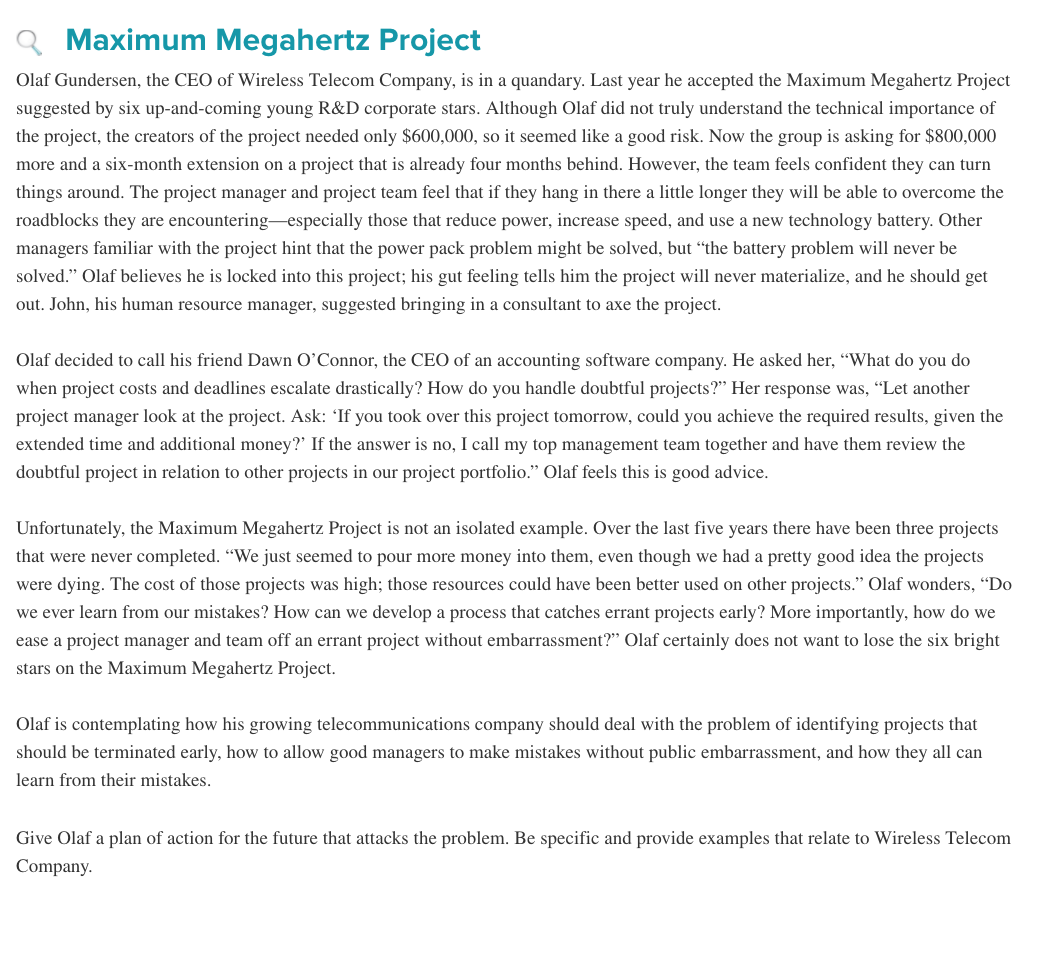
Q Maximum Megahertz Project Olaf Gundersen, the CEO of Wireless Telecom Company, is in a quandary. Last year he accepted the Maximum Megahertz Project suggested by six up-and-coming young R&D corporate stars. Although Olaf did not truly understand the technical importance of the project, the creators of the project needed only $600,000, so it seemed like a good risk. Now the group is asking for $800,000 more and a six-month extension on a project that is already four months behind. However, the team feels confident they can turn things around. The project manager and project team feel that if they hang in there a little longer they will be able to overcome the roadblocks they are encounteringespecially those that reduce power, increase speed, and use a new technology battery. Other managers familiar with the project hint that the power pack problem might be solved, but the battery problem will never be solved. Olaf believes he is locked into this project; his gut feeling tells him the project will never materialize, and he should get out. John, his human resource manager, suggested bringing in a consultant to axe the project. Olaf decided to call his friend Dawn O'Connor, the CEO of an accounting software company. He asked her, What do you do when project costs and deadlines escalate drastically? How do you handle doubtful projects? Her response was, Let another project manager look at the project. Ask: 'If you took over this project tomorrow, could you achieve the required results, given the extended time and additional money?' If the answer is no, I call my top management team together and have them review the doubtful project in relation to other projects in our project portfolio. Olaf feels this is good advice. Unfortunately, the Maximum Megahertz Project is not an isolated example. Over the last five years there have been three projects that were never completed. We just seemed to pour more money into them, even though we had a pretty good idea the projects were dying. The cost of those projects was high; those resources could have been better used on other projects. Olaf wonders, Do we ever learn from our mistakes? How can we develop a process that catches errant projects early? More importantly, how do we ease a project manager and team off an errant project without embarrassment? Olaf certainly does not want to lose the six bright stars on the Maximum Megahertz Project. Olaf is contemplating how his growing telecommunications company should deal with the problem of identifying projects that should be terminated early, how to allow good managers to make mistakes without public embarrassment, and how they all can learn from their mistakes. Give Olaf a plan of action for the future that attacks the problem. Be specific and provide examples that relate to Wireless Telecom Company









 Study Help