







Question: This question carries 25marks,please answer accordingly.Please elaborate and explain. The CO2CRC Otway Project: Overcoming Challenges from Planning to Execution Introduction Geological sequestration is a promising
This question carries 25marks,please answer accordingly.Please elaborate and explain.
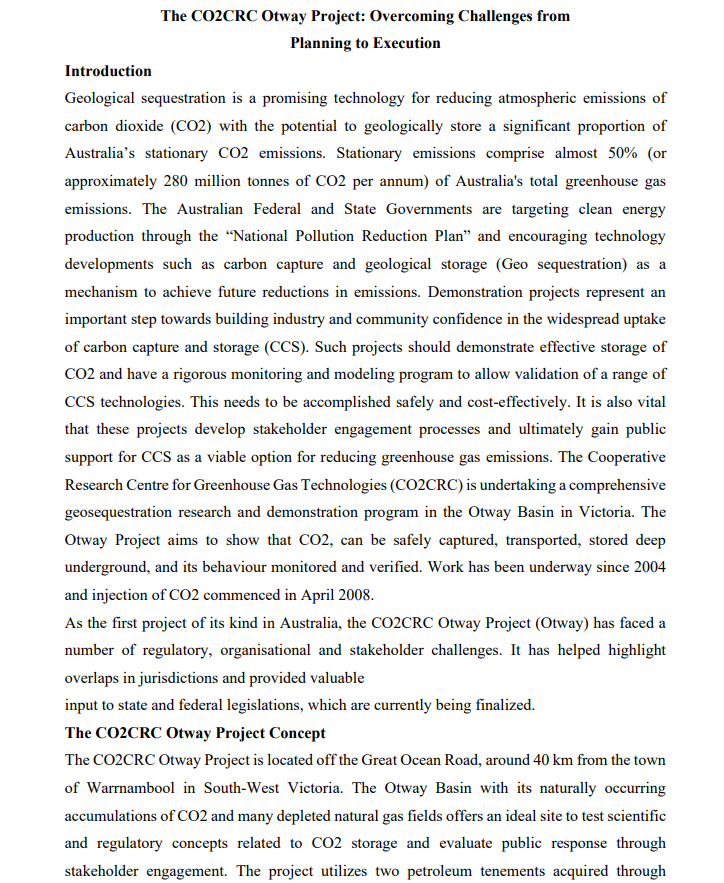
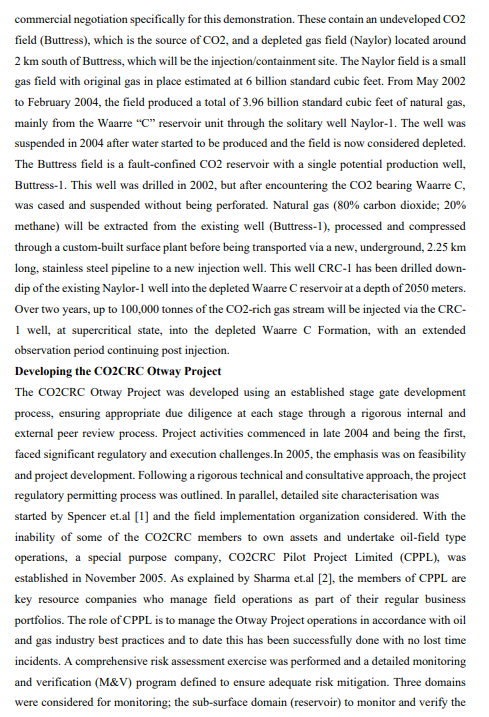
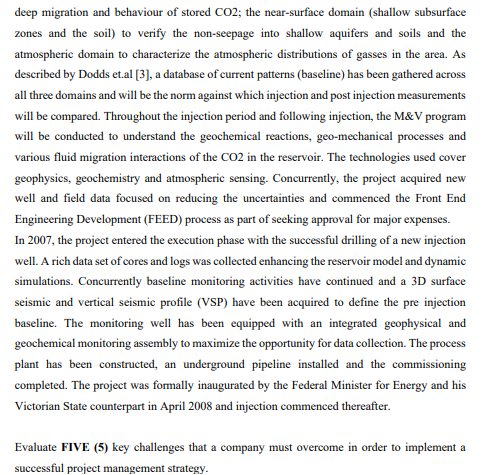
The CO2CRC Otway Project: Overcoming Challenges from Planning to Execution Introduction Geological sequestration is a promising technology for reducing atmospheric emissions of carbon dioxide (CO2) with the potential to geologically store a significant proportion of Australia's stationary CO2 emissions. Stationary emissions comprise almost 50% (or approximately 280 million tonnes of CO2 per annum) of Australia's total greenhouse gas emissions. The Australian Federal and State Governments are targeting clean energy production through the "National Pollution Reduction Plan" and encouraging technology developments such as carbon capture and geological storage (Geo sequestration) as a mechanism to achieve future reductions in emissions. Demonstration projects represent an important step towards building industry and community confidence in the widespread uptake of carbon capture and storage (CCS). Such projects should demonstrate effective storage of CO2 and have a rigorous monitoring and modeling program to allow validation of a range of CCS technologies. This needs to be accomplished safely and cost-effectively. It is also vital that these projects develop stakeholder engagement processes and ultimately gain public support for CCS as a viable option for reducing greenhouse gas emissions. The Cooperative Research Centre for Greenhouse Gas Technologies (CO2CRC) is undertaking a comprehensive geosequestration research and demonstration program in the Otway Basin in Victoria. The Otway Project aims to show that CO2, can be safely captured, transported, stored deep underground, and its behaviour monitored and verified. Work has been underway since 2004 and injection of CO2 commenced in April 2008. As the first project of its kind in Australia, the CO2CRC Otway Project (Otway) has faced a number of regulatory, organisational and stakeholder challenges. It has helped highlight overlaps in jurisdictions and provided valuable input to state and federal legislations, which are currently being finalized. The CO2CRC Otway Project Concept The CO2CRC Otway Project is located off the Great Ocean Road, around 40km from the town of Warrnambool in South-West Victoria. The Otway Basin with its naturally occurring accumulations of CO2 and many depleted natural gas fields offers an ideal site to test scientific and regulatory concepts related to CO2 storage and evaluate public response through stakeholder engagement. The project utilizes two petroleum tenements acquired through commercial negotiation specifically for this demonstration. These contain an undeveloped CO2 field (Buttress), which is the source of CO2, and a depleted gas field (Naylor) located around 2km south of Buttress, which will be the injection/containment site. The Naylor field is a small gas field with original gas in place estimated at 6 billion standard cubic feet. From May 2002 to February 2004, the field produced a total of 3.96 billion standard cubic feet of natural gas, mainly from the Waarre "C" reservoir unit through the solitary well Naylor-1. The well was suspended in 2004 after water started to be produced and the field is now considered depleted. The Buttress field is a fault-confined CO2 reservoir with a single potential production well, Buttress-1. This well was drilled in 2002, but after encountering the CO2 bearing Waarre C, was cased and suspended without being perforated. Natural gas ( 80% carbon dioxide; 20% methane) will be extracted from the existing well (Buttress-1), processed and compressed through a custom-built surface plant before being transported via a new, underground, 2.25km long, stainless steel pipeline to a new injection well. This well CRC-1 has been drilled downdip of the existing Naylor-1 well into the depleted Waarre C reservoir at a depth of 2050 meters. Over two years, up to 100,000 tonnes of the CO2-rich gas stream will be injected via the CRC 1 well, at supercritical state, into the depleted Waarre C Formation, with an extended observation period continuing post injection. Developing the CO2CRC Otway Project The CO2CRC Otway Project was developed using an established stage gate development process, ensuring appropriate due diligence at each stage through a rigorous internal and external peer review process. Project activities commenced in late 2004 and being the first, faced significant regulatory and execution challenges. In 2005 , the emphasis was on feasibility and project development. Following a rigorous technical and consultative approach, the project regulatory permitting process was outlined. In parallel, detailed site characterisation was started by Spencer et.al [1] and the field implementation organization considered. With the inability of some of the CO2CRC members to own assets and undertake oil-field type operations, a special purpose company, CO2CRC Pilot Project Limited (CPPL), was established in November 2005. As explained by Sharma et.al [2], the members of CPPL are key resource companies who manage field operations as part of their regular business portfolios. The role of CPPL is to manage the Otway Project operations in accordance with oil and gas industry best practices and to date this has been successfully done with no lost time incidents. A comprehensive risk assessment exercise was performed and a detailed monitoring and verification (M\&V) program defined to ensure adequate risk mitigation. Three domains were considered for monitoring; the sub-surface domain (reservoir) to monitor and verify the deep migration and behaviour of stored CO2; the near-surface domain (shallow subsurface zones and the soil) to verify the non-seepage into shallow aquifers and soils and the atmospheric domain to characterize the atmospheric distributions of gasses in the area. As described by Dodds et.al [3], a database of current patterns (baseline) has been gathered across all three domains and will be the norm against which injection and post injection measurements will be compared. Throughout the injection period and following injection, the M\&V program will be conducted to understand the geochemical reactions, geo-mechanical processes and various fluid migration interactions of the CO2 in the reservoir. The technologies used cover geophysics, geochemistry and atmospheric sensing. Concurrently, the project acquired new well and field data focused on reducing the uncertainties and commenced the Front End Engineering Development (FEED) process as part of seeking approval for major expenses. In 2007 , the project entered the execution phase with the successful drilling of a new injection well. A rich data set of cores and logs was collected enhancing the reservoir model and dynamic simulations. Concurrently baseline monitoring activities have continued and a 3D surface seismic and vertical seismic profile (VSP) have been acquired to define the pre injection baseline. The monitoring well has been equipped with an integrated geophysical and geochemical monitoring assembly to maximize the opportunity for data collection. The process plant has been constructed, an underground pipeline installed and the commissioning completed. The project was formally inaugurated by the Federal Minister for Energy and his Victorian State counterpart in April 2008 and injection commenced thereafter. Evaluate FIVE (5) key challenges that a company must overcome in order to implement a
Step by Step Solution
There are 3 Steps involved in it

Get step-by-step solutions from verified subject matter experts
 Study Help