







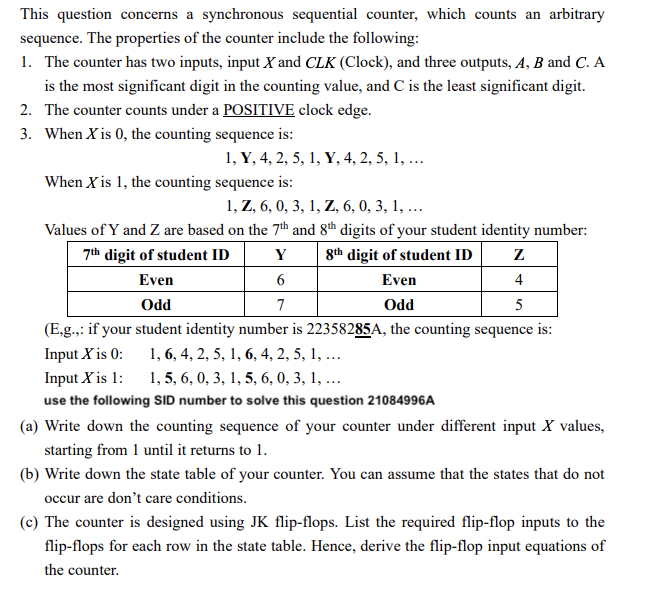
Question: This question concerns a synchronous sequential counter, which counts an arbitrary sequence. The properties of the counter include the following: The counter has two inputs,
This question concerns a synchronous sequential counter, which counts an arbitrary
sequence. The properties of the counter include the following:
The counter has two inputs, input and Clock and three outputs, and A
is the most significant digit in the counting value, and C is the least significant digit.
The counter counts under a POSITIVE clock edge.
When is the counting sequence is:
dots
When is the counting sequence is:
dots
Values of Y and Z are based on the and digits of your student identity number:
Eg: if your student identity number is A the counting sequence is:
Input is :dots
Input is :dots
use the following SID number to solve this question A
a Write down the counting sequence of your counter under different input values,
starting from until it returns to
b Write down the state table of your counter. You can assume that the states that do not
occur are don't care conditions.
c The counter is designed using JK flipflops. List the required flipflop inputs to the
flipflops for each row in the state table. Hence, derive the flipflop input equations of
the counter.
Step by Step Solution
There are 3 Steps involved in it
1 Expert Approved Answer
Step: 1 Unlock

Question Has Been Solved by an Expert!
Get step-by-step solutions from verified subject matter experts
Step: 2 Unlock
Step: 3 Unlock
 Study Help