







Question: This question is about the pumping lemma for context-free languages. Let A = {w belongsto {a, b, c, d}* | n_a(w) = n_b(w) and n_c(w)
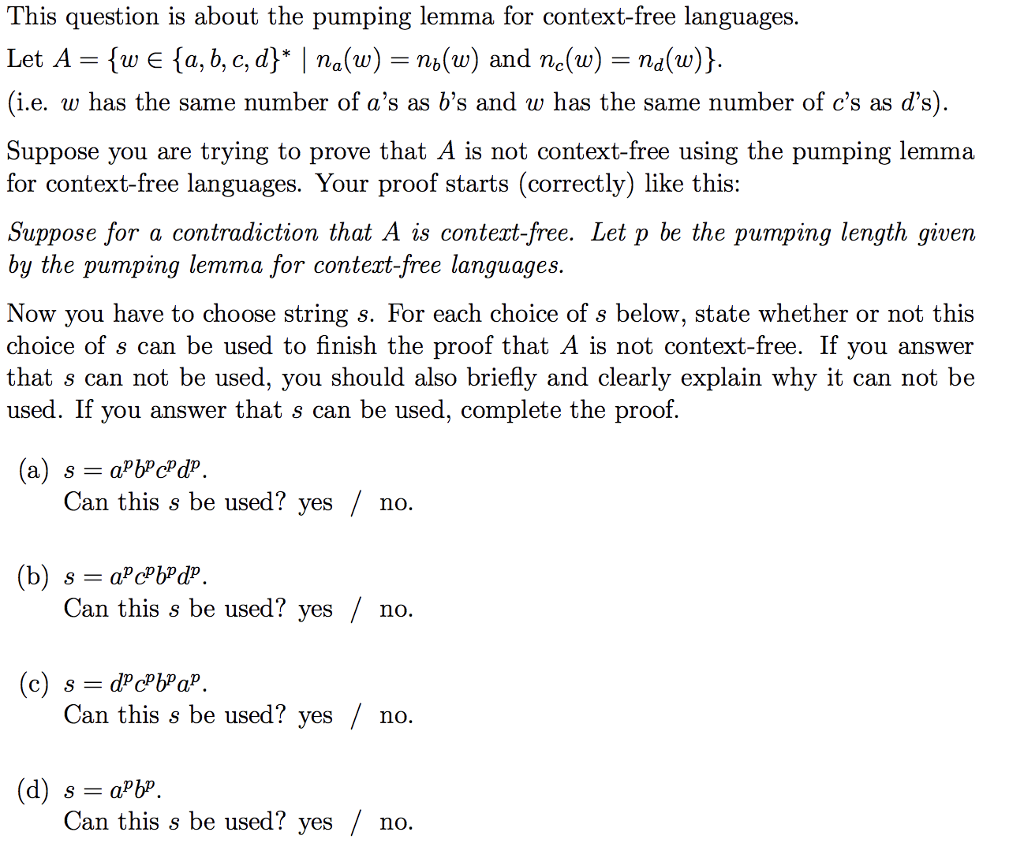
This question is about the pumping lemma for context-free languages. Let A = {w belongsto {a, b, c, d}* | n_a(w) = n_b(w) and n_c(w) = n_d(w)}. (i.e. w has the same number of a's as 6's and w has the same number of c's as d's). Suppose you are trying to prove that A is not context-free using the pumping lemma for context-free languages. Your proof starts (correctly) like this: Suppose for a contradiction that A is context-free. Let p be the pumping length given by the pumping lemma for context-free languages. Now you have to choose string s. For each choice of s below, state whether or not this choice of s can be used to finish the proof that A is not context-free. If you answer that s cannot be used, you should also briefly and clearly explain why it cannot be used. If you answer that s can be used, complete the proof. (a) s = a^p b^p c^p d^p. Can this s be used? yeso. (b) s = a^p c^p b^p d^p. Can this s be used? yeso. (c) s = d^p c^p b^p a^p. Can this s be used? yeso. (d) s = a^p bp. Can this s be used? yeso
Step by Step Solution
There are 3 Steps involved in it

Get step-by-step solutions from verified subject matter experts
 Study Help