







Question: this question is based on ROY MODEL and the subject is economics of migration. so please solve all the parts i have put it many
this question is based on ROY MODEL and the subject is economics of migration. so please solve all the parts i have put it many times
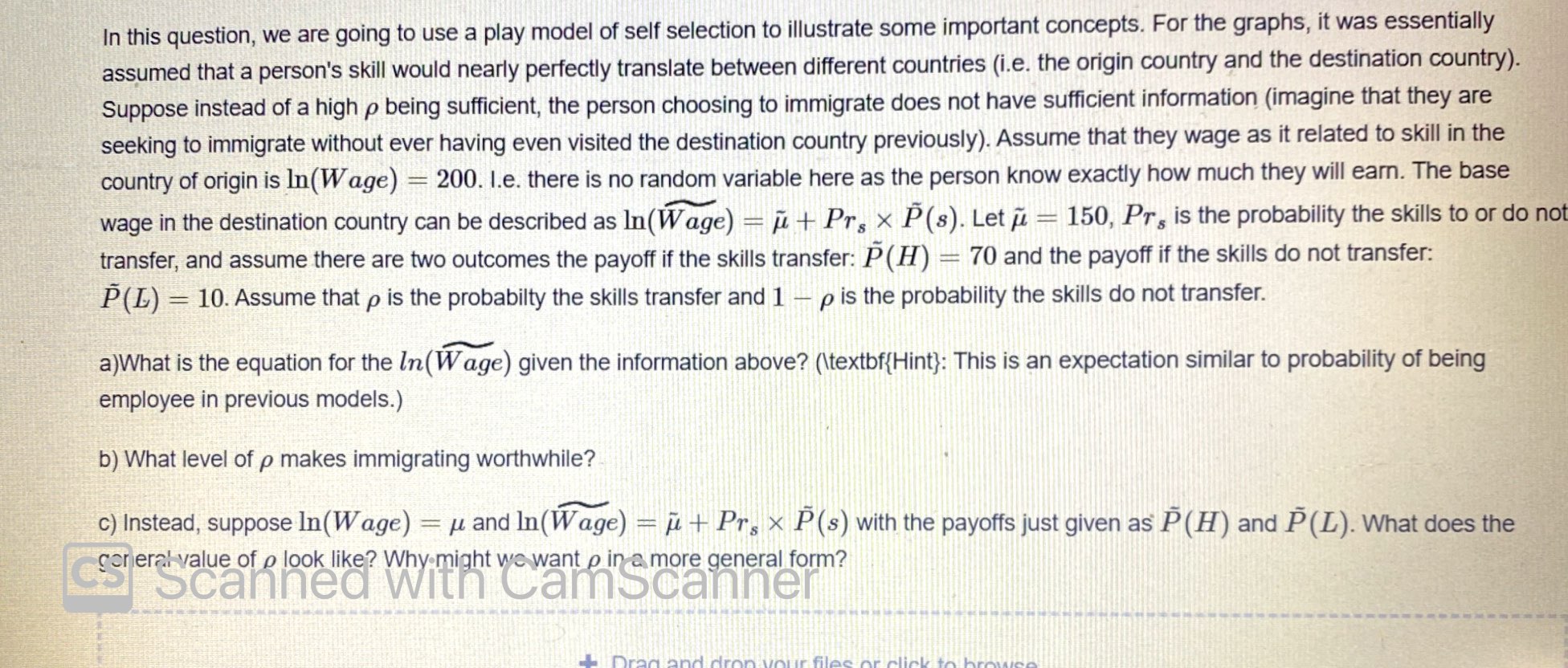
In this question, we are going to use a play model of self selection to illustrate some important concepts. For the graphs, it was essentially assumed that a person's skill would nearly perfectly translate between different countries (i.e. the origin country and the destination country). Suppose instead of a high p being sufficient, the person choosing to immigrate does not have sufficient information (imagine that they are seeking to immigrate without ever having even visited the destination country previously). Assume that they wage as it related to skill in the country of origin is In(Wage) - 200. I.e. there is no random variable here as the person know exactly how much they will earn. The base wage in the destination country can be described as In (Wage) - it | PT, X P(s). Let - 150, Pr, is the probability the skills to or do not transfer, and assume there are two outcomes the payoff if the skills transfer: P(H) - 70 and the payoff if the skills do not transfer: P(L) - 10. Assume that p is the probabilty the skills transfer and 1 - p is the probability the skills do not transfer. a)What is the equation for the In (Wage) given the information above? (\\textbf(Hint): This is an expectation similar to probability of being employee in previous models.) b) What level of p makes immigrating worthwhile? c) Instead, suppose In(Wage) = / and In(Wage) = at + Pr, x P(s) with the payoffs just given as P (H) and P(L). What does the general value of p look like? Why might we want p in a more general form? Scanned with Camscanner
Step by Step Solution
There are 3 Steps involved in it

Get step-by-step solutions from verified subject matter experts
 Study Help