



Question: This question is for CBA 400 course. Reading/Review: Merck case: Detailed SIMAC: Please write a Conclusion to the SIMAC Outline. Your Conclusion should include the
This question is for CBA 400 course.
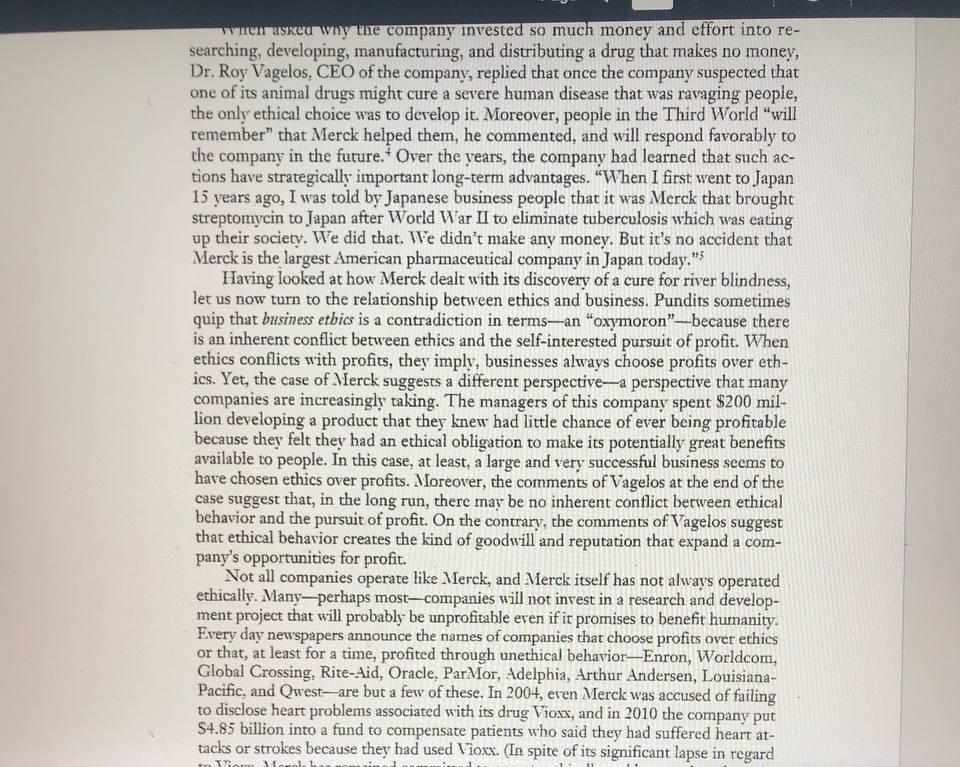
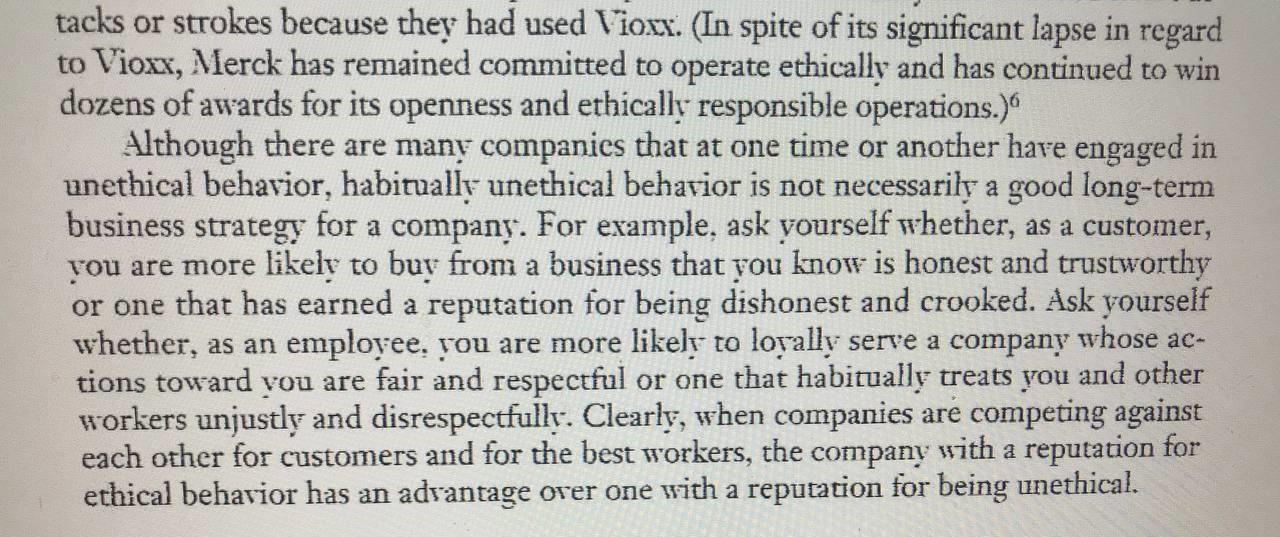
Reading/Review: Merck case:
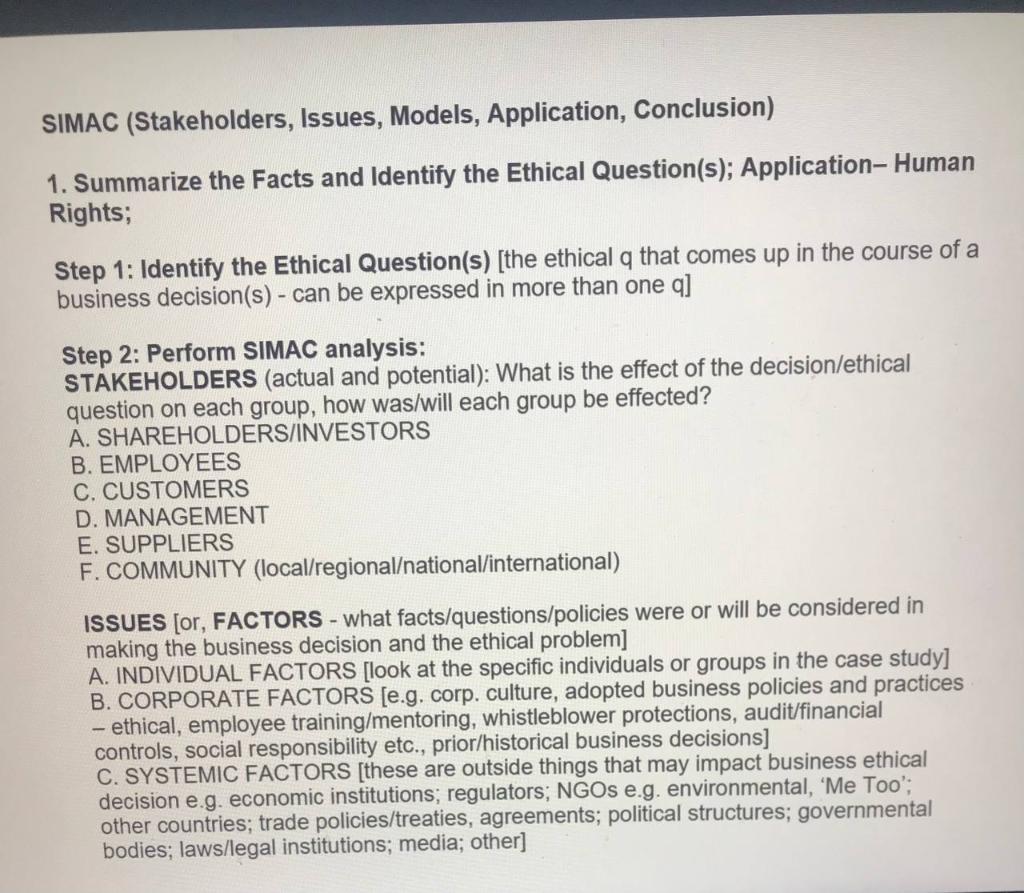
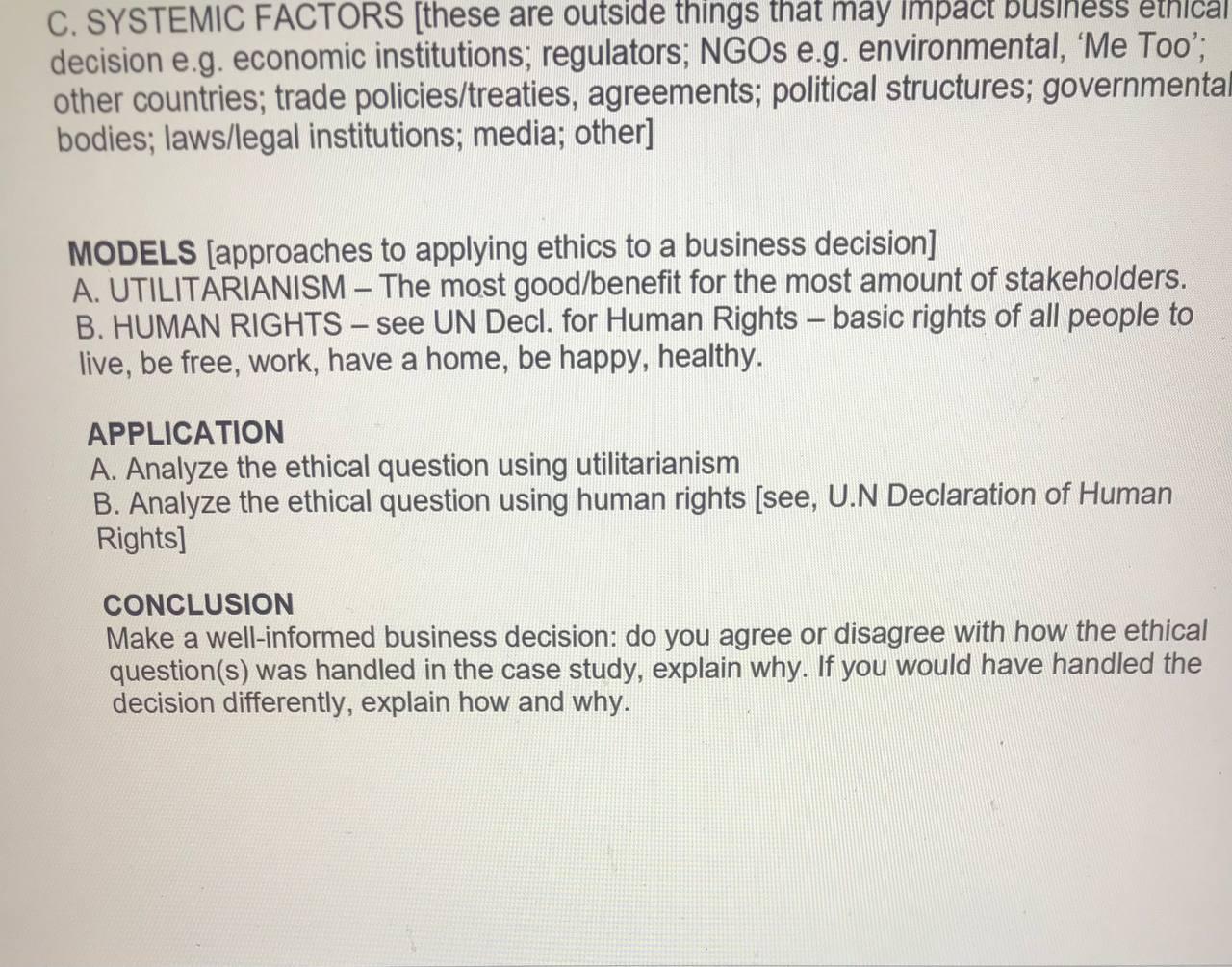
Detailed SIMAC:
Please write a Conclusion to the SIMAC Outline. Your Conclusion should include the following:
1. Make a well-informed business decision based on a Utilitarian analysis.
2. How would a Human Rights analysis differ?
3. Do you agree with how Merck handled the Issues? If not, explain why.
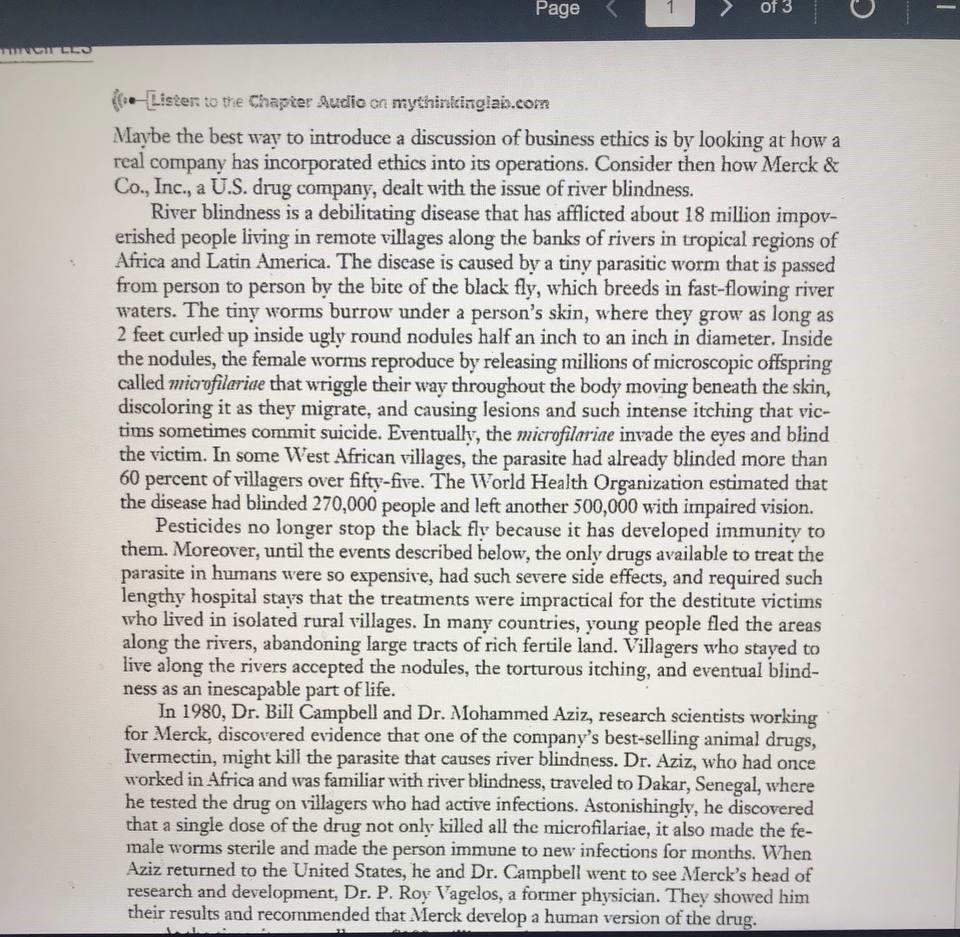
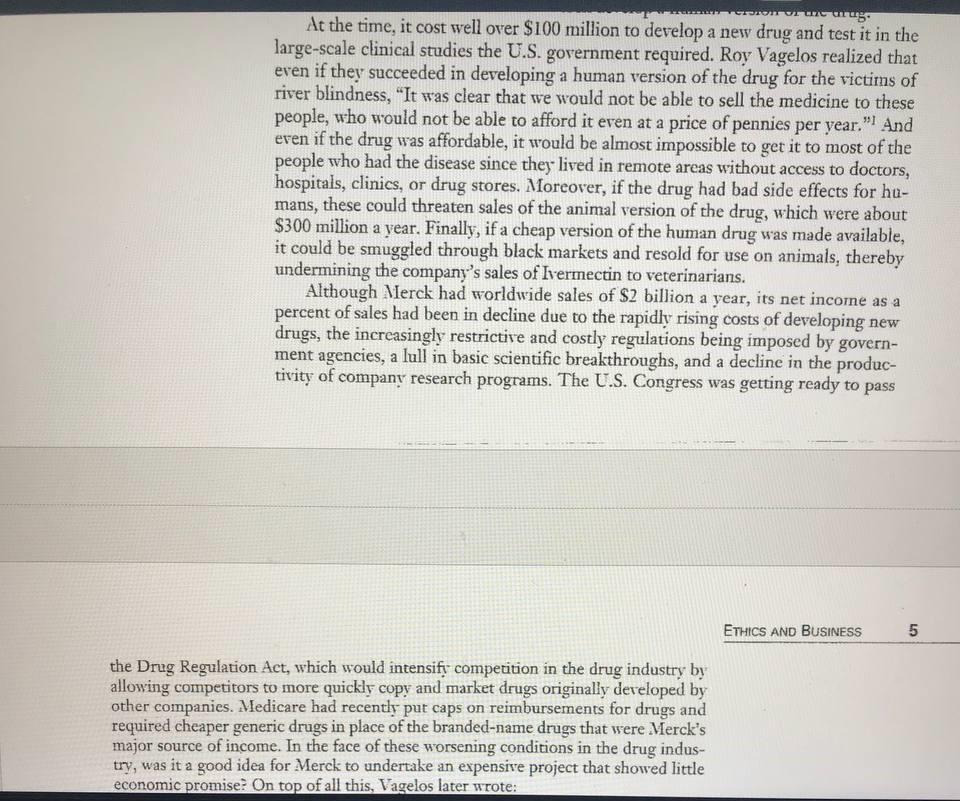
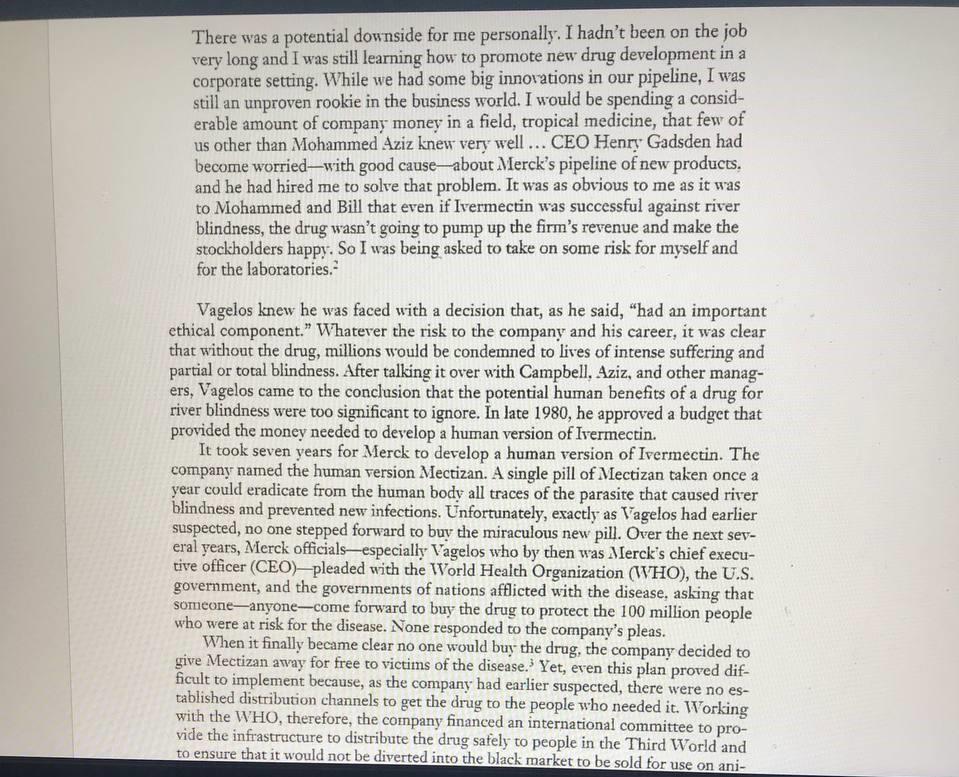
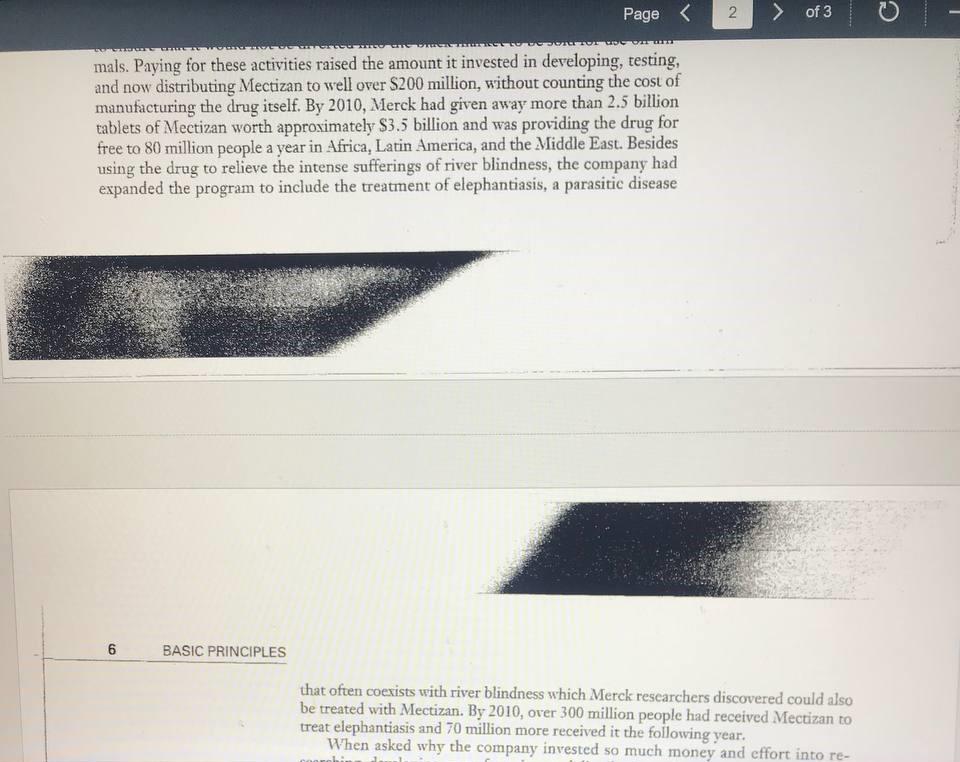
fiu- [isters to the Chapier Audio on mythinlinglab.com Maybe the best way to introduce a discussion of business ethics is by looking at how a real company has incorporated ethics into its operations. Consider then how Merck \& Co., Inc., a U.S. drug company, dealt with the issue of river blindness. River blindness is a debilitating disease that has afflicted about 18 million impoverished people living in remote villages along the banks of rivers in tropical regions of Africa and Latin America. The disease is caused by a tiny parasitic worm that is passed from person to person by the bite of the black fly, which breeds in fast-flowing river waters. The tiny worms burrow under a person's skin, where they grow as long as 2 feet curled up inside ugly round nodules half an inch to an inch in diameter. Inside the nodules, the female worms reproduce by releasing millions of microscopic offspring called microfilariae that wriggle their way throughout the body moving beneath the skin, discoloring it as they migrate, and causing lesions and such intense itching that victims sometimes commit suicide. Eventually, the microfilariae invade the eyes and blind the victim. In some West African villages, the parasite had already blinded more than 60 percent of villagers over fifty-five. The World Health Organization estimated that the disease had blinded 270,000 people and left another 500,000 with impaired vision. Pesticides no longer stop the black fly because it has developed immunity to them. Moreover, until the events described below, the only drugs available to treat the parasite in humans were so expensive, had such severe side effects, and required such lengthy hospital stays that the treatments were impractical for the destitute victims who lived in isolated rural villages. In many countries, young people fled the areas along the rivers, abandoning large tracts of rich fertile land. Villagers who stayed to live along the rivers accepted the nodules, the torturous itching, and eventual blindness as an inescapable part of life. In 1980, Dr. Bill Campbell and Dr. Mohammed Aziz, research scientists working for Merck, discovered evidence that one of the company's best-selling animal drugs, Ivermectin, might kill the parasite that causes river blindness. Dr. Aziz, who had once worked in Africa and was familiar with river blindness, traveled to Dakar, Senegal, where he tested the drug on villagers who had active infections. Astonishingly, he discovered that a single dose of the drug not only killed all the microfilariae, it also made the female worms sterile and made the person immune to new infections for months. When Aziz returned to the United States, he and Dr. Campbell went to see Merck's head of research and development, Dr. P. Roy Vagelos, a former physician. They showed him their results and recommended that Merck develop a human version of the drug. At the time, it cost well over $100 million to develop a new drug and test it in the large-scale clinical studies the U.S. government required. Roy Vagelos realized that even if they succeeded in developing a human version of the drug for the victims of river blindness, "It was clear that we would not be able to sell the medicine to these people, who would not be able to afford it even at a price of pennies per year." And even if the drug was affordable, it would be almost impossible to get it to most of the people who had the disease since they lived in remote areas without access to doctors, hospitals, clinics, or drug stores. Moreover, if the drug had bad side effects for hamans, these could threaten sales of the animal version of the drug, which were about $300 million a year. Finally, if a cheap version of the human drug was made available, it could be smuggled through black markets and resold for use on animals, thereby undermining the company's sales of Frermectin to veterinarians. Although Merck had worldwide sales of \$2 billion a year, its net income as a percent of sales had been in decline due to the rapidly rising costs of developing new drugs, the increasingly restrictive and costly regulations being imposed by government agencies, a lull in basic scientific breakthroughs, and a decline in the productivity of company research programs. The U.S. Congress was getting ready to pass ETHICS AND BUSINESS 5 the Drug Regulation Act, which would intensify competition in the drug industry by allowing competitors to more quickly copy and market drugs originally deteloped by other companies. Medicare had recently put caps on reimbursements for drugs and required cheaper generic drugs in place of the branded-name drugs that were Merck's major source of income. In the face of these worsening conditions in the drug industry, was it a good idea for Merck to undertake an expensive project that showed little economic promise? On top of all this, Vagelos later wrote: There was a potential downside for me personally. I hadn't been on the job very long and I was still learning how to promote new drug development in a corporate setting. While we had some big innorations in our pipeline, I was still an unproven rookie in the business world. I would be spending a considerable amount of company money in a field, tropical medicine, that few of us other than Mohammed Aziz knew very well ... CEO Henry Gadsden had become worried - with good cause - about Merck's pipeline of new products, and he had hired me to solve that problem. It was as obvious to me as it was to Mohammed and Bill that even if Ivermectin was successful against river blindness, the drug wasn't going to pump up the firm's revenue and make the stockholders happy. So I was being asked to take on some risk for myself and for the laboratories. 2 Vagelos knew he was faced with a decision that, as he said, "had an important ethical component." Whatever the risk to the company and his career, it was clear that without the drug, millions would be condemned to lives of intense suffering and partial or total blindness. After talking it over with Campbell, Aziz, and other managers, Vagelos came to the conclusion that the potential human benefits of a drug for river blindness were too significant to ignore. In late 1980, he approved a budget that provided the money needed to develop a human version of Ivermectin. It took seven years for Merck to develop a human version of Ivermectin. The company named the human version Mectizan. A single pill of Mectizan taken once a year could eradicate from the human body all traces of the parasite that caused river blindness and prevented new infections. Unfortunately, exactly as Vagelos had earlier suspected, no one stepped forward to buy the miraculous new pill. Over the next several years, Merck officials-especially Vagelos who by then was Merck's chief executive officer (CEO) -pleaded with the World Health Organization (WHO), the U.S. government, and the governments of nations afflicted with the disease, asking that someone - anyone-come forward to buy the drug to protect the 100 million people who were at risk for the disease. None responded to the company's pleas. When it finally became clear no one would buy the drug, the company decided to give Mectizan away for free to victims of the disease. 3 Yet, even this plan proved difficult to implement because, as the company had earlier suspected, there were no established distribution channels to get the drug to the people who needed it. Working with the WHO, therefore, the company financed an international committee to provide the infrastructure to distribute the drug safely to people in the Third World and to ensure that it would not be diverted into the black market to be sold for use on ani- mals. Paying for these activities raised the amount it invested in developing, testing, and now distributing Mectizan to well over \$200 million, without counting the cost of manufacturing the drug itself. By 2010, Merck had given away more than 2.5 billion tablets of Mectizan worth approximately $3.5 billion and was providing the drug for free to 80 million people a year in Africa, Latin America, and the Middle East. Besides using the drug to relieve the intense sufferings of river blindness, the company had expanded the program to include the treatment of elephantiasis, a parasitic disease 6 BASIC PRINCIPLES that often coexists with river blindness which Merck researchers discovered could also be treated with Mectizan. By 2010 , over 300 million people had received Mectizan to treat elephantiasis and 70 million more received it the following year. When asked why the company invested so much money and effort into re- searching, developing, manufacturing, and distributing a drug that makes no money, Dr. Roy Vagelos, CEO of the company, replied that once the company suspected that one of its animal drugs might cure a severe human disease that was ravaging people, the only ethical choice was to derelop it. Moreover, people in the Third World "will remember" that Merck helped them, he commented, and will respond favorably to the company in the future. +Over the years, the company had learned that such actions have strategically important long-term advantages. "When I first went to Japan 15 years ago, I was told by Japanese business people that it was Merck that brought streptomycin to Japan after World W ar II to eliminate tuberculosis which was eating up their society. We did that. We didn't make any money. But it's no accident that Merck is the largest American pharmaceutical company in Japan today." Having looked at how Merck dealt with its discovery of a cure for river blindness, let us now turn to the relationship between ethics and business. Pundits sometimes quip that business etbics is a contradiction in terms-an "oxymoron"-because there is an inherent conflict between ethics and the self-interested pursuit of profit. When ethics conflicts with profits, they imply, businesses always choose profits over ethics. Yet, the case of Merck suggests a different perspective - a perspective that many companies are increasingly taking. The managers of this company spent $200 million developing a product that they knew had little chance of ever being profitable because they felt they had an ethical obligation to make its potentially great benefits available to people. In this case, at least, a large and very successful business secms to have chosen ethics over profits. Moreover, the comments of Vagelos at the end of the case suggest that, in the long run, there may be no inherent conflict between ethical behavior and the pursuit of profit. On the contrary, the comments of Vagelos suggest that ethical behavior creates the kind of goodwill and reputation that expand a company's opportunities for profit. Not all companies operate like Merck, and Merck itself has not always operated ethically. Many-perhaps most-companies will not invest in a research and development project that will probably be unprofitable eren if it promises to benefit humanity. Every day newspapers announce the names of companies that choose profits over ethics or that, at least for a time, profited through unethical behavior-Enron, Worldcom, Global Crossing, Rite-Aid, Oracle, ParMor, Adelphia, Arthur Andersen, LouisianaPacific, and Qwest-are but a few of these. In 2004, eren Merck was accused of failing to disclose heart problems associated with its drug Vioxx, and in 2010 the company put S4.85 billion into a fund to compensate patients who said they had suffered heart attacks or strokes because they had used Vioxs. (In spite of its significant lapse in regard tacks or strokes because they had used Vioxx. (In spite of its significant lapse in regard to Vioxx, Merck has remained committed to operate ethically and has continued to win dozens of awards for its openness and ethically responsible operations. )6 Although there are many companies that at one time or another have engaged in unethical behavior, habitually unethical behavior is not necessarily a good long-term business strategy for a company. For example, ask yourself whether, as a customer, you are more likely to buy from a business that you know is honest and trustworthy or one that has earned a reputation for being dishonest and crooked. Ask yourself whether, as an employee, you are more likely to loyally serve a company whose actions toward you are fair and respectful or one that habitually treats you and other workers unjustly and disrespectfully. Clearly, when companies are competing against each other for customers and for the best workers, the company with a reputation for ethical behavior has an adrantage orer one with a reputation for being unethical. 1. Summarize the Facts and Identify the Ethical Question(s); Application-Human Rights; Step 1: Identify the Ethical Question(s) [the ethical q that comes up in the course of a business decision(s) - can be expressed in more than one q] Step 2: Perform SIMAC analysis: STAKEHOLDERS (actual and potential): What is the effect of the decision/ethical question on each group, how was/will each group be effected? A. SHAREHOLDERS/INVESTORS B. EMPLOYEES C. CUSTOMERS D. MANAGEMENT E. SUPPLIERS F. COMMUNITY (local/regionalational/international) ISSUES [or, FACTORS - what facts/questions/policies were or will be considered in making the business decision and the ethical problem] A. INDIVIDUAL FACTORS [look at the specific individuals or groups in the case study] B. CORPORATE FACTORS [e.g. corp. culture, adopted business policies and practices - ethical, employee training/mentoring, whistleblower protections, audit/financial controls, social responsibility etc., prior/historical business decisions] C. SYSTEMIC FACTORS [these are outside things that may impact business ethical decision e.g. economic institutions; regulators; NGOs e.g. environmental, 'Me Too'; other countries; trade policies/treaties, agreements; political structures; governmental bodies; laws/legal institutions; media; other] C. SYSTEMIC FACTORS [these are outside things tnat may impact ousiness etnical decision e.g. economic institutions; regulators; NGOs e.g. environmental, 'Me Too'; other countries; trade policies/treaties, agreements; political structures; governmenta bodies; laws/legal institutions; media; other] MODELS [approaches to applying ethics to a business decision] A. UTILITARIANISM - The most good/benefit for the most amount of stakeholders. B. HUMAN RIGHTS - see UN Decl. for Human Rights - basic rights of all people to live, be free, work, have a home, be happy, healthy. APPLICATION A. Analyze the ethical question using utilitarianism B. Analyze the ethical question using human rights [see, U.N Declaration of Human Rights] CONCLUSION Make a well-informed business decision: do you agree or disagree with how the ethical question(s) was handled in the case study, explain why. If you would have handled the decision differently, explain how and why
Step by Step Solution
There are 3 Steps involved in it

Get step-by-step solutions from verified subject matter experts