







Question: THIS QUESTION IS FROM SUBJECT MATHEMATICS FOR COMPUTING. PLEASE PUT YOUR ANSWER ! DONT COPY/PASTE OTHER PERSON'S ANSWER. IF YOU COPY/PASTE, I WILL DOWNVOTE !
THIS QUESTION IS FROM SUBJECT MATHEMATICS FOR COMPUTING. PLEASE PUT YOUR ANSWER ! DONT COPY/PASTE OTHER PERSON'S ANSWER.
IF YOU COPY/PASTE, I WILL DOWNVOTE !
*NEED CLEAN AND CLEAR ANSWER*
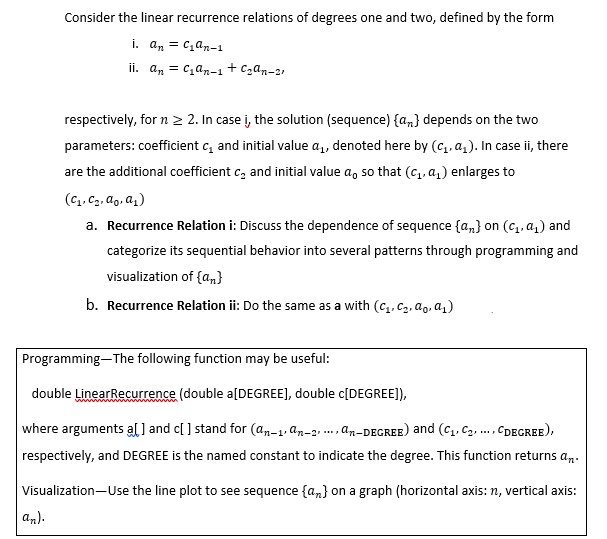
Consider the linear recurrence relations of degrees one and two, defined by the form i. an = can-1 ii. an = can-1 + Can-3, respectively, for n 2 2. In case i, the solution (sequence) {an} depends on the two parameters: coefficient c, and initial value a, denoted here by (CZ, ay). In case ii, there are the additional coefficient C, and initial value a, so that (C1, aj) enlarges to (C1,C2, 20, 21) a. Recurrence Relation i: Discuss the dependence of sequence {an} on (C1, a.) and categorize its sequential behavior into several patterns through programming and visualization of {an} b. Recurrence Relation ii: Do the same as a with (C1, C2,2g, a.) Programming, The following function may be useful: double LinearRecurrence (double a[DEGREE], double C[DEGREE]), where arguments al ] and c[ ] stand for (an-1,An-2, ..., On-DEGREE) and (C1, C2, ...,CDEGREE), respectively, and DEGREE is the named constant to indicate the degree. This function returns an. Visualization-Use the line plot to see sequence {an} on a graph (horizontal axis: n, vertical axis: an)
Step by Step Solution
There are 3 Steps involved in it

Get step-by-step solutions from verified subject matter experts
 Study Help