







Question: This question looks at how there can be more than one way to express an idea in logical notation. For this question, we will
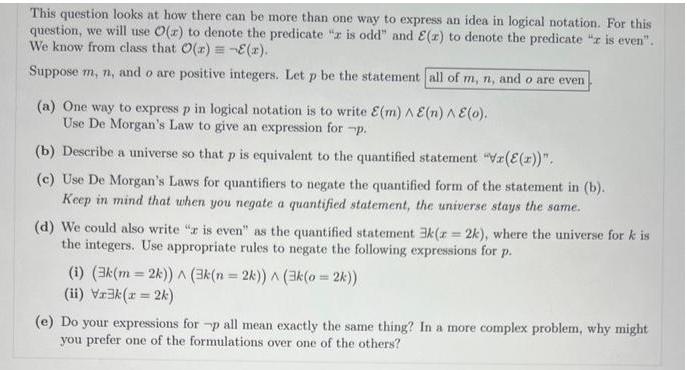
This question looks at how there can be more than one way to express an idea in logical notation. For this question, we will use O(r) to denote the predicate "z is odd" and E(z) to denote the predicate "z is even". We know from class that O(r)=E(x). Suppose m, n, and o are positive integers. Let p be the statement all of m, n, and o are even (a) One way to express p in logical notation is to write E(m) A E(n) AE(o). Use De Morgan's Law to give an expression for p. (b) Describe a universe so that p is equivalent to the quantified statement "Va(E(x))", (c) Use De Morgan's Laws for quantifiers to negate the quantified form of the statement in (b). Keep in mind that when you negate a quantified statement, the universe stays the same. (d) We could also write "r is even" as the quantified statement 3k(z = 2k), where the universe for k is the integers. Use appropriate rules to negate the following expressions for p. (i) (3k(m=2k)) ^ (3k(n=2k)) ^ (3k(o = 2k)) (ii) Vrk(x = 2k) (e) Do your expressions for p all mean exactly the same thing? In a more complex problem, why might you prefer one of the formulations over one of the others?
Step by Step Solution
3.53 Rating (160 Votes )
There are 3 Steps involved in it

Get step-by-step solutions from verified subject matter experts
 Study Help