







Question: This question please Digital systems use analog voltages to represent the abstract bits 0 and 1 . As analog signals are subject to noise
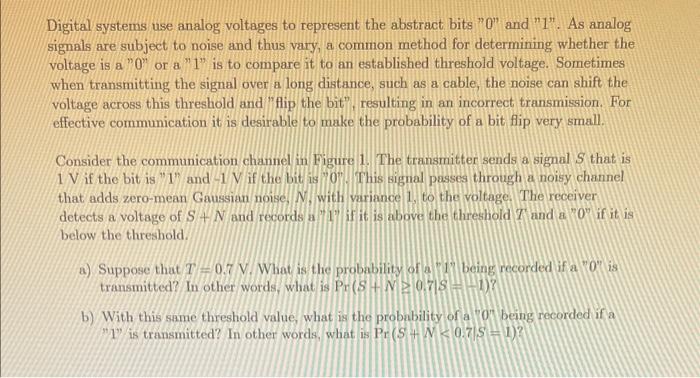
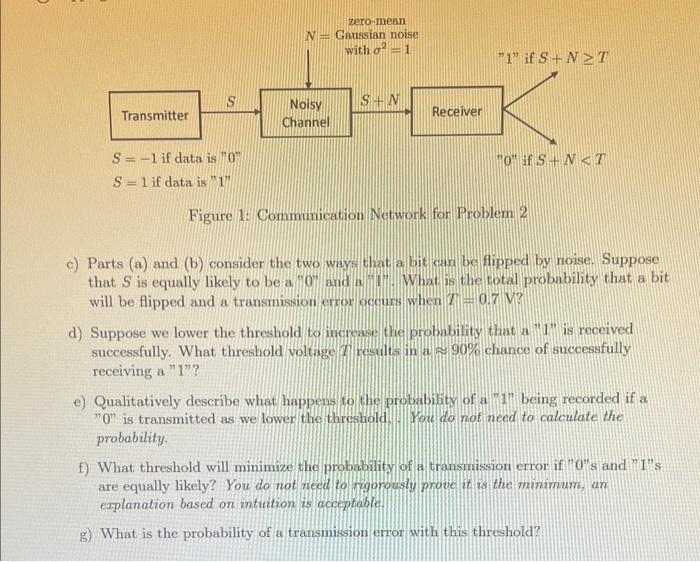
Digital systems use analog voltages to represent the abstract bits "0" and " 1 ". As analog signals are subject to noise and thus vary, a common method for determining whether the voltage is a " 0 " or a " 1 " is to compare it to an established threshold voltage. Sometimes when transmitting the signal over a long distance, such as a cable, the noise can shif the voltage across this threshold and "flip the bit", resulting in an incorrect transmission. For effective communication it is desirable to make the probability of a bit flip very small. Consider the communication channel in Figure 1. The transmitter sends a signal S that is 1V if the bit is " 1" and 1Y if the bit is 70 . This signal passes through a noisy channel that adds zero-mean Gaussian noise. N, with variance 1, to the voltage. The receiver detects a voltage of S+N and records a " 1" if it is above the threshold T and a 0 if it is below the threshold. a) Suppose that T=0.7V. What is the probability of a I. being recorded if a 0 . is transmitted? In other words, what is Pr(S+N0.7s=1) ? b) With this same threshold value what is the probability of a wor being recorded if a "1" is transmitted? In other words, what is Pr(S+N
Step by Step Solution
There are 3 Steps involved in it

Get step-by-step solutions from verified subject matter experts
 Study Help