





Question: This question will have you calculating 2 EOQ and ROP values and interpreting the results. For both EOQ and ROP, give your final answer in
This question will have you calculating 2 EOQ andThis question will have you calculating 2 EOQ and

  1. This question will have you calculating 2 EOQ and ROP values and interpreting the results. For both EOQ and ROP, give your final answer in full sock sets (ROUND UP to the next whole number). The specific questions to answer are based in parts a-c. Tips to solve the EOQ and ROP are given below in bullet points.
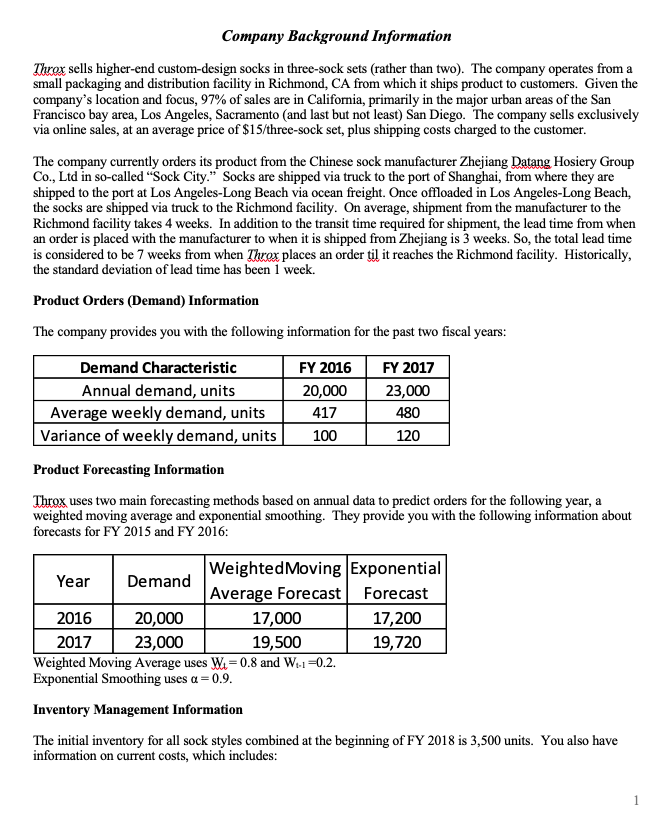
    1. Calculate EOQ and ROP for FY2017 based on the Exponential Forecast .
    2. Calculate the EOQ and ROP based upon actual demand for FY2017
    3. Using the responses from parts a & b, indicate what the implications are for inventory management costs in FY2017. In other words, 1. Compare the total costs for both EOQ values and analyze what it shows you. 2. What if any are the implications of the ROP based on the forecast vs the ROP based on actual demand.

See additional tips below:

  • Use a service level of 95% (z=1.65) when calculating the ROP
  • Calculate average weekly demand (d ) by dividing the forecast by 50 weeks
  • For the variance in weekly demand, use the data provided in the table on page 2 of the case with the FY2017 forecast for all approaches.
  • Remember that there is a difference between variance and standard deviation and how you apply these values in the ROP formula
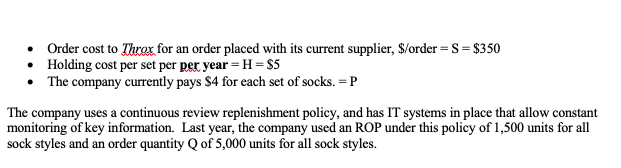
  • Annual Inventory management costs will include the following: Annual Holding Costs, Annual Ordering Costs, and Purchase Cost.
Company Background Information Threx sells higher-end custom-design socks in three-sock sets (rather than two). The company operates from a small packaging and distribution facility in Richmond, CA from which it ships product to customers. Given the company's location and focus, 97% of sales are in California, primarily in the major urban areas of the San Francisco bay area, Los Angeles, Sacramento (and last but not least) San Diego. The company sells exclusively via online sales, at an average price of $15/three-sock set, plus shipping costs charged to the customer. The company currently orders its product from the Chinese sock manufacturer Zhejiang Datang Hosiery Group Co., Ltd in so-called "Sock City." Socks are shipped via truck to the port of Shanghai, from where they are shipped to the port at Los Angeles-Long Beach via ocean freight. Once offloaded in Los Angeles-Long Beach, the socks are shipped via truck to the Richmond facility. On average, shipment from the manufacturer to the Richmond facility takes 4 weeks. In addition to the transit time required for shipment, the lead time from when an order is placed with the manufacturer to when it is shipped from Zhejiang is 3 weeks. So, the total lead time is considered to be 7 weeks from when Throx places an order til it reaches the Richmond facility. Historically, the standard deviation of lead time has been 1 week. Product Orders (Demand) Information The company provides you with the following information for the past two fiscal years: Demand Characteristic FY 2016 FY 2017 Annual demand, units 20,000 23,000 Average weekly demand, units 417 480 Variance of weekly demand, units 100 120 Product Forecasting Information Throx uses two main forecasting methods based on annual data to predict orders for the following year, a weighted moving average and exponential smoothing. They provide you with the following information about forecasts for FY 2015 and FY 2016: Weighted Moving Exponential Year Demand Average Forecast Forecast 2016 20,000 17,000 17,200 2017 23,000 19,500 19,720 Weighted Moving Average uses Wi=0.8 and W. =0.2. Exponential Smoothing uses a=0.9. Inventory Management Information The initial inventory for all sock styles combined at the beginning of FY 2018 is 3,500 units. You also have information on current costs, which includes: Order cost to Throx for an order placed with its current supplier, $/order=S=$350 Holding cost per set per per year = H = $5 The company currently pays $4 for each set of socks. =P The company uses a continuous review replenishment policy, and has IT systems in place that allow constant monitoring of key information. Last year, the company used an ROP under this policy of 1,500 units for all sock styles and an order quantity Q of 5,000 units for all sock styles

Step by Step Solution

There are 3 Steps involved in it

1 Expert Approved Answer
Step: 1 Unlock blur-text-image

Question Has Been Solved by an Expert!

Get step-by-step solutions from verified subject matter experts

Step: 2 Unlock
Step: 3 Unlock

Students Have Also Explored These Related General Management Questions!