Question: This week's mini case relates to Marketing - the four P's: translating the 4Ps into digital marketing campaigns. MARKETING - Mini Case.pdf Read the attached
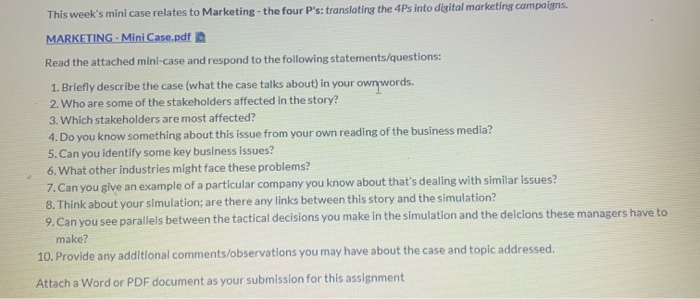
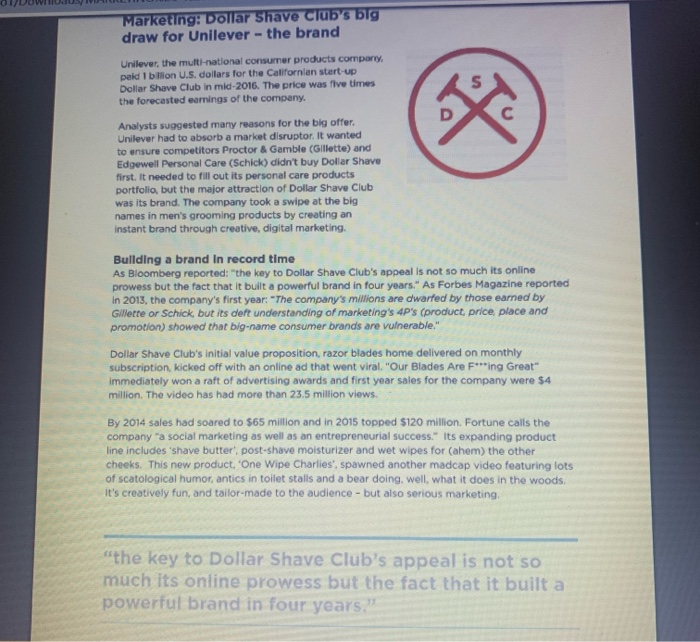
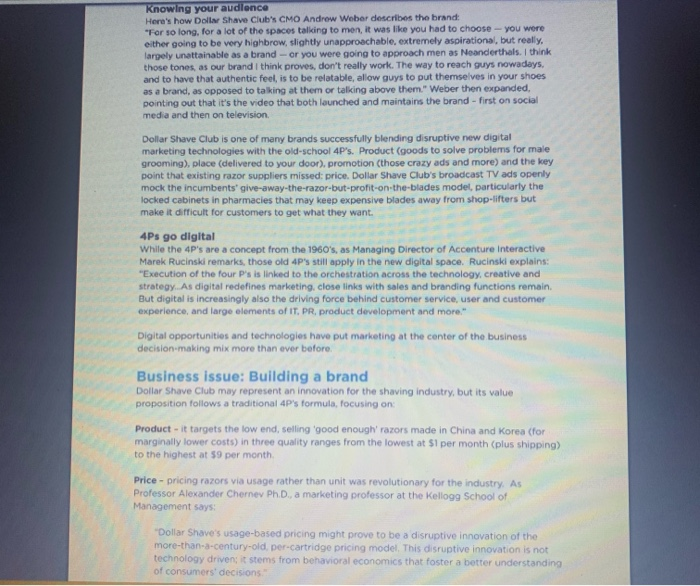
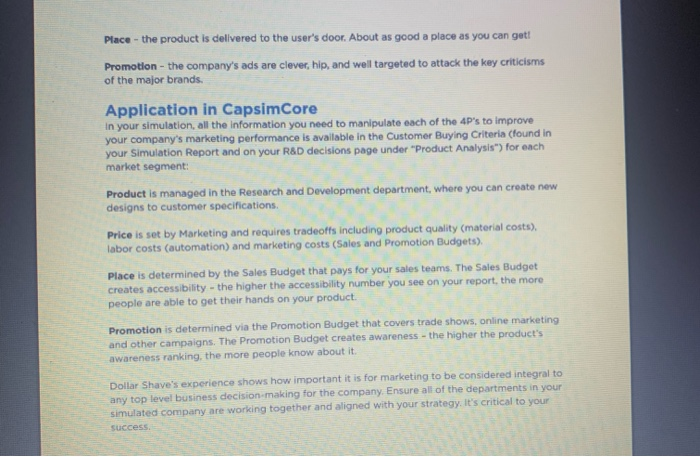
This week's mini case relates to Marketing - the four P's: translating the 4Ps into digital marketing campaigns. MARKETING - Mini Case.pdf Read the attached mini-case and respond to the following statements/questions: 1. Briefly describe the case (what the case talks about) in your own words. 2. Who are some of the stakeholders affected in the story? 3. Which stakeholders are most affected? 4. Do you know something about this issue from your own reading of the business media? 5. Can you identify some key business issues? 6. What other industries might face these problems? 7. Can you give an example of a particular company you know about that's dealing with similar issues? 8. Think about your simulation; are there any links between this story and the simulation? 9. Can you see parallels between the tactical decisions you make in the simulation and the deicions these managers have to make? 10. Provide any additional comments/observations you may have about the case and topic addressed. Attach a Word or PDF document as your submission for this assignment Marketing: Dollar Shave Club's big draw for Unilever - the brand & Unilever, the multi-national consumer products company paid I billion U.S. dollars for the Californian start-up Dollar Shave Club in mid-2016. The price was five times the forecasted earnings of the company. Analysts suggested many reasons for the big offer. Unilever had to absorb a market disruptor. It wanted to ensure competitors Proctor & Gamble (Gillette) and Edgewell Personal Care (Schick) didn't buy Dollar Shave first. It needed to fill out its personal care products portfolio, but the major attraction of Dollar Shave Club was its brand. The company took a swipe at the big names in men's grooming products by creating an instant brand through creative, digital marketing. Building a brand in record time As Bloomberg reported: "the key to Dollar Shave Club's appeal is not so much its online prowess but the fact that it built a powerful brand in four years." As Forbes Magazine reported In 2013, the company's first year: "The company's millions are dwarfed by those earned by Gillette or Schick, but its delt understanding of marketing's 4P's (product, price, place and promotion) showed that big-name consumer brands are vulnerable." Dollar Shave Club's initial value proposition, razor blades home delivered on monthly subscription, kicked off with an online ad that went viral. "Our Blades Are F***ing Great" immediately won a raft of advertising awards and first year sales for the company were $4 million. The video has had more than 23.5 million views By 2014 sales had soared to $65 million and in 2015 topped $120 million. Fortune calls the company "a social marketing as well as an entrepreneurial success." Its expanding product line includes 'shave butter, post-shave moisturizer and wet wipes for (ahem) the other cheeks. This new product. 'One Wipe Charlies' spawned another madcap video featuring lots of scatological humor, antics in toilet stalls and a bear doing, well, what it does in the woods. it's creatively fun, and tailor-made to the audience - but also serious marketing "the key to Dollar Shave Club's appeal is not so much its online prowess but the fact that it built a powerful brand in four years." Knowing your audience Here's how Dollar Shave Club's CMO Andrew Weber describes the brand: "For so long, for a lot of the spaces talking to men, it was like you had to choose - you were either going to be very highbrow, slightly unapproachable, extremely aspirational, but really largely unattainable as a brand - or you were going to approach men as Neanderthals. I think those tones, as our brand I think proves, don't really work. The way to reach guys nowadays, and to have that authentic feel, is to be relatable, allow guys to put themselves in your shoes as a brand, as opposed to talking at them or talking above them." Weber then expanded, pointing out that it's the video that both launched and maintains the brand - first on social media and then on television. Dollar Shave Club is one of many brands successfully blending disruptive new digital marketing technologies with the old-school 4P's. Product (goods to solve problems for male grooming), place (delivered to your door), promotion (those crazy ads and more) and the key point that existing razor suppliers missed: price. Dollar Shave Club's broadcast TV ads openly mock the incumbents' give-away-the-razor-but-profit-on-the-blades model, particularly the locked cabinets in pharmacies that may keep expensive blades away from shop-lifters but make it difficult for customers to get what they want. 4Ps go digital While the 4P's are a concept from the 1960's, as Managing Director of Accenture Interactive Marek Rucinski remarks, those old 4P's still apply in the new digital space. Rucinski explains: "Execution of the four P's is linked to the orchestration across the technology, creative and strategy. As digital redefines marketing, close links with sales and branding functions remain. But digital is increasingly also the driving force behind customer service, user and customer experience, and large elements of IT, PR, product development and more." Digital opportunities and technologies have put marketing at the center of the business decision-making mix more than ever before. Business issue: Building a brand Dollar Shave Club may represent an innovation for the shaving industry, but its value proposition follows a traditional 4P's formula, focusing on Product - it targets the low end, selling 'good enough' razors made in China and Korea (for marginally lower costs) in three quality ranges from the lowest at $1 per month (plus shipping) to the highest at 59 per month Price - pricing razors via usage rather than unit was revolutionary for the industry. As Professor Alexander Chernev Ph.D. a marketing professor at the Kellogg School of Management says: "Dollar Shave's usage-based pricing might prove to be a disruptive innovation of the more-than-a-century-old, per cartridge pricing model. This disruptive innovation is not technology driven; it stems from behavioral economics that foster a better understanding of consumers' decisions." Place - the product is delivered to the user's door. About as good a place as you can gett Promotion - the company's ads are clever, hip, and well targeted to attack the key criticisms of the major brands. Application in CapsimCore in your simulation, all the information you need to manipulate each of the 4P's to improve your company's marketing performance is available in the Customer Buying Criteria (found in your Simulation Report and on your R&D decisions page under "Product Analysis") for each market segment Product is managed in the Research and Development department, where you can create new designs to customer specifications Price is set by Marketing and requires tradeoffs including product quality (material costs), labor costs (automation) and marketing costs (Sales and Promotion Budgets), Place is determined by the Sales Budget that pays for your sales teams. The Sales Budget creates accessibility - the higher the accessibility number you see on your report, the more people are able to get their hands on your product. Promotion is determined via the Promotion Budget that covers trade shows online marketing and other campaigns. The Promotion Budget creates awareness - the higher the product's awareness ranking, the more people know about it Dollar Shave's experience shows how important it is for marketing to be considered integral to any top level business decision-making for the company. Ensure all of the departments in your simulated company are working together and aligned with your strategy. It's critical to your Success This week's mini case relates to Marketing - the four P's: translating the 4Ps into digital marketing campaigns. MARKETING - Mini Case.pdf Read the attached mini-case and respond to the following statements/questions: 1. Briefly describe the case (what the case talks about) in your own words. 2. Who are some of the stakeholders affected in the story? 3. Which stakeholders are most affected? 4. Do you know something about this issue from your own reading of the business media? 5. Can you identify some key business issues? 6. What other industries might face these problems? 7. Can you give an example of a particular company you know about that's dealing with similar issues? 8. Think about your simulation; are there any links between this story and the simulation? 9. Can you see parallels between the tactical decisions you make in the simulation and the deicions these managers have to make? 10. Provide any additional comments/observations you may have about the case and topic addressed. Attach a Word or PDF document as your submission for this assignment Marketing: Dollar Shave Club's big draw for Unilever - the brand & Unilever, the multi-national consumer products company paid I billion U.S. dollars for the Californian start-up Dollar Shave Club in mid-2016. The price was five times the forecasted earnings of the company. Analysts suggested many reasons for the big offer. Unilever had to absorb a market disruptor. It wanted to ensure competitors Proctor & Gamble (Gillette) and Edgewell Personal Care (Schick) didn't buy Dollar Shave first. It needed to fill out its personal care products portfolio, but the major attraction of Dollar Shave Club was its brand. The company took a swipe at the big names in men's grooming products by creating an instant brand through creative, digital marketing. Building a brand in record time As Bloomberg reported: "the key to Dollar Shave Club's appeal is not so much its online prowess but the fact that it built a powerful brand in four years." As Forbes Magazine reported In 2013, the company's first year: "The company's millions are dwarfed by those earned by Gillette or Schick, but its delt understanding of marketing's 4P's (product, price, place and promotion) showed that big-name consumer brands are vulnerable." Dollar Shave Club's initial value proposition, razor blades home delivered on monthly subscription, kicked off with an online ad that went viral. "Our Blades Are F***ing Great" immediately won a raft of advertising awards and first year sales for the company were $4 million. The video has had more than 23.5 million views By 2014 sales had soared to $65 million and in 2015 topped $120 million. Fortune calls the company "a social marketing as well as an entrepreneurial success." Its expanding product line includes 'shave butter, post-shave moisturizer and wet wipes for (ahem) the other cheeks. This new product. 'One Wipe Charlies' spawned another madcap video featuring lots of scatological humor, antics in toilet stalls and a bear doing, well, what it does in the woods. it's creatively fun, and tailor-made to the audience - but also serious marketing "the key to Dollar Shave Club's appeal is not so much its online prowess but the fact that it built a powerful brand in four years." Knowing your audience Here's how Dollar Shave Club's CMO Andrew Weber describes the brand: "For so long, for a lot of the spaces talking to men, it was like you had to choose - you were either going to be very highbrow, slightly unapproachable, extremely aspirational, but really largely unattainable as a brand - or you were going to approach men as Neanderthals. I think those tones, as our brand I think proves, don't really work. The way to reach guys nowadays, and to have that authentic feel, is to be relatable, allow guys to put themselves in your shoes as a brand, as opposed to talking at them or talking above them." Weber then expanded, pointing out that it's the video that both launched and maintains the brand - first on social media and then on television. Dollar Shave Club is one of many brands successfully blending disruptive new digital marketing technologies with the old-school 4P's. Product (goods to solve problems for male grooming), place (delivered to your door), promotion (those crazy ads and more) and the key point that existing razor suppliers missed: price. Dollar Shave Club's broadcast TV ads openly mock the incumbents' give-away-the-razor-but-profit-on-the-blades model, particularly the locked cabinets in pharmacies that may keep expensive blades away from shop-lifters but make it difficult for customers to get what they want. 4Ps go digital While the 4P's are a concept from the 1960's, as Managing Director of Accenture Interactive Marek Rucinski remarks, those old 4P's still apply in the new digital space. Rucinski explains: "Execution of the four P's is linked to the orchestration across the technology, creative and strategy. As digital redefines marketing, close links with sales and branding functions remain. But digital is increasingly also the driving force behind customer service, user and customer experience, and large elements of IT, PR, product development and more." Digital opportunities and technologies have put marketing at the center of the business decision-making mix more than ever before. Business issue: Building a brand Dollar Shave Club may represent an innovation for the shaving industry, but its value proposition follows a traditional 4P's formula, focusing on Product - it targets the low end, selling 'good enough' razors made in China and Korea (for marginally lower costs) in three quality ranges from the lowest at $1 per month (plus shipping) to the highest at 59 per month Price - pricing razors via usage rather than unit was revolutionary for the industry. As Professor Alexander Chernev Ph.D. a marketing professor at the Kellogg School of Management says: "Dollar Shave's usage-based pricing might prove to be a disruptive innovation of the more-than-a-century-old, per cartridge pricing model. This disruptive innovation is not technology driven; it stems from behavioral economics that foster a better understanding of consumers' decisions." Place - the product is delivered to the user's door. About as good a place as you can gett Promotion - the company's ads are clever, hip, and well targeted to attack the key criticisms of the major brands. Application in CapsimCore in your simulation, all the information you need to manipulate each of the 4P's to improve your company's marketing performance is available in the Customer Buying Criteria (found in your Simulation Report and on your R&D decisions page under "Product Analysis") for each market segment Product is managed in the Research and Development department, where you can create new designs to customer specifications Price is set by Marketing and requires tradeoffs including product quality (material costs), labor costs (automation) and marketing costs (Sales and Promotion Budgets), Place is determined by the Sales Budget that pays for your sales teams. The Sales Budget creates accessibility - the higher the accessibility number you see on your report, the more people are able to get their hands on your product. Promotion is determined via the Promotion Budget that covers trade shows online marketing and other campaigns. The Promotion Budget creates awareness - the higher the product's awareness ranking, the more people know about it Dollar Shave's experience shows how important it is for marketing to be considered integral to any top level business decision-making for the company. Ensure all of the departments in your simulated company are working together and aligned with your strategy. It's critical to your Success









 Study Help