







Question: Three different objects, all with different masses, are initially at rest at the bottom of a set of steps. Each step is of uniform
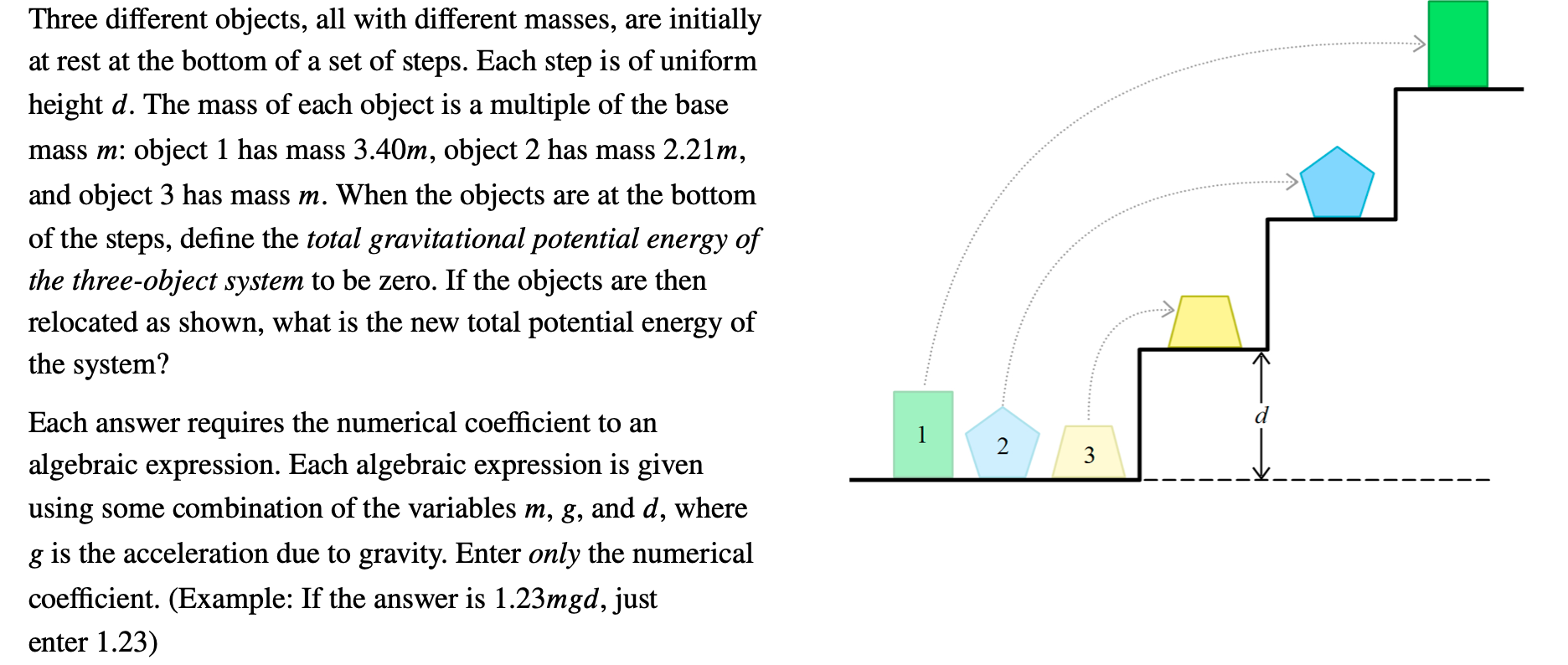
Three different objects, all with different masses, are initially at rest at the bottom of a set of steps. Each step is of uniform height d. The mass of each object is a multiple of the base mass m: object 1 has mass 3.40m, object 2 has mass 2.21m, and object 3 has mass m. When the objects are at the bottom of the steps, define the total gravitational potential energy of the three-object system to be zero. If the objects are then relocated as shown, what is the new total potential energy of the system? Each answer requires the numerical coefficient to an algebraic expression. Each algebraic expression is given using some combination of the variables m, g, and d, where g is the acceleration due to gravity. Enter only the numerical coefficient. (Example: If the answer is 1.23mgd, just enter 1.23) 2 3 This potential energy was calculated relative to the bottom of the stairs. If you were to redefine the reference height such that the total potential energy of the system became zero, how high above the bottom of the stairs would the new reference height be? d Now, find a new reference height (measured again from the bottom of the stairs) such that the highest two objects have the exact same potential energy.
Step by Step Solution
There are 3 Steps involved in it
To calculate the new total potential energy of the system after the objects are relocated we need to ... View full answer

Get step-by-step solutions from verified subject matter experts
 Study Help