







Question: Throughout the lab, please help me write an introduction and Abstract for my lab report, (has to be a big paragraph) thank you Important note:
![Important note: [ [tt+t] This part may be done/completed outside of Laboratory](https://s3.amazonaws.com/si.experts.images/answers/2024/09/66dff2800fae4_63966dff27fa923c.jpg)
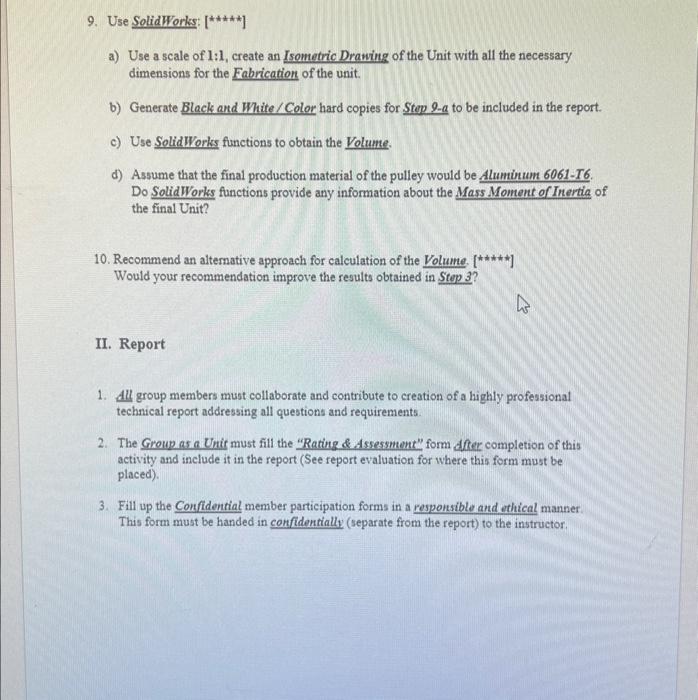
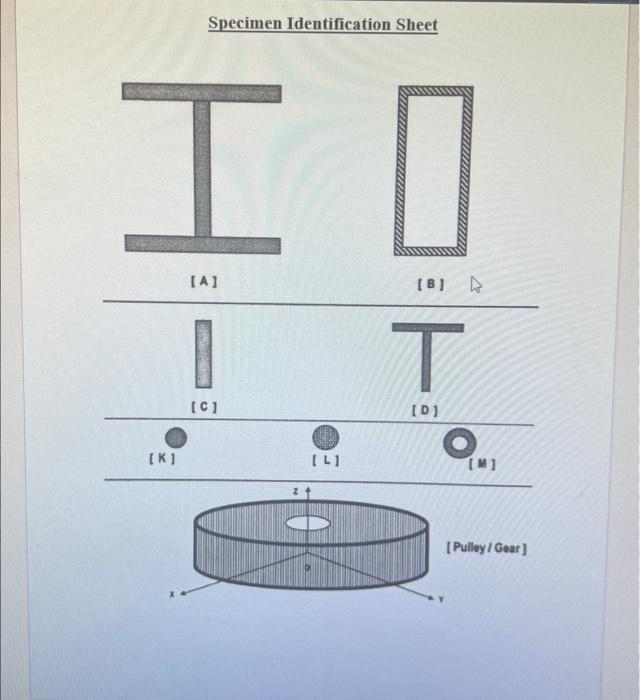
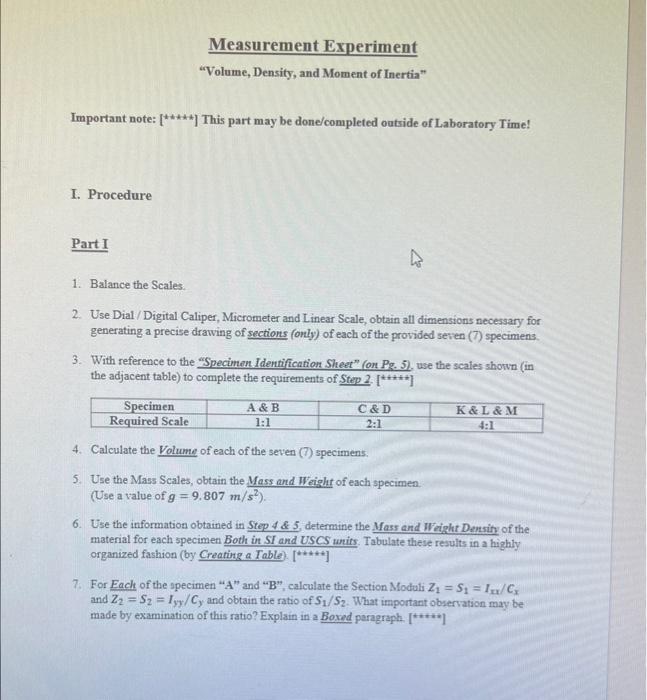
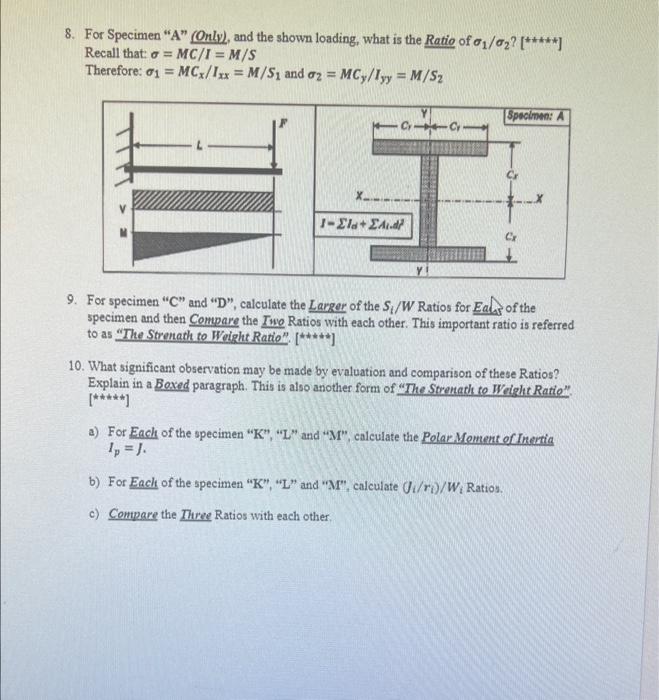
Important note: [ [tt+t] This part may be done/completed outside of Laboratory Time! I. Procedure PartI 1. Balance the Scales. 2. Use Dial / Digital Caliper, Micrometer and Linear Scale, obtain all dimensions necessary for generating a precise drawing of sections (only) of each of the provided seven (7) specimens. 3. With reference to the "Speciman Identification Sheet" (on Pg.5 ), use the scates shown (in the adjacent table) to complete the requirements of Step2[[t+t+t] 4. Calculate the Volume of each of the seven (7) specimens. 5. Use the Mass Scales, obtain the Mass and Weight of each specimen. (Use a value of g=9.807m/s2 ). 6. Use the information obtained in Step 4\&5, determine the Mass and Weighe Density of the material for each specimen Both in SI and USCS wnits. Tabulate these results in a highly organized fashion (by Creating a Table). [++] 7. For Each of the specimen "A" and "B", calculate the Section Moduli Z1=S1=Ix/CX and Z2=S2=Iyy/Cy and obtain the ratio of S1/S2. What important observation may be made by examination of this ratio? Explain in a Boxed paragraph. [*+ti*] 8. For Specimen "A" (Onlv), and the shown loading, what is the Ratio of 1/2 ? [*+t+ ] Recall that =MC/I=M/S Therefore: 1=MCx/Ixx=M/S1 and 2=MCy/Iyy=M/S2 9. For specimen "C" and "D", calculate the Larger of the Si/W Ratios for Ealas of the specimen and then Compare the Two Ratios with each other. This important ratio is referred to as "The Strenath to Weight Ration. [*+*+*] 10. What significant observation may be made by evaluation and comparison of these Ratios? Explain in a Boxed paragraph. This is also another form of "The Strenath to Weight Ratio". [] a) For Each of the specimen "K", "L" and "M", calculate the Rolar Moment of Inertia Ip=f b) For Eacls of the specimen "K", "L" and "M", calculate (Ji/ri)/Wi Ratios. c) Compare the Iliree Ratios with each other. Refer to the shown coordinate system attached to the Pulley / Gear. 1. Obtain all necessary dimensions for generation of a fully detailed drawing of the unit. [In 15 - 20 Minutes Max:] 2. Measure the Mass of the unit. 3. Use the information obtained in Steps 182 , caleulate the Volume and determine the Mass and Weight Density of the material Both in SI and USCS units. Tabulate the results side by side in one table. [t+t+t] 4. Compare the Density of this material with water. Would the Unit submerge in water? 5. Assume that such a Unit (with a density less than water) has to be submerged in water, what means do you recommend? Explain in a Eoxed paragraph. [t**t*] 6. Calculate the "Mass Moment of Inertia" of the Unit W/R to the " Z " axis (the normal rotation axis), [+k+k+] 7. If the material of the Unit changes to Brass, would this change the results obtained in Stop 4 ? If so, by what Ratio? Explain in a Boored paragraph. [ [+++]] 8. If Aluminum 6061-T6 is used as the material of the Unit and a Torque of 80 lbsin is applied W/R to the " Z" axis, what would be the angular acceleration of the Pulley Gear? [++] 9. Use SolidWorks: [**tk*] a) Use a scale of 1:1, create an Isometric Drawing of the Unit with all the necessary dimensions for the Fabrication of the unit. b) Generate Black and White / Color hard copies for Stop 9a to be included in the report. c) Use SolidWorks functions to obtain the Volume. d) Assume that the final production material of the pulley would be Aluminum 6061-T6. Do SolidWorks functions provide any information about the Mass Moment of Inertia of the final Unit? 10. Recommend an alternative approach for calculation of the Volume. [] Would your recommendation improve the results obtained in Stop 3 ? II. Report 1. All group members must collaborate and contribute to creation of a highly professional technical report addressing all questions and requirements. 2. The Group as a Unir must fill the "Rating \& Assessment" form dffer completion of this activity and include it in the report (See report evaluation for where this form must be placed). 3. Fill up the Confidential member participation forms in a responsible and ethical manner. This form must be handed in confidentially (separate from the report) to the instructor. Smenimen Tanntifinatinn Ghant
Step by Step Solution
There are 3 Steps involved in it

Get step-by-step solutions from verified subject matter experts
 Study Help