







Question: thsts all we got NOTE: In a previous assignment you described the following binding forces, and indicated their approximate strengths: Hydrogen bonding Ionic interactions Hydrophobic
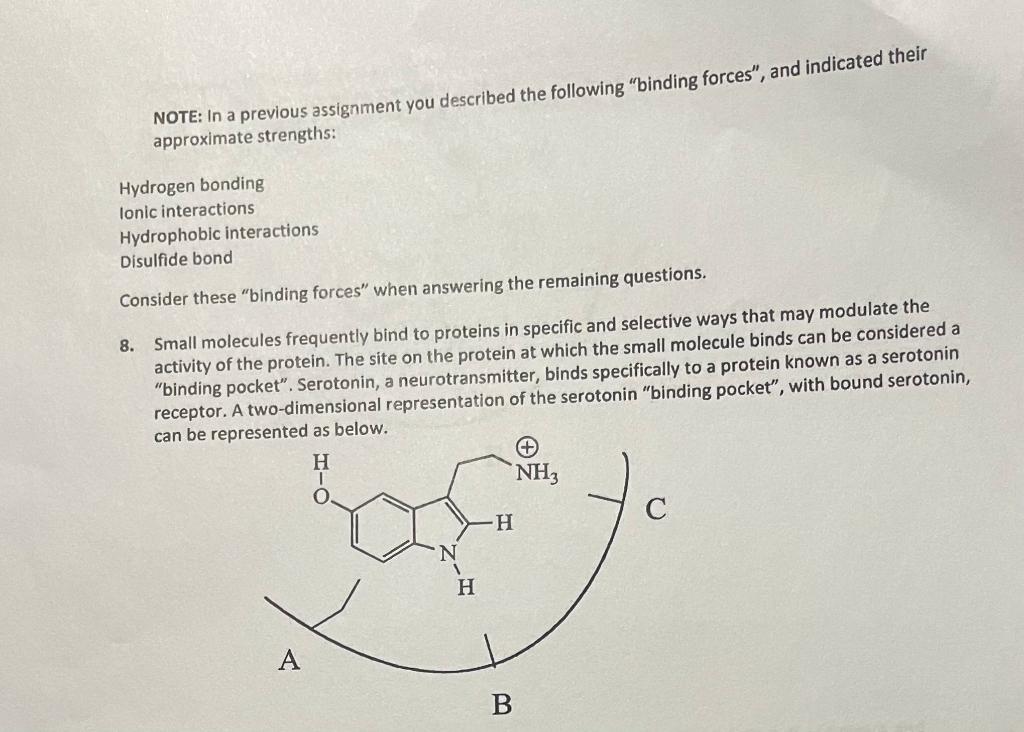
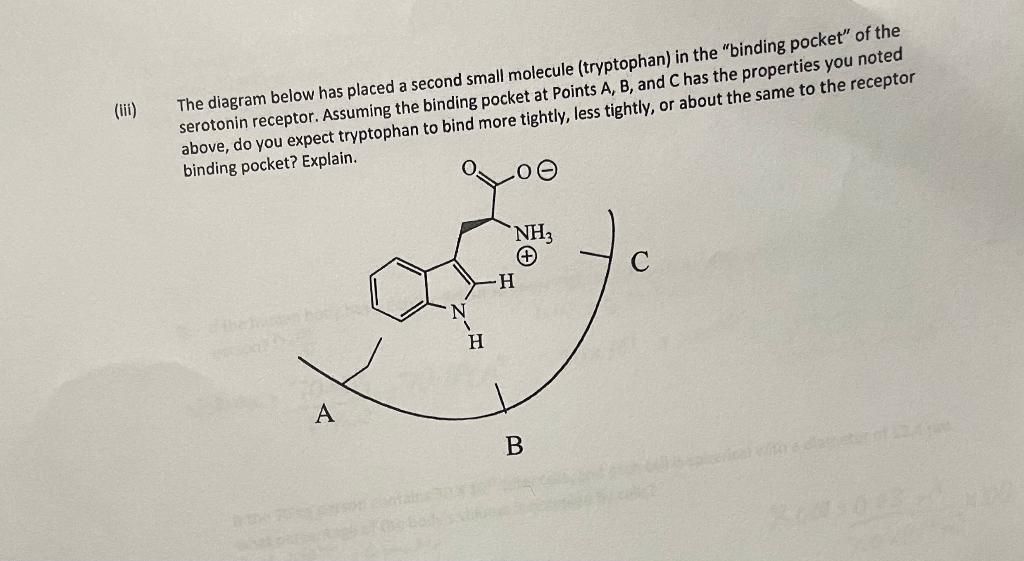
NOTE: In a previous assignment you described the following "binding forces", and indicated their approximate strengths: Hydrogen bonding Ionic interactions Hydrophobic interactions Disulfide bond Consider these "binding forces" when answering the remaining questions. Small molecules frequently bind to proteins in specific and selective ways that may modulate the activity of the protein. The site on the protein at which the small molecule binds can be considered a "binding pocket". Serotonin, a neurotransmitter, binds specifically to a protein known as a serotonin receptor. A two-dimensional representation of the serotonin "binding pocket", with bound serotonin, can be represented as below. H NH 8. 1 H N H B The diagram below has placed a second small molecule (tryptophan) in the "binding pocket" of the serotonin receptor. Assuming the binding pocket at Points A, B, and C has the properties you noted above, do you expect tryptophan to bind more tightly, less tightly, or about the same to the receptor binding pocket? Explain. NH3 -H H A B NOTE: In a previous assignment you described the following "binding forces", and indicated their approximate strengths: Hydrogen bonding Ionic interactions Hydrophobic interactions Disulfide bond Consider these "binding forces" when answering the remaining questions. Small molecules frequently bind to proteins in specific and selective ways that may modulate the activity of the protein. The site on the protein at which the small molecule binds can be considered a "binding pocket". Serotonin, a neurotransmitter, binds specifically to a protein known as a serotonin receptor. A two-dimensional representation of the serotonin "binding pocket", with bound serotonin, can be represented as below. H NH 8. 1 H N H B The diagram below has placed a second small molecule (tryptophan) in the "binding pocket" of the serotonin receptor. Assuming the binding pocket at Points A, B, and C has the properties you noted above, do you expect tryptophan to bind more tightly, less tightly, or about the same to the receptor binding pocket? Explain. NH3 -H H A B
Step by Step Solution
There are 3 Steps involved in it

Get step-by-step solutions from verified subject matter experts
 Study Help