



Question: Thw first 2 lines are the question and then the example is given for reference Problem 1 Using the information in Example 8.1.5 in your
Thw first 2 lines are the question and then the example is given for reference
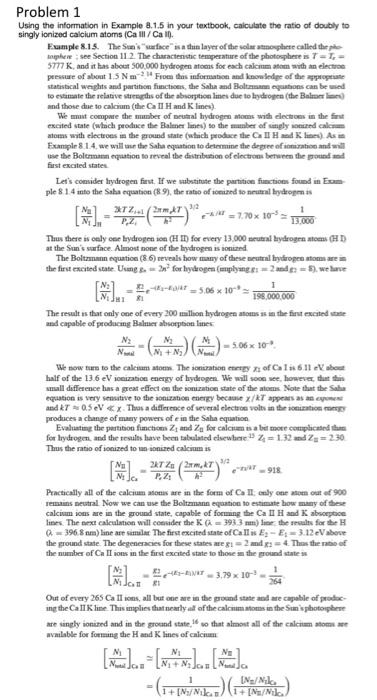
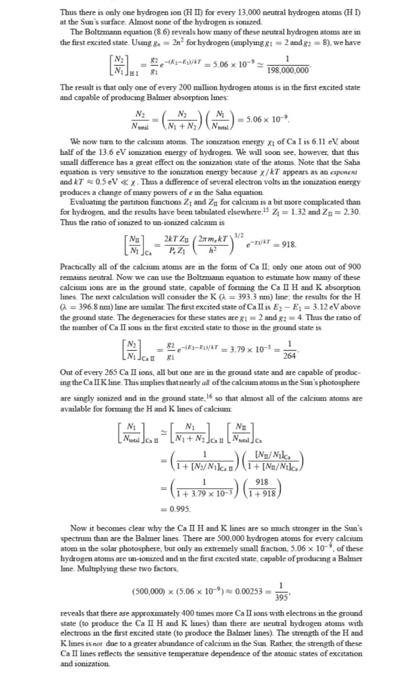
Problem 1 Using the information in Example 8.1.5 in your textbook, calculate the ratio of doubly to singly ionized calcium atoms (Ca III /Ca II). mipitere ; see Section 112 . The charactenstic temeperature of the photomphere is 7=Tr= 577K, and it has abour 500.000 hydropen atoms for each calcomm atom with an electroe pessure of stout 1.5Nm214 Froen ins information and knomledpe of the apropriane statistical weiphts and partition finctioes, the Salha and Boltranmen equations can be wied to evtamate the relatrve stregghs of the abvorjtica limes due to lydropen (dhe Balmar leav) and those due to calcium (the CaIIH and K lines) We amit compwe the mumber of neural hydrogm moms with electoons in the firt excited state (whach produce the Balener linev) to the mamber of sitigly ionised calcan aloms with electroes in the pround state (which prodace the CaIH mal K linec). As in Fxampie 8.1.4, we will tur the Saha equation to determine the degree of ianimatice ant will ase be Bolemantequation to reveal the divitribsion of electrons benween the pound and fist excated statet. Let's consider lrydeogen fant, If we uubtitute the partition functions found in Exom ple 81.4 anto the Saha equation ( 89 ), the ratio of iceiand to neutral bydtogen is [NTNa]i=PiZixTZi+1(m12m,kT)3/2ekikT=7.70105=13,0001 Thus these is eely cee bydrogen ion ( H T) for every 13.000 seutal trydrogen atoens (H D) at the Sun s surface. Almost none of the hydrogen is ionited The Boltzmann equation (86) reveals bow many of these seutral hydiopen atoma are in [N1N2]H1=R1N1e0L4L0,1t=5.06103198,000,0001 The result ws that only coe of every 200 million hydrogen anoms as in the firnt excited ume and capable of producing Beltur abvorption tine- NmalN2=(N1+N2N2)(NmilN1)=5.06107 We bow turs to the calcam atons. The ionimation energ x of Ca1 is 6.11 eV abeet half of the 13.6eV ionization energy of hydropen We will soon see, howeve, that thin small difference has a great effect on the ionuzatice state of the atoens. Note thut the Sulha equation is very senituve to the abnizatice energy becauc x/kT appeats as an eyves produces a change of muary powers of in the Salha equation Evaluating the partibon finctices Z1 and Zn for calcium is a bet more coupheasd than for lydrogen and the results have been tabulated elsewhre 13Z4=1.32 and Z==2.30 Thus the ratio of ionized to 1 an ionized calcium is [N1Nm]Ca=P1Z12kTZn(h22m0kT)3/2en2ir=918 Practically all of the calcium asonis are in the form of Ca II: only ane anom oen of 900 remains newral Now we can use the Boltamann equation to estimate how many of these calcinm ioms are in the ground state, capable of forming the CaIIH and K absorptice lines. The nena calculmion will consider the K(a=3933mm) lioe the sevalts for the H a=396.8nm ) line are simile The first excited atate of CaIIl is E2E1=3.12eV abeve the pround state. The degeneracies for these states are g1=2 and x1=4. Thas the mbo of the number of Ca II ions in the first excited state to those in the eround state in [N1N2]C=R1k1e4E1L1N=3,79103=2641 Out of every 265Ca II wass, all but one are in the goend state and are copable of podscare singly ionimed and in the groend state, if so that almout all of the calcian atome ane avmilable for forming the H and K lines of caicium [NmadN1]a[N1+N1N1]G[Nm+1Nn]a=(1+[NI/N1k1)(1+[Nm/N1]l6[Nm/N1]0) Thus there is only one bydrogen ioe (H II) for every 13,000 neutral hydrogen atoms (If D ) at the Sum 's saface. Almost bone of the bydrogen is ionued The Bolemumann equatice ( 86 ) reveals how many of these seutal bydrogen atoms are in the first excited state. Uing gn=2n2 for laydrogra (muplymg R!=2 and g2=8 ), we have [N1N2]MII=R1k2e41C1,2r=5.06103=198,000,0001 The result is that anly one of every 200 milloon hydrogen atous is in the first excited state and capable of producing Bulmer absorption lines: NmeiN2=(N1+N2N2)(NmadN1)=5.06107, We now san to the calciam atorm. The jonctation energy xt of Ca I is 6.11eV abous half of the 13.6eV ionizaticn energy of hrdrogen. We will soon see. bowever that this small difference bas a preat effect oe the sonization state of the aioms. Note that the Saha equation is very vensitive to the ionization eneryy becaase x/kT appean at an aponce and KT w 0.5eV&X. Thas a differeace of seveal electron volts in the ionuzation everng produces a change of many powers of e in the Saha equation Evaluating the pertition finctom Z7 and Zt for calcuim is a bit more complicaled than for hydrogen, and the revulas have been tabalased elsewhere. 13Z1=1.32 and Zn=2.30 Thus the ratio of icaized to ma-ionired calcrim is [N1Na]C2=P2Z12kTZa(h22m,kT)3/2enikT=918. Prachcally all of the calcium atoms are in the form of Ca III, celly one anom out of 900 remains neutral. Now we can use the Boltrmaun equation to entimuse how many of these calciem ions are in the ground state, capable of foenaing the CaIIH and K absorption lines. The arxt ealculation will consider the K(=393.3mm) lane, the rewals for the H (=396.8mm) line are imilar The firu excited state of Ca Ilis E2E1=3.12eV above the gromd late. The degeneracies for these states are gl=2 and g2=4. Thas the ratio of the mataber of Ga II ions an the firt excitel state to thone in the pround state th Out of every 265Ca II ions, all but one ane in the ground utate and me capable of prodocing the Ca IIK lise. This aniplies thatneatly all of the calcuum atous in the Sun s photosphere are sinely sonized and in the mound state. 16 so that almost all of the calciuan atouns are avalable for formint the H and K liner of calcium =(1+3.791011)(1+918918)=0.995. Now it becomes clear why the Ca II II and K lines are so mmch stronger in the Sun's spectrum than are the Balmer lanes. There are $00,000 bydrogen atoms for every calcium whond ta the wole photovphere, but only an exdemely amall fiachon. 5.06108, of these lene. Multriplying dhese two fictors. (500.000)(5.06109)=0.00293=3951 reveals that there ase approximately 400 times more Ca II ions with electrons in the ground state ( 6 prodace the Ca II H and K lenes) than there are neutral lyduogen atomis with electrons in the firt excited state (to produce the Balnser lines) The stregrth of the H and K. lines iknot doe to a geater abrundance of calcium in the Sun. Ranber the strength of these Ca Il lines reflects the sensitive temperanure dependence of the atomac states of excetation and ionization. Problem 1 Using the information in Example 8.1.5 in your textbook, calculate the ratio of doubly to singly ionized calcium atoms (Ca III /Ca II). mipitere ; see Section 112 . The charactenstic temeperature of the photomphere is 7=Tr= 577K, and it has abour 500.000 hydropen atoms for each calcomm atom with an electroe pessure of stout 1.5Nm214 Froen ins information and knomledpe of the apropriane statistical weiphts and partition finctioes, the Salha and Boltranmen equations can be wied to evtamate the relatrve stregghs of the abvorjtica limes due to lydropen (dhe Balmar leav) and those due to calcium (the CaIIH and K lines) We amit compwe the mumber of neural hydrogm moms with electoons in the firt excited state (whach produce the Balener linev) to the mamber of sitigly ionised calcan aloms with electroes in the pround state (which prodace the CaIH mal K linec). As in Fxampie 8.1.4, we will tur the Saha equation to determine the degree of ianimatice ant will ase be Bolemantequation to reveal the divitribsion of electrons benween the pound and fist excated statet. Let's consider lrydeogen fant, If we uubtitute the partition functions found in Exom ple 81.4 anto the Saha equation ( 89 ), the ratio of iceiand to neutral bydtogen is [NTNa]i=PiZixTZi+1(m12m,kT)3/2ekikT=7.70105=13,0001 Thus these is eely cee bydrogen ion ( H T) for every 13.000 seutal trydrogen atoens (H D) at the Sun s surface. Almost none of the hydrogen is ionited The Boltzmann equation (86) reveals bow many of these seutral hydiopen atoma are in [N1N2]H1=R1N1e0L4L0,1t=5.06103198,000,0001 The result ws that only coe of every 200 million hydrogen anoms as in the firnt excited ume and capable of producing Beltur abvorption tine- NmalN2=(N1+N2N2)(NmilN1)=5.06107 We bow turs to the calcam atons. The ionimation energ x of Ca1 is 6.11 eV abeet half of the 13.6eV ionization energy of hydropen We will soon see, howeve, that thin small difference has a great effect on the ionuzatice state of the atoens. Note thut the Sulha equation is very senituve to the abnizatice energy becauc x/kT appeats as an eyves produces a change of muary powers of in the Salha equation Evaluating the partibon finctices Z1 and Zn for calcium is a bet more coupheasd than for lydrogen and the results have been tabulated elsewhre 13Z4=1.32 and Z==2.30 Thus the ratio of ionized to 1 an ionized calcium is [N1Nm]Ca=P1Z12kTZn(h22m0kT)3/2en2ir=918 Practically all of the calcium asonis are in the form of Ca II: only ane anom oen of 900 remains newral Now we can use the Boltamann equation to estimate how many of these calcinm ioms are in the ground state, capable of forming the CaIIH and K absorptice lines. The nena calculmion will consider the K(a=3933mm) lioe the sevalts for the H a=396.8nm ) line are simile The first excited atate of CaIIl is E2E1=3.12eV abeve the pround state. The degeneracies for these states are g1=2 and x1=4. Thas the mbo of the number of Ca II ions in the first excited state to those in the eround state in [N1N2]C=R1k1e4E1L1N=3,79103=2641 Out of every 265Ca II wass, all but one are in the goend state and are copable of podscare singly ionimed and in the groend state, if so that almout all of the calcian atome ane avmilable for forming the H and K lines of caicium [NmadN1]a[N1+N1N1]G[Nm+1Nn]a=(1+[NI/N1k1)(1+[Nm/N1]l6[Nm/N1]0) Thus there is only one bydrogen ioe (H II) for every 13,000 neutral hydrogen atoms (If D ) at the Sum 's saface. Almost bone of the bydrogen is ionued The Bolemumann equatice ( 86 ) reveals how many of these seutal bydrogen atoms are in the first excited state. Uing gn=2n2 for laydrogra (muplymg R!=2 and g2=8 ), we have [N1N2]MII=R1k2e41C1,2r=5.06103=198,000,0001 The result is that anly one of every 200 milloon hydrogen atous is in the first excited state and capable of producing Bulmer absorption lines: NmeiN2=(N1+N2N2)(NmadN1)=5.06107, We now san to the calciam atorm. The jonctation energy xt of Ca I is 6.11eV abous half of the 13.6eV ionizaticn energy of hrdrogen. We will soon see. bowever that this small difference bas a preat effect oe the sonization state of the aioms. Note that the Saha equation is very vensitive to the ionization eneryy becaase x/kT appean at an aponce and KT w 0.5eV&X. Thas a differeace of seveal electron volts in the ionuzation everng produces a change of many powers of e in the Saha equation Evaluating the pertition finctom Z7 and Zt for calcuim is a bit more complicaled than for hydrogen, and the revulas have been tabalased elsewhere. 13Z1=1.32 and Zn=2.30 Thus the ratio of icaized to ma-ionired calcrim is [N1Na]C2=P2Z12kTZa(h22m,kT)3/2enikT=918. Prachcally all of the calcium atoms are in the form of Ca III, celly one anom out of 900 remains neutral. Now we can use the Boltrmaun equation to entimuse how many of these calciem ions are in the ground state, capable of foenaing the CaIIH and K absorption lines. The arxt ealculation will consider the K(=393.3mm) lane, the rewals for the H (=396.8mm) line are imilar The firu excited state of Ca Ilis E2E1=3.12eV above the gromd late. The degeneracies for these states are gl=2 and g2=4. Thas the ratio of the mataber of Ga II ions an the firt excitel state to thone in the pround state th Out of every 265Ca II ions, all but one ane in the ground utate and me capable of prodocing the Ca IIK lise. This aniplies thatneatly all of the calcuum atous in the Sun s photosphere are sinely sonized and in the mound state. 16 so that almost all of the calciuan atouns are avalable for formint the H and K liner of calcium =(1+3.791011)(1+918918)=0.995. Now it becomes clear why the Ca II II and K lines are so mmch stronger in the Sun's spectrum than are the Balmer lanes. There are $00,000 bydrogen atoms for every calcium whond ta the wole photovphere, but only an exdemely amall fiachon. 5.06108, of these lene. Multriplying dhese two fictors. (500.000)(5.06109)=0.00293=3951 reveals that there ase approximately 400 times more Ca II ions with electrons in the ground state ( 6 prodace the Ca II H and K lenes) than there are neutral lyduogen atomis with electrons in the firt excited state (to produce the Balnser lines) The stregrth of the H and K. lines iknot doe to a geater abrundance of calcium in the Sun. Ranber the strength of these Ca Il lines reflects the sensitive temperanure dependence of the atomac states of excetation and ionization Step by Step Solution
There are 3 Steps involved in it
1 Expert Approved Answer
Step: 1 Unlock

Question Has Been Solved by an Expert!
Get step-by-step solutions from verified subject matter experts
Step: 2 Unlock
Step: 3 Unlock