


Question: Time left 0:59:21 A tourism company needs to transport 14 groups of tourists in group sizes, as shown in the table below. The company uses
Time left 0:59:21 A tourism company needs toTime left 0:59:21 A tourism company needs to

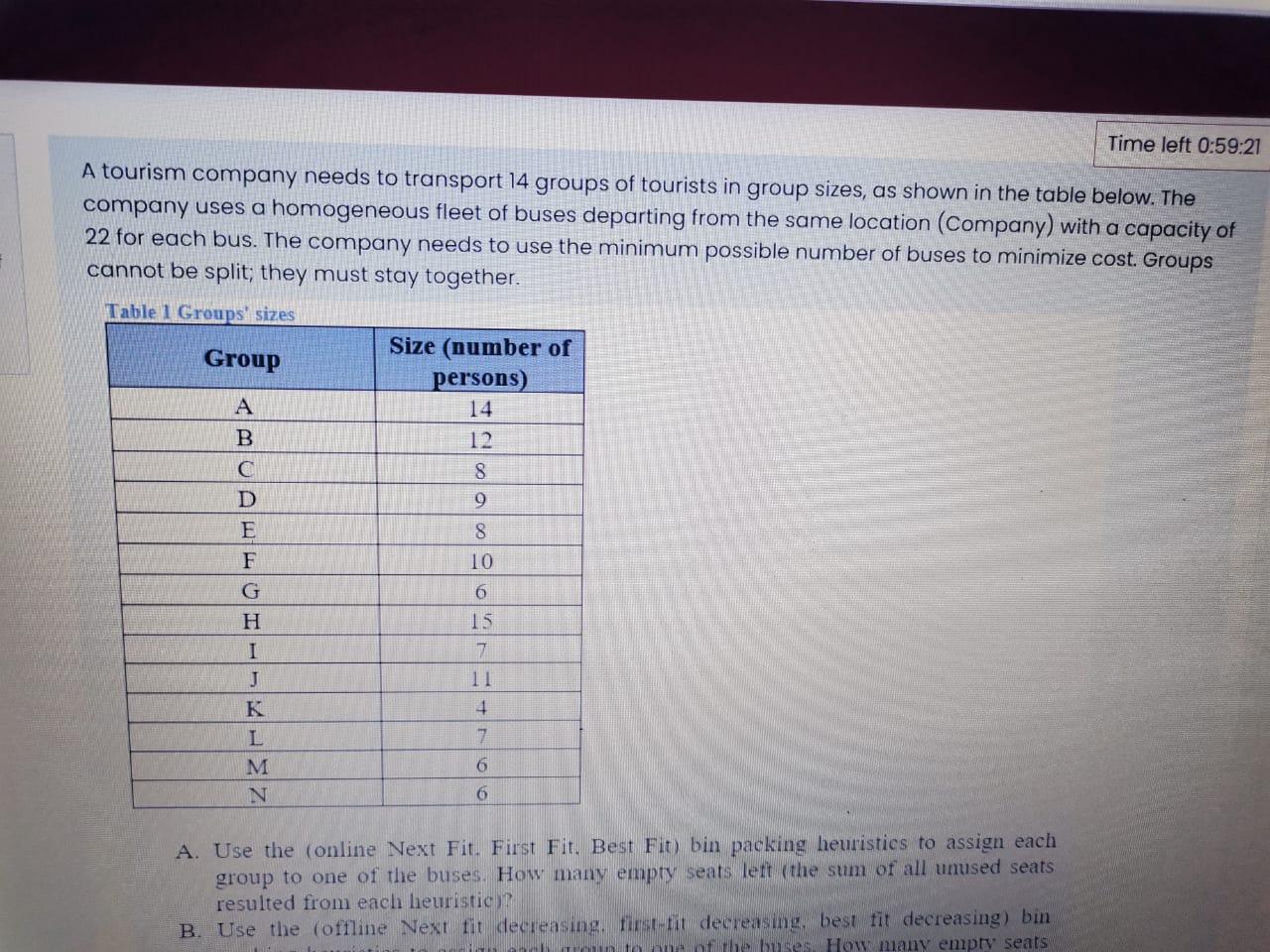
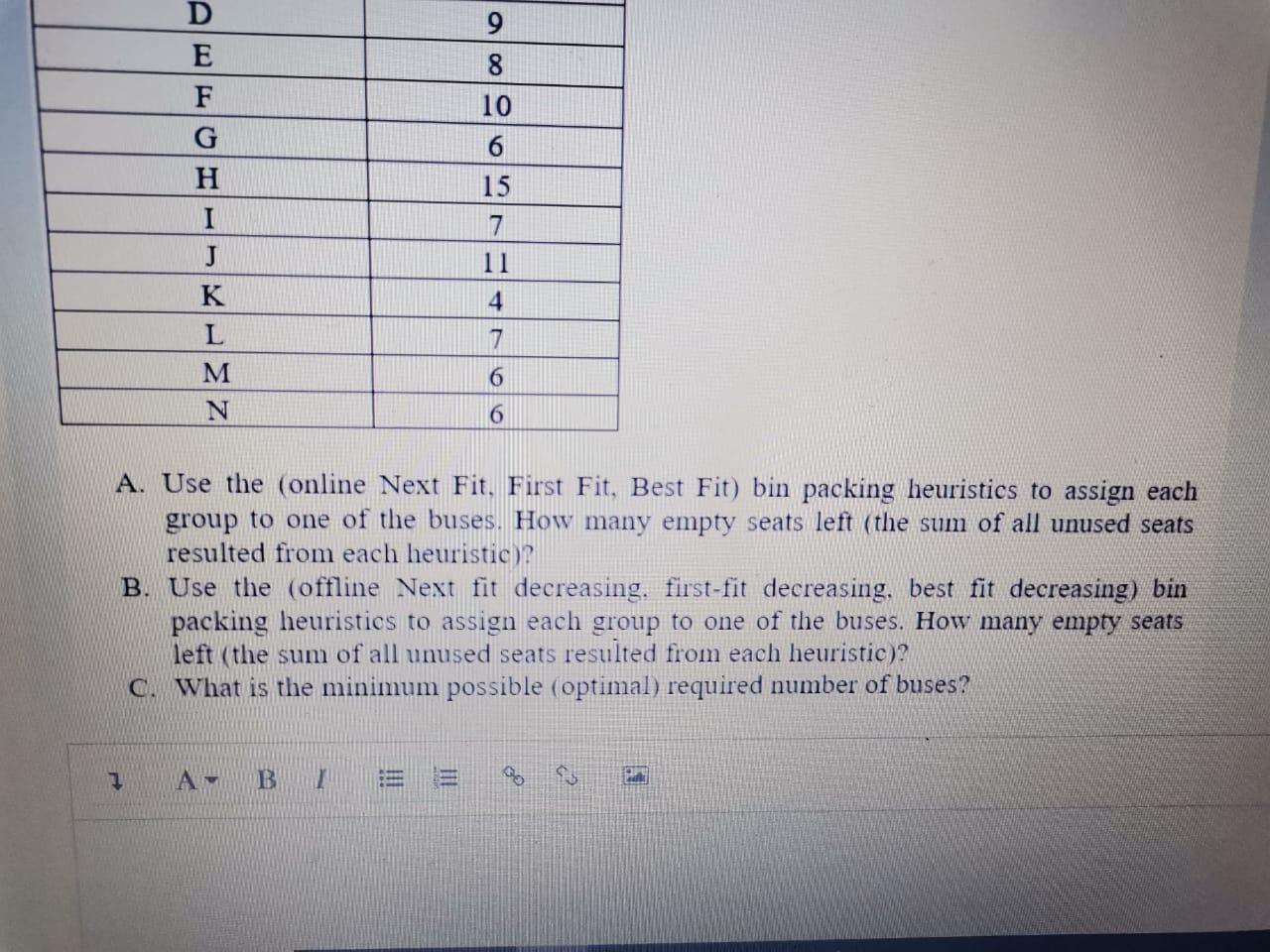
Time left 0:59:21 A tourism company needs to transport 14 groups of tourists in group sizes, as shown in the table below. The company uses a homogeneous fleet of buses departing from the same location (Company) with a capacity of 22 for each bus. The company needs to use the minimum possible number of buses to minimize cost. Groups cannot be split; they must stay together. Table 1 Groups' sizes Size (number of Group persons) 14 A B 12 8 D 9 E 8. F 10 G H 6 15 7 I J K L M N 4 17 6 6 A. Use the (online Next Fit. First Fit. Best Fit bin packing heuristics to assign each group to one of the buses. How many empty seats left the sum of all unused seats resulted from each heuristic) B. Use the (offline Next fit decreasing first-fit decreasing best fit decreasing) bin un to one the buses. How many empty seats 9 D E F G H 10 6 I 15 7 11 4 J K L M 7 6 N 6 A. Use the online Next Fit, First Fit, Best Fit) bin packing heuristics to assign each group to one of the buses. How many empty seats left (the sum of all unused seats resulted from each heuristic)? B. Use the offline Next fit decreasing, first-fit decreasing, best fit decreasing) bin packing heuristics to assign each group to one of the buses. How many empty seats left (the sum of all unused seats resulted from each heuristic)? What is the minimum possible (optimal) required number of buses? A B Go Time left 0:59:21 A tourism company needs to transport 14 groups of tourists in group sizes, as shown in the table below. The company uses a homogeneous fleet of buses departing from the same location (Company) with a capacity of 22 for each bus. The company needs to use the minimum possible number of buses to minimize cost. Groups cannot be split; they must stay together. Table 1 Groups' sizes Size (number of Group persons) 14 A B 12 8 D 9 E 8. F 10 G H 6 15 7 I J K L M N 4 17 6 6 A. Use the (online Next Fit. First Fit. Best Fit bin packing heuristics to assign each group to one of the buses. How many empty seats left the sum of all unused seats resulted from each heuristic) B. Use the (offline Next fit decreasing first-fit decreasing best fit decreasing) bin un to one the buses. How many empty seats 9 D E F G H 10 6 I 15 7 11 4 J K L M 7 6 N 6 A. Use the online Next Fit, First Fit, Best Fit) bin packing heuristics to assign each group to one of the buses. How many empty seats left (the sum of all unused seats resulted from each heuristic)? B. Use the offline Next fit decreasing, first-fit decreasing, best fit decreasing) bin packing heuristics to assign each group to one of the buses. How many empty seats left (the sum of all unused seats resulted from each heuristic)? What is the minimum possible (optimal) required number of buses? A B Go

Step by Step Solution

There are 3 Steps involved in it

1 Expert Approved Answer
Step: 1 Unlock blur-text-image

Question Has Been Solved by an Expert!

Get step-by-step solutions from verified subject matter experts

Step: 2 Unlock
Step: 3 Unlock

Students Have Also Explored These Related General Management Questions!