







Question: Time series - TO SOLVE USE PYTHON Time series and forecast Using PYTHON (Jupyter notebook) Consider the time series obtained by the following model (2k
Time series - TO SOLVE USE PYTHON
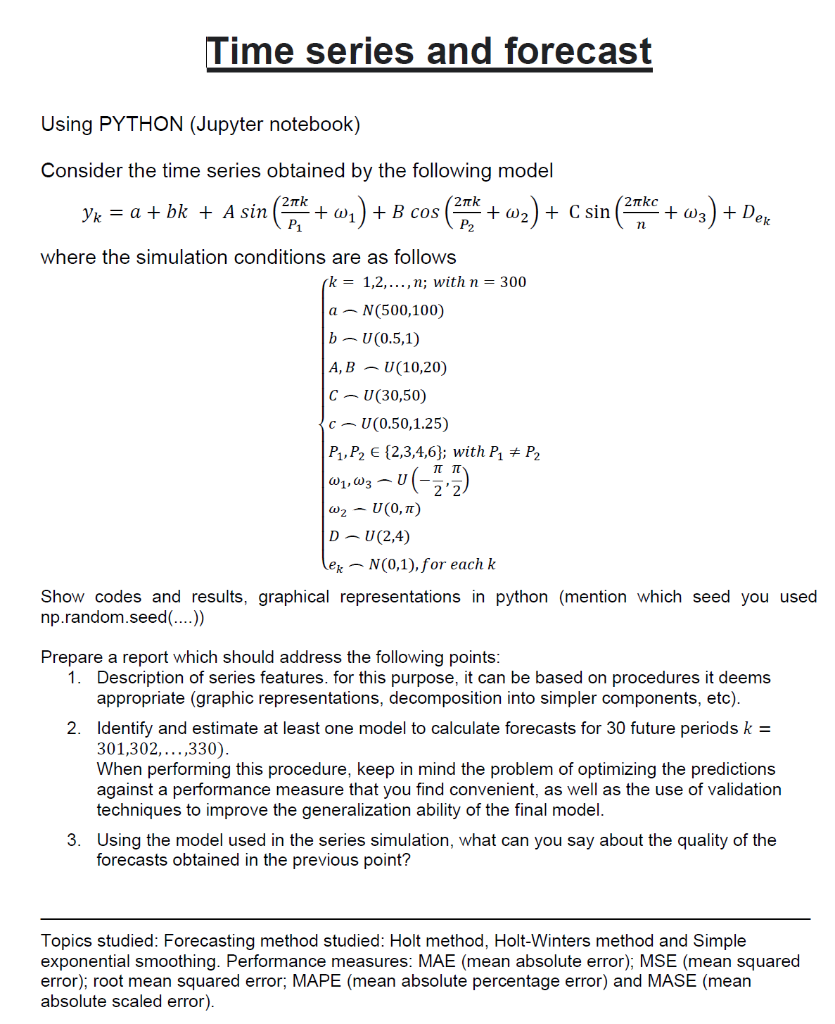
Time series and forecast Using PYTHON (Jupyter notebook) Consider the time series obtained by the following model (2k (2k (2 tkc Yk = a + bk + A sin 2 + wn) + B cos + -w2) + + C sin + w3) + Dex P1 + n where the simulation conditions are as follows (k = 1,2,...,n; with n = 300 a-N(500,100) b - U(0.5,1) A,B U(10,20) CU(30,50) CU(0.50,1.25) P1, P2 E {2,3,4,6}; with P1 = P2 1,0 v-7) W2 - U(0,1) D-U (2,4) Lex - N(0,1), for each k Show codes and results, graphical representations in python (mention which seed you used np.random.seed (...)) Prepare a report which should address the following points: 1. Description of series features, for this purpose, it can be based on procedures it deems appropriate (graphic representations, decomposition into simpler components, etc). 2. Identify and estimate at least one model to calculate forecasts for 30 future periods k = 301,302, ...,330). When performing this procedure, keep in mind the problem of optimizing the predictions against a performance measure that you find convenient, as well as the use of validation techniques to improve the generalization ability of the final model. 3. Using the model used in the series simulation, what can you say about the quality of the forecasts obtained in the previous point? Topics studied: Forecasting method studied: Holt method, Holt-Winters method and Simple exponential smoothing. Performance measures: MAE (mean absolute error); MSE (mean squared error); root mean squared error; MAPE (mean absolute percentage error) and MASE (mean absolute scaled error). Time series and forecast Using PYTHON (Jupyter notebook) Consider the time series obtained by the following model (2k (2k (2 tkc Yk = a + bk + A sin 2 + wn) + B cos + -w2) + + C sin + w3) + Dex P1 + n where the simulation conditions are as follows (k = 1,2,...,n; with n = 300 a-N(500,100) b - U(0.5,1) A,B U(10,20) CU(30,50) CU(0.50,1.25) P1, P2 E {2,3,4,6}; with P1 = P2 1,0 v-7) W2 - U(0,1) D-U (2,4) Lex - N(0,1), for each k Show codes and results, graphical representations in python (mention which seed you used np.random.seed (...)) Prepare a report which should address the following points: 1. Description of series features, for this purpose, it can be based on procedures it deems appropriate (graphic representations, decomposition into simpler components, etc). 2. Identify and estimate at least one model to calculate forecasts for 30 future periods k = 301,302, ...,330). When performing this procedure, keep in mind the problem of optimizing the predictions against a performance measure that you find convenient, as well as the use of validation techniques to improve the generalization ability of the final model. 3. Using the model used in the series simulation, what can you say about the quality of the forecasts obtained in the previous point? Topics studied: Forecasting method studied: Holt method, Holt-Winters method and Simple exponential smoothing. Performance measures: MAE (mean absolute error); MSE (mean squared error); root mean squared error; MAPE (mean absolute percentage error) and MASE (mean absolute scaled error)
Step by Step Solution
There are 3 Steps involved in it

Get step-by-step solutions from verified subject matter experts
 Study Help