Question: title: organizational therey Read the attached case study and answer the following questions: 1. 2. As noted in this chapter IT is essential to suc-
title: organizational therey
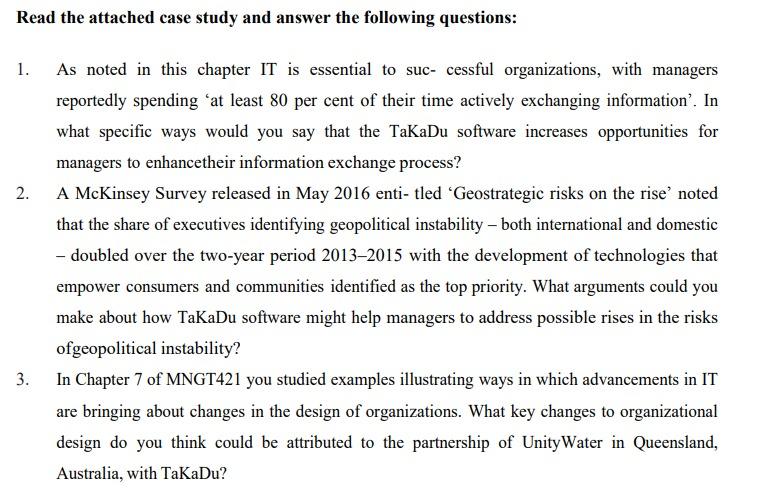
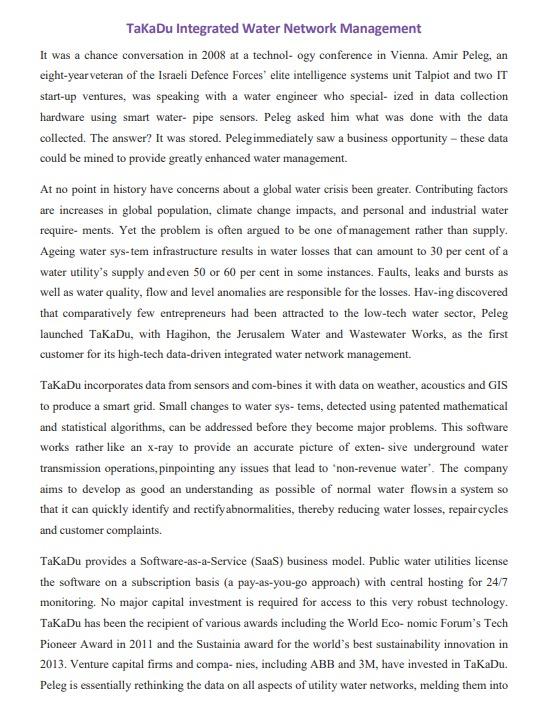
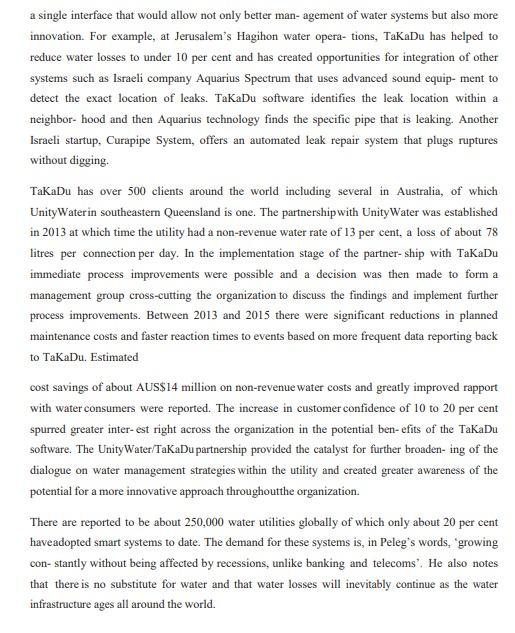
Read the attached case study and answer the following questions: 1. 2. As noted in this chapter IT is essential to suc- cessful organizations, with managers reportedly spending at least 80 per cent of their time actively exchanging information'. In what specific ways would you say that the TaKaDu software increases opportunities for managers to enhancetheir information exchange process? A McKinsey Survey released in May 2016 enti- tled 'Geostrategic risks on the rise noted that the share of executives identifying geopolitical instability - both international and domestic - doubled over the two-year period 20132015 with the development of technologies that empower consumers and communities identified as the top priority. What arguments could you make about how TaKaDu software might help managers to address possible rises in the risks ofgeopolitical instability? In Chapter 7 of MNGT421 you studied examples illustrating ways in which advancements in IT are bringing about changes in the design of organizations. What key changes to organizational design do you think could be attributed to the partnership of Unity Water in Queensland, Australia, with TaKaDu? 3. TakaDu Integrated Water Network Management It was a chance conversation in 2008 at a technology conference in Vienna. Amir Peleg, an eight-year veteran of the Israeli Defence Forces' elite intelligence systems unit Talpiot and two IT start-up ventures, was speaking with a water engineer who specialized in data collection hardware using smart water-pipe sensors. Peleg asked him what was done with the data collected. The answer? It was stored. Peleg immediately saw a business opportunity - these data could be mined to provide greatly enhanced water management. At no point in history have concerns about a global water crisis been greater. Contributing factors are increases in global population, climate change impacts, and personal and industrial water requirements. Yet the problem is often argued to be one of management rather than supply. Ageing water sys-tem infrastructure results in water losses that can amount to 30 per cent of a water utility's supply and even 50 or 60 per cent in some instances. Faults, leaks and bursts as well as water quality, flow and level anomalies are responsible for the losses. Hav-ing discovered that comparatively few entrepreneurs had been attracted to the low-tech water sector, Peleg launched TaKaDu, with Hagihon, the Jerusalem Water and Wastewater Works, as the first customer for its high-tech data-driven integrated water network management. TaKaDu incorporates data from sensors and com-bines it with data on weather, acoustics and GIS to produce a smart grid. Small changes to water systems, detected using patented mathematical and statistical algorithms can be addressed before they become major problems. This software works rather like an X-ray to provide an accurate picture of extensive underground water transmission operations, pinpointing any issues that lead to 'non-revenue water'. The company aims to develop as good an understanding as possible of normal water flows in a system so that it can quickly identify and rectify abnormalities, thereby reducing water losses, repair cycles and customer complaints. TaKaDu provides a Software-as-a-Service (SaaS) business model. Public water utilities license the software on a subscription basis (a pay-as-you-go approach) with central hosting for 24/7 monitoring. No major capital investment is required for access to this very robust technology. TaKaDu has been the recipient of various awards including the World Eco-nomic Forum's Tech Pioneer Award in 2011 and the Sustainia award for the world's best sustainability innovation in 2013. Venture capital firms and companies, including ABB and 3M, have invested in TaKaDu. Peleg is essentially rethinking the data on all aspects of utility water networks, melding them into . a single interface that would allow not only better man- agement of water systems but also more innovation. For example, at Jerusalem's Hagihon water opera- tions, TaKaDu has helped to reduce water losses to under 10 per cent and has created opportunities for integration of other systems such as Israeli company Aquarius Spectrum that uses advanced sound equipment to detect the exact location of leaks. TaKaDu software identifies the leak location within a neighbor- hood and then Aquarius technology finds the specific pipe that is leaking. Another Israeli startup, Curapipe System, offers an automated leak repair system that plugs ruptures without digging TaKaDu has over 500 clients around the world including several in Australia, of which UnityWaterin southeastern Queensland is one. The partnership with UnityWater was established in 2013 at which time the utility had a non-revenue water rate of 13 per cent, a loss of about 78 litres per connection per day. In the implementation stage of the partner-ship with TaKaDu immediate process improvements were possible and a decision was then made to form a management group cross-cutting the organization to discuss the findings and implement further process improvements. Between 2013 and 2015 there were significant reductions in planned maintenance costs and faster reaction times to events based on more frequent data reporting back to TaKaDu. Estimated cost savings of about AUS$14 million on non-revenue water costs and greatly improved rapport with water consumers were reported. The increase in customer confidence of 10 to 20 per cent spurred greater inter-est right across the organization in the potential ben-efits of the TaKaDu software. The Unity Water/TaKaDu partnership provided the catalyst for further broaden- ing of the dialogue on water management strategies within the utility and created greater awareness of the potential for a more innovative approach throughoutthe organization. There are reported to be about 250,000 water utilities globally of which only about 20 per cent have adopted smart systems to date. The demand for these systems is, in Peleg's words, 'growing con- stantly without being affected by recessions, unlike banking and telecoms. He also notes that there is no substitute for water and that water losses will inevitably continue as the water infrastructure ages all around the world









 Study Help